

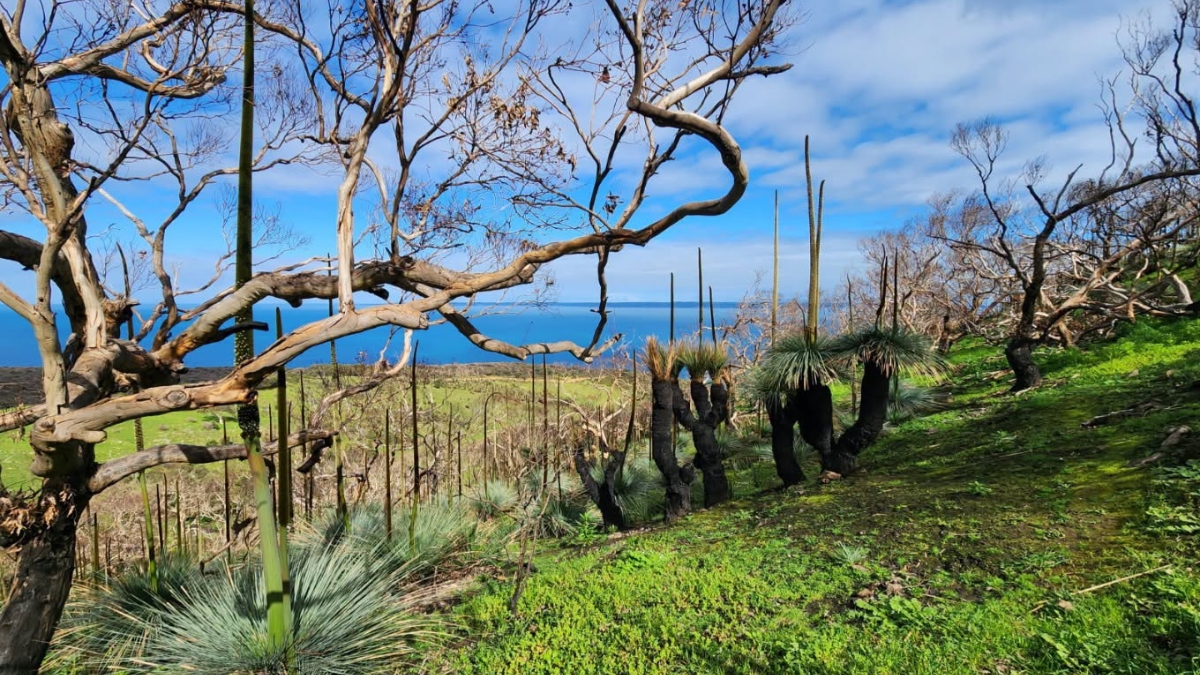
Seven months after a major bushfire tore through more than 4,500 hectares of the Fleurieu Peninsula, Deep Creek National Park has reached a significant recovery milestone, with its final closed campground reopening in time for spring.
Wuldi Krikin Ngawanthi (Eagle Waterhole Campground) was the final campground to reopen following repairs after the February bushfires, meaning all campgrounds across Deep Creek National Park are officially ready to welcome campers again.
Deep Creek National Park ranger Grace said the campsite now looks a little more open, with views towards the ocean less obstructed than before the fire.
“There are some views that you wouldn’t have been able to see before with all the really tall trees that are there,” Grace said.
“Of course, the trees are quite burnt, but there’s lots of epicormic regrowth coming up at the moment as well. So it’s starting to really grow back really well.”
Right now, Grace is seeing plenty of orchids and lilies appearing throughout the park, with recent rainfall also helping the understory spring back to life.
Although the campgrounds have reopened, some areas of the park remain affected by ongoing restoration works, including a detour between Trig Campground and Yapari Ngawanthi (Cliffs Campground).
As visitors make their way through the national park, signs of regrowth are becoming increasingly visible, from fresh green vegetation and colourful wildflowers to towering grass tree spikes and returning wildlife.
“Since the park fully reopened, we’ve definitely seen an increase in the amount of people coming through, particularly being spring and with the nicer weather at the moment,” Grace said.
In fact, over the past month and a half, most of the park’s campgrounds have been booked out on weekends.
“It’s really great to see people coming back into the park, enjoying it and wanting to look at the regrowth, see what’s down here, have a look at the orchids and the wildflowers, and appreciate the park again.”
Located around 100 kilometres from Adelaide, Deep Creek National Park is an easy option for both a weekend camping trip and a day out in nature.
Autumn and spring are among the best times to explore the park on foot, with blooming flora and plenty of wildlife to spot along the way. Kangaroos, echidnas and around 100 bird species are among the animals commonly found throughout the park.
“Our weather down here at the moment is absolutely beautiful and we’re still seeing some whales going past,” Grace said.
“You’re still getting the beautiful spring flowers coming out, lots of baby animals, lots of ducks and kangaroos around at the moment too.”
Four of the park’s five campgrounds are accessible by 2WD vehicles, while Wuldi Krikin Ngawanthi is a hike-in campground along the Heysen Trail.
There are 15 walking trails throughout the park, each offering a different way to explore the landscape, with views across Backstairs Passage, Kangaroo Island and the expansive Deep Creek Valley.
Since the bushfires, some of the park’s most popular areas to reopen have included the Ridgetop Retreats, Glenburn Cottage and Deep Creek Homestead, Stringybark Campground and the Boat Harbour Beach 4WD track.
“It’s very common that even though there are lots of people out there, you’ll go out on a trail and have it mostly all to yourself. It’s beautiful still,” Grace said.
“We’ve got such a vast array of trails down here, so there’s something for everyone to come and enjoy and come and see.”
For more info on Deep Creek National Park, click here.
