

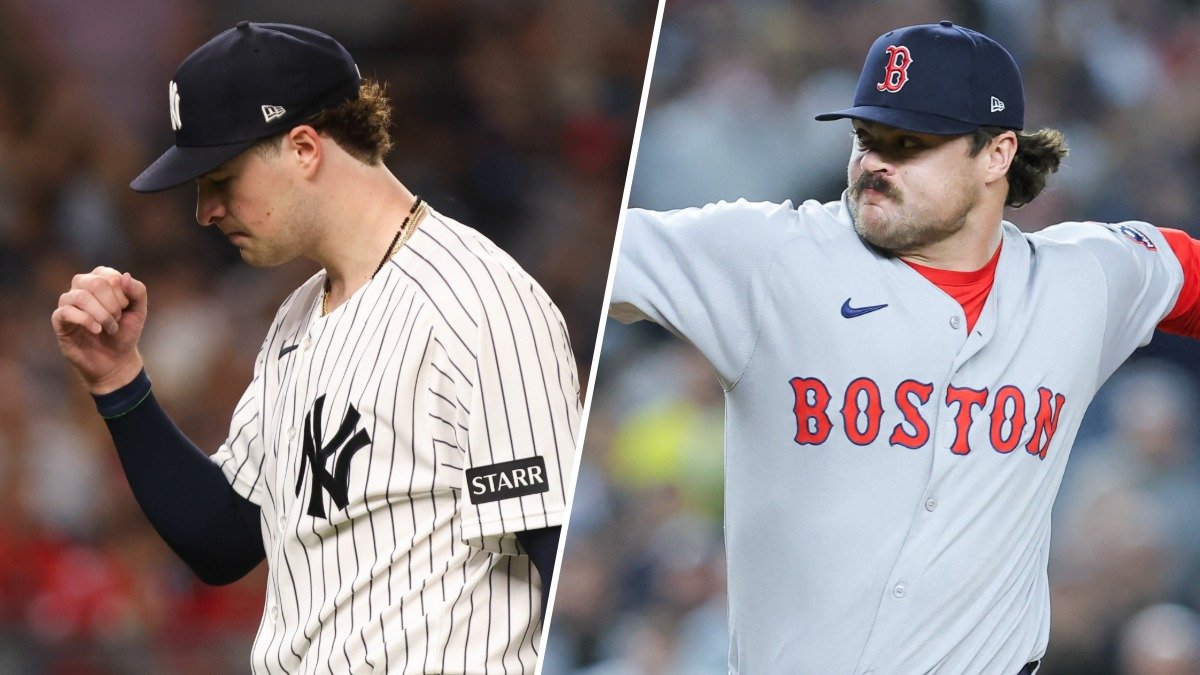
One could make the argument, if one were so inclined, that the Red Sox would have been better off tanking the last week of their season in an effort to set up a postseason path that avoided both the Yankees and Rays until the ALCS.
Sure, the Red Sox went 1-5 against the Astors this year, But they did go 3-3 against the Rangers, and a path that involved either of those teams in the Wild Card Series and the Guardians in the ALDS feels like a more realistic path to the ALCS than going through the Bronx and St. Pete.
Nevertheless, the path is solidified, as Friday’s matinee win over the Cubs locked the Red Sox in for a trip to New York on Tuesday night, the second straight postseason featuring the Red Sox and Yankees in the Wild Card Series.
The Yankees won the season series, 7-6, over the Red Sox, after taking three of four in a late-August series. The Red Sox went just 2-4 at Yankee Stadium this season, getting outscored 34-15. That number was heavily influenced by the Yankees’ 16-1 win in the final game of that series, though.
In a weird way, the Yankees helped kick-start the Red Sox’ historic turnaround when they swept a series at Fenway Park in late April. Alex Cora was fired two days after the Yankees finished off that sweep to drop the Red Sox to 9-16 on the young season. Chad Tracy got the call from Triple-A Worcester to run the operation in Boston, and though it still took some time for the Red Sox to get rolling, their 32-5 stretch from late June through early August is why they secured themselves a second straight playoff berth.
This will mark the third Wild Card meeting for the Red Sox and Yankees since 2021. In the first meeting, the Red Sox beat the Yankees when the round was a winner-take-all one-game “series.” The Red Sox won Game 1 in New York last year before the Yankees won Games 2 and 3 to advance to the ALDS.
Boston defeated New York 3-1 in the 2018 ALDS, which was the first postseason meeting for the two rivals since their historic ALCS meetings in 2003 and 2004.
For this one, the Yankees are heavy favorites to win the series. Is that the right call?
Let’s work our way around the diamond to see how the Red Sox and Yankees have fared against each other this season.
Team Numbers
As a team, the Red Sox own a .199 batting average and .579 OPS against the Yankees this year. That’s their worst OPS against any opponent and second-worst average, just a single point better than their .198 average in three games against Miami.
The Yankees have hit a bit better, with a team .232 batting average and .660 OPS against Boston. They do have 114 strikeouts, compared to the Red Sox’ 95.
Pitching-wise, the Red Sox staff has a 4.18 ERA and 1.175 WHIP against New York, while Yankees pitchers have a a 2.28 ERA and a 1.006 WHIP against the Red Sox.
INFIELD/CATCHER
Willson Contreras cast some serious doubt on his playoff availability when detailing the lack of progress he’s making in his recovery from a right hand injury. Mickey Gasper likely lost his spot due to a right biceps injury suffered Friday afternoon. That removes quite a bit of thump from a lineup where thump is hard to find.
Assuming those bats are unavailable for this series, here’s how the Red Sox infield group of Nick Sogard, Andruw Monasterio, Isiah Kiner-Falefa, Trevor Story, Caleb Durbin and Adley Rutschman (behind the plate, of course) have hit against the Yankees this season.
Caleb Durbin: .182 AVG, .523 OPS, 13 SO
Isiah Kiner-Falefa: 0-for-8
Andruw Monasterio: .158 AVG, .516 OPS
Adley Rutschman: .150 AVG, .371 OPS
Nick Sogard: .250 AVG, .750 OPS, HR
Trevor Story: .231 AVG, .593 OPS
For what it’s worth, Conteras only batted .191 with a .673 OPS against the Yankees, while Gasper batted .143 with a .393 OPS.
For the Yankees, the lineup is sure to vary. So for the sake of being comprehensive, here’s how Paul Goldschmidt, Ben Rice, Luis Garcia Jr., Jazz Chisholm Jr., Anthony Volpe, George Lombard Jr., Ryan McMahon, Amed Rosario, Jose Caballero and Austin Wells have fared vs. Boston this year.
Jose Caballero: .318 AVG, .856 OPS
Jazz Chisholm Jr.: .205 AVG, .615 OPS
Luis Garcia Jr.: .444 AVG, .944 OPS
Paul Goldschmidt: .211 AVG, .645 OPS
George Lombard Jr.: .143 AVG, .393 OPS
Ryan McMahon: .333 AVG., .667 OPS
Ben Rice: .163 AVG, .473 OPS
Amed Rosario: .314 AVG, .775 OPS
Anthony Volpe: .118 AVG, .426 OPS
Austin Wells: .143 AVG, .453 OPS
Advantage: Yankees
Their numbers aren’t gaudy, but they’re much better than Boston’s.
OUTFIELD
The Red Sox are almost assuredly rolling with a four-man crew of Roman Anthony, Ceddanne Rafaela, Wilyer Abreu and Jarren Duran to play the outfield and man the DH spot in this one. Jahmai Jones may earn a spot to bat against lefties. Here’s how they played vs. the Yankees this year.
Wilyer Abreu: .222 AVG, .714 OPS
Roman Anthony: .286 AVG, .804 OPS (in 8 plate appearances)
Jarren Duran: .211 AVG, .468 OPS
Jahmai Jones: .167 AVG, .611 OPS (in 9 plate appearances)
Ceddanne Rafaela: .222 AVG, .399 OPS
For the Yankees, Aaron Judge’s availability remains very much in question. He batted .333 with a .905 OPS against Boston this year. Assuming Judge can’t play, here’s how the group of Cody Bellinger, Spencer Jones, Trent Grisham (who’s trying to recover from a hamstring injury) and Heliot Ramos performed vs. the Red Sox this year.
Cody Bellinger: .200 AVG, .532 OPS
Trent Grisham: .192 AVG, .613 OPS
Spencer Jones: .389 AVG, .813 OPS
Heliot Ramos: .429 AVG, 1.667 OPS
Advantage: Red Sox
Even though Ramos dominated the Red Sox this year (7-for-12 with a double, a home run and four walks), that was a bit of an anomaly for the .242 hitter. And for whatever advantage the Yankees’ bats without Judge might have, the elite defense of Rafaela and Abreu is a significant factor.
STARTING PITCHERS
In some order, the Red Sox will line up Sonny Gray, Payton Tolle, and Ranger Suarez. The Yankees will counter with Max Fried, Cam Schlittler, and either Carlos Rodon or Gerrit Cole.
Red Sox starters vs. Yankees this year:
Sonny Gray: 2 starts, 1-0 record, 1.98 ERA, 0.878 WHIP, 12 SO, 3 BB
Ranger Suarez: 3 starts, 0-2 record, 6.06 ERA, .308 BAA, 1.469 WHIP, 12 SO, 4 BB
Payton Tolle: 2 starts, 1-0 record, 0.69 ERA, 0.538 WHIP, 18 SO, 3 BB
Gerrit Cole: 1 start, 0-1 record, 6.75 ERA, 1.500 WHIP, 5 SO, 1 BB
Max Fried: 2 starts, 1-0 record, 0.77 ERA, 0.771 WHIP, 13 SO, 3 BB
Carlos Rodon: 2 starts, 0-1 record, 1.86 ERA, 0.931 WHIP, 11 SO, 5 BB
Cam Schlittler: 4 starts, 2-1 record, 0.74 ERA, 0.986 WHIP, 27 SO, 9 BB
Advantage: Yankees
It would be harder to have better numbers than Tolle and Gray, but the Yankees have them in Fried and Schlittler. That advantage will be slight, though, as Games 1 and 2 should be low-scoring affairs where one bad pitch could make the difference. Game 3 could be fascinating. Ranger Suarez has tremendous career postseason numbers but obviously pitched poorly vs. New York this year. Meanwhile the Yankees would have to decide between Carlos Rodon and Gerrit Cole with the entire season on the line.
CLOSER
The Red Sox have Aroldis Chapman, who has been slightly more human in 2026 than he was in 2025. For the Yankees, it’s David Bednar, who’s dominated the Red Sox this year.
Aroldis Chapman vs. NYY: 4 appearances, 3 saves, 2.25 ERA, 2.000 WHIP, 4 SO, 5 BB
David Bednar vs. BOS: 5 appearances, 2 saves, 0.00 ERA, 0.333 WHIP, 3 SO, 0 BB
Chapman’s five walks vs. the Yankees were more than he’s issued to any other team this year. Bednar, meanwhile, allowed just one base runner in his six innings of work.
Advantage: Yankees
Not many teams can claim an advantage over the Red Sox in the closer spot, but Bednar’s been that good — against everybody, but especially against the Red Sox.
