

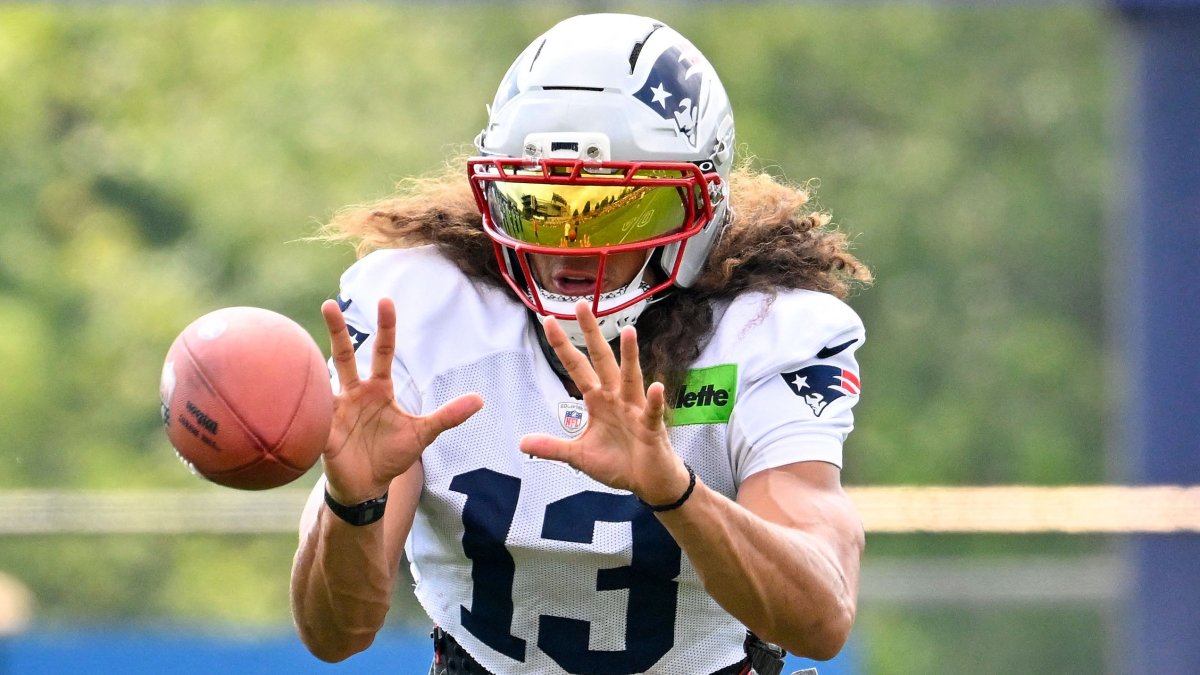
The Patriots spent much of their focus this offseason on the wide receiver position. There’s plenty of room to question how well they handled it.
For certain, acquiring A.J. Brown was a massive swing, and one that made great sense for a team in need of a WR1 to pair with Drake Maye. On the other hand, giving up a first-round pick (and a fifth-round pick) when it seemed as though zero other teams were pursuing Brown was, in all likelihood, an overpay.
Cutting Stefon Diggs and signing Romeo Doubs prior to the Brown trade was likewise sensible, though Doubs’ Patriots debut was nothing short of a disaster. In the middle of the summer, trading Kayshon Boutte for safety/special teamer Jaylen Reed was not a move that made the Patriots a better team.
And now we’ve learned that the team essentially threatened veteran receiver Mack Hollins with getting cut if he didn’t agree to change the terms of the incentive bonuses in his contract. Spotrac’s Michael Ginnitti reported this week that the Patriots changed Hollins’ incentives, bumping up the lowest number from 30 receptions to 47 receptions for a $300,000 bonus. The number for another $300,000 bonus went from 40 to 50, and the number of receptions for an additional $400,000 bonus went from 50 to 55.
The #Patriots renegotiated WR Mack Hollins’ incentive package for 2026 in order to make them not likely to be earned.
Reception Incentives
was 30, now 47: $300k
was 40, now 50: $300k
was 50, now 55: $400k
Hollins caught 46 passes last season.
— Spotrac (@spotrac) September 16, 2026
Hollins has topped 50 receptions just once in his career, when he caught 57 passes in Josh McDaniels’ offense in Las Vegas in 2022. With 46 receptions last year, the 47-catch incentive became “not likely to be earned,” thus pushing off any potential cap hit to the 2027 season if any bonuses hit.
Hollins spoke to the media on Wednesday in Foxboro and was asked if the tweaked contract motivates him.
“Yeah, I’d say it does. Makes you wanna come out and work, but not any harder than I already work,” he said, dropping to a decidedly less excited tone than the manner in which he had been answering other questions. “That’s an unfortunate sign of the business, but I’m happy to be here.”
Hollins was asked what made him open to changing the incentives.
“Um, I wouldn’t say — like, nobody wants to change anything,” he answered. “But that’s sometimes what happens.”
The Boston Herald’s Doug Kyed then followed up with Hollins, who said that the Patriots didn’t explicitly threaten to cut him if he didn’t accept the new terms, but stated that such an outcome was implied.
“That’s kind of how it works,” Hollins told Kyed. “That’s the risk that you run. It’s like, ‘Hey, you could take this offer, or we could potentially cut you.’ They’re not saying, like — that’s the business.”
That “negotiation,” such as it was, happened during the summer, when Hollins — who’s been in the league for a decade, who was a massively important player for the Patriots last season, and who returned from a lacerated spleen to lead the team in receiving in the AFC title game and the Super Bowl — was used in preseason games, when most veterans were watching calmly from the sidelines.
Between the Boutte trade and the threat to cut Hollins, it’s fair to wonder why exactly the front office was so intent on tinkering with the wide receiver room. Specifically, in the wake of Brown suffering a high ankle sprain that’s expected to cost him six weeks, it’s particularly puzzling why the Patriots felt comfortable playing things fast and loose with their insurance in the event that Brown suffered an injury. (Brown has missed time in five of his seven seasons.)
With Hollins, potentially ending the receiver’s Patriots tenure over the specifics of some incentives that could cost, at most, $1 million feels like some questionable roster management. (The fact that the Patriots paid out a $400,000 incentive for Hollins after he came up short of reaching it last season makes the situation all the more puzzling.)
Ultimately, after Brown’s injury, the Patriots probably wish they still had Boutte in the locker room, but they’re undoubtedly happy that they didn’t cut Hollins over the incentive change. He caught four passes for 51 yards in the Week 1 loss in Seattle, including an 11-yard catch on fourth-and-9 late in the game. That catch could have come on the game-tying or game-winning drive in the fourth quarter, but Maye’s ill-advised decision to throw to Hollins on the game-losing interception is a good indicator that the quarterback is going to lean on the veteran heavily during Brown’s absence.
So, barring injury, it feels likely that Hollins will at least hit the first level of incentives. And depending on how effective Brown is when he does return, Hollins should be in the neighborhood of hitting the second level and perhaps the third, too.
However it ends up, it will still be fair to wonder what the point was of playing hardball over such a relatively trivial incentive detail for an important player on and off the field for the Patriots.
