

You expect doctors to sit around and discuss all kinds of things: cardiovascular health, germs, golf. One thing you don’t expect them to discuss: whether college is worth it for their kids.
And yet Michael, a specialist at a highly regarded local hospital, says he and his colleagues talk, in amazement and despair, about the price of higher education—and what it offers back in return. “You’re asked to pay $90,000 a year with no guarantees of anything, including employment,” he says. “You then have to ask, ‘What is the value added?’”
“I have these conversations constantly with my colleagues, and really everyone I know feels the same,” he says. “It’s a big lift.”
One colleague recently told him that one of his kids wanted to go into a trade. “And he was very supportive of that,” Michael says. “Incredibly supportive.”
Michael, who prefers to use just his first name because he works for a large local health system, has spent the past two decades, basically since the births of his two sons, stressed over college. “We were thinking about it even back then,” he says. “How would we afford it?”
Over the years, he and his wife have mused over whether college was a good bet, or whether they’d be better off just putting the money into real estate or an investment fund. He also wondered whether his sons might be better off learning a trade, though neither was interested.
When it came time to look at schools, Michael encouraged them to consider UMass, a more cost-efficient option, but both ended up on the Amherst campus waitlist. Fast-forward and his older son just graduated from Babson and has an accounting job at a large downtown firm. The younger one is starting his sophomore year at Emerson, where he’s focusing on the business of media. Two sons, two bills of roughly the same size, and two very different bets on what a diploma will be worth.
That a doctor—someone in a field whose members are famously well-educated and well-compensated—has these doubts at all is a fair snapshot of higher education in 2026. “I’m a professional,” Michael says. “I just can’t even imagine some of the families, how they would be able to do it.”
But the money is only half of what’s bothering him. The other half is the part nobody can answer: what, exactly, all that money is supposed to buy.
Michael’s doubts arrive at the worst possible time for higher education. Nationwide, schools are having trouble filling seats amid declining birthrates, leaving many at risk of falling short of the tuition money they need to operate. This past spring, Hampshire College in Amherst and Anna Maria College in Paxton became the latest Massachusetts colleges to announce closures, bringing the decade’s toll to 13 schools closed and nine merged in the state. In April, consulting firm Huron reported that about a quarter of the nation’s roughly 1,700 private nonprofit colleges and universities “could face financial exigency” within the next decade. Many schools have already cut faculty, staff, and spending. Peter Stokes, a Huron managing director, says that, based on the most recently available data from 2024, 42 of the 69 schools in Massachusetts face some level of risk. The schools in the biggest trouble are mostly smaller, with low brand recognition and small endowments, he says.
MIT president Sally Kornbluth is facing decreased funding from the federal government. / Photo by Jessica Rinaldi/The Boston Globe
But big schools are feeling pain, too. President Donald Trump’s campaign against higher ed has threatened the basic model of modern research institutions. His federal funding cuts—still being fought over in court—have kneecapped research budgets and injected enormous uncertainty into universities’ finances. And his new endowment tax—now 8 percent on schoools with the largest endowments—has hit Harvard and MIT hard, with the possibility of further taxes hovering over other schools.
In May, MIT president Sally Kornbluth reported that federally funded research was down 20 percent at the school from a year prior, and that the incoming graduate class would shrink by roughly 500 students. Facing a $300 million shortfall, the school has announced plans to close libraries and forgo merit raises, the Boston Globe reported. Kornbluth called the shrinking research pipeline “a loss for the nation.” Meanwhile, Harvard’s Faculty of Arts and Sciences, home to the university’s undergraduate and Ph.D. programs, is laying off as much as a quarter of its administrative staff against a projected $365 million structural deficit. Boston University cut staff last year, as well. “This is the most challenging period that I’ve seen for higher education,” says Brian Rosenberg, who teaches at Harvard’s Graduate School of Education and is the former president of Macalester College, a liberal arts school in Minnesota.
Consider the rest of the storm currently battering campuses. Birthrates have been falling for nearly two decades, meaning fewer applicants at exactly the moment families are growing skeptical of sky-high tuitions. The pool of international students, long a major source of income for American schools, has also declined. The Institute of International Education’s Spring 2026 Snapshot found that nearly two-thirds of schools expect their international enrollment to drop this coming academic year.
Then there’s AI, which may reshape the entire labor market and has left everyone from freshman advisers to college presidents guessing how to prepare students for a future they can’t describe. A few have started asking a stranger question: whether the 18-year-old on a leafy campus is still the customer at all, or whether the future belongs to the 40-year-old whose job just changed underneath them.
Underlying all of this is that very simple question: Is college worth it? For decades, that was an easy answer. A college degree was a ticket to a prosperous future.
Today, there is more doubt than ever.
There’s a “crisis of confidence” in higher education, says Paul Reville, the Massachusetts Secretary of Education from 2008 to 2013, who now teaches at the Harvard Graduate School of Education. “You can’t necessarily count on that job being there, because a lot of them are getting eliminated,” he says.
Reville still believes in the value of a degree. A 2025 state report concluded that graduates with postsecondary degrees from Massachusetts public colleges and universities earn $20,000 to $30,000 more per year than those with just high school diplomas.
But Arthur Levine, the president of Brandeis University, believes that schools have lost sight of what students want from college: a launching pad for their careers. “We lost track of the real world, and we got so self-involved,” he says. “We need to give students the skills that will allow them to negotiate a world that’s being transformed.”
The question of what higher education will become may seem abstract. But for families staring at a tuition bill, or kids trying to decide whether to enroll at all, the issue could not be more real. The deal a generation of parents was sold—pay for the degree, get the good job—is a promise most institutions can no longer quite make. For a city built on higher education, the stakes are larger still.
For decades, the area’s colleges and universities have served as its economic engine—or “the goose that lays the golden egg,” in the words of Richard Freeland, the president of Northeastern University from 1996 to 2006, the Commissioner of Higher Education for Massachusetts from 2009 to 2015, and a historian who has written multiple books on higher ed.
According to the Association of Independent Colleges and Universities in Massachusetts, its 59 members support more than 320,000 jobs and generate more than $71 billion in economic impact for the state. For proof, look no further than Kendall Square or Longwood.
But the future is not guaranteed, according to Freeland. “It’s not written in the stars that Boston will always be that kind of a leading college town,” he says.
In an interview, Governor Maura Healey was blunt about the challenge: “Trump’s cuts to research funding threaten one of our greatest economic strengths and advantages,” she says. “Right now, countries around the world are trying to actively recruit away the very talent that we have in Massachusetts higher ed, that we’ve spent decades investing in, developing, and that the country has invested in.”
Could the city and state lose their preeminence?
“Is it something that happens tomorrow? No,” Healey says. “But if we don’t shore things up and take care of ourselves in this moment…then we may see that kind of research and education happen in other places around the world. So yes, it’s a risk for Massachusetts. It’s a risk for this country. And we need to act.”
So here we are: At the moment colleges and universities are most in need of public support, they have never been more doubted. Levine believes that the future will hinge on whether schools can prove their value. All schools in Massachusetts, he believes, must change. “They absolutely have to,” he says.
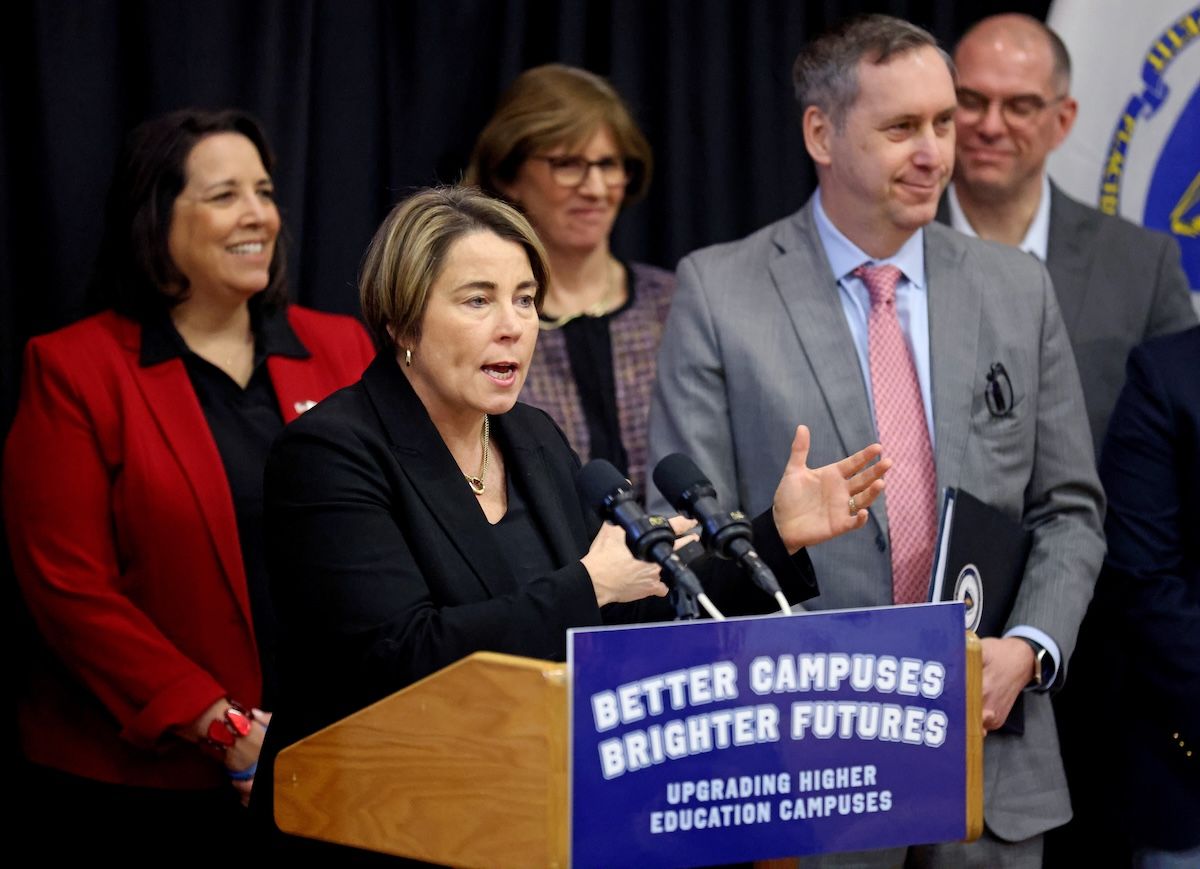
Governor Healey has proposed $400 million in funding for local colleges. / Photo by Matt Stone/MediaNews Group/Boston Herald via Getty Images
Colleges saw some of this coming. As the Great Recession hit, fertility rates in America began to plummet. In 2007, the average American woman birthed 2.12 children—about the replacement rate for the population. Last year, that number was just below 1.6. Put another way, in 2007, there were 4.3 million births in the U.S.; in 2025, there were just 3.6 million, according to National Center for Health Statistics data.
There are plenty of reasons for this—housing and childcare, you may have heard, have become pretty expensive—but for colleges, none of them really matter. What does matter is that schools are starting to fall off what has become known as “the demographic cliff.” Kids born in 2008 are now headed for college, and there simply aren’t enough of them. The problem is even more acute in the Northeast, which has the lowest fertility rate of any region in the country. “There are just too many seats right now in an area where the demographics are shrinking for college-age students, and shrinking pretty dramatically,” Rosenberg says. “So you’re going to have fewer institutions. Some of them [could be] pretty well-known institutions.”
Nobody enjoys guessing which schools go next. But it’s also not hard to see which are running budget deficits and losing students—two signs of potential problems. Just in the Fenway, Simmons University and the Wentworth Institute of Technology are both in the red, according to their most recent financial filings from 2024, and facing declining enrollments. Their former Fenway neighbor, Wheelock College, is already gone, merged into Boston University in 2018.
There is another sign, and it’s grimmer. Last month, the Wall Street Journal reported that financially strapped private colleges have increasingly been raiding their restricted endowments—money donors gave for a designated purpose, such as a named scholarship—to cover day-to-day operating costs. Nearly 200 private colleges tapped restricted funds in 2025, up from 131 in 2021, according to estimates the story cited from the higher education consultancy Perspective Data Science. Most of it went to routine bills. Attorneys general have started taking schools to court over the practice, and several states have recently made it easier for donors to sue.
The international students who might have filled some of the schools’ seats aren’t coming, either. They often attend well-known colleges like Boston University, which reported having 12,853 international students in the fall of 2023, a figure that was down to rougly 9,500 in 2025. But their absence trickles down to smaller ones.
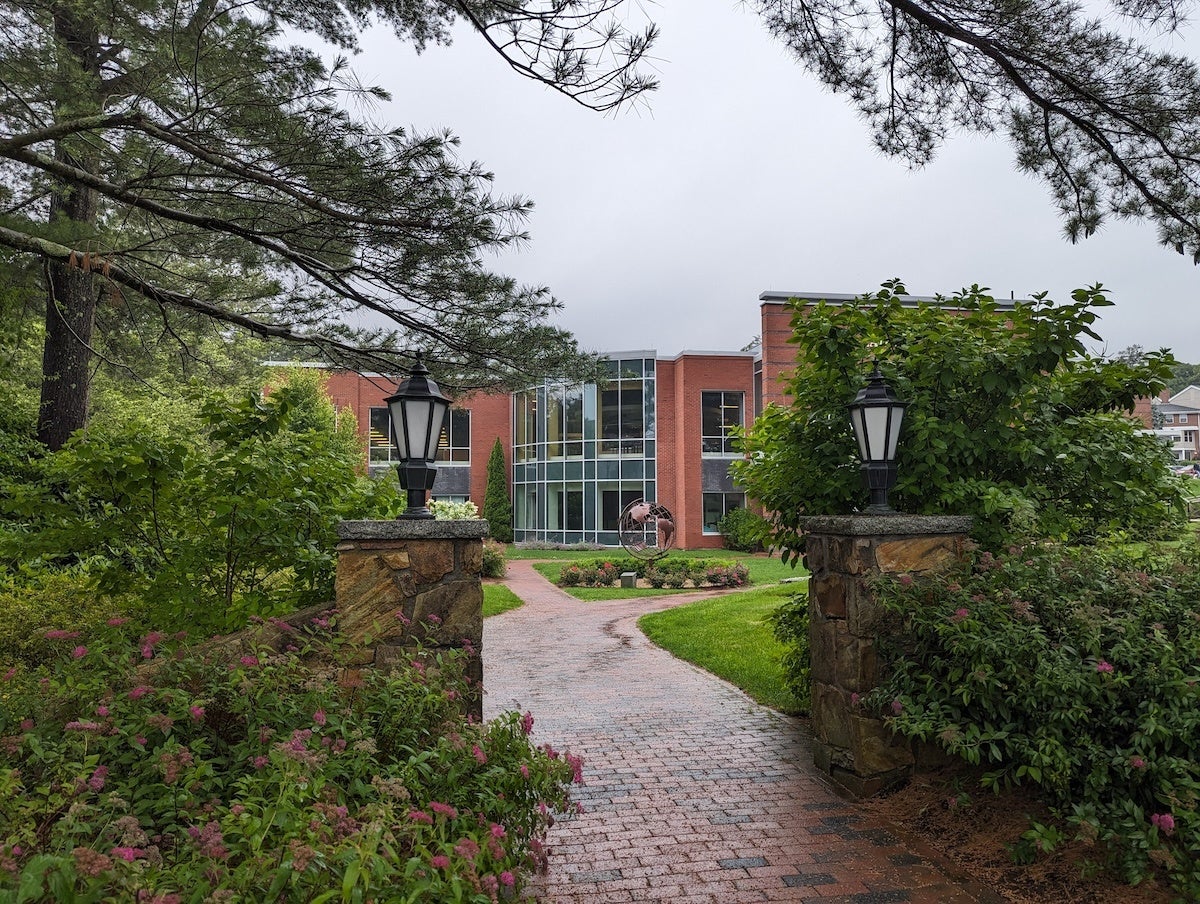
Endicott College is preparing for the future of higher education with a “workforce-aligned” approach. / SDKB/WIKIPEDIA
Bryan Cain, the president of Endicott College in Beverly, says that while his school has only a small international population, more-prestigious institutions are now going deeper into their domestic waitlists to fill out their classes. So some students who put down deposits at Endicott, he says, realize, “‘Oh, shoot, I just got into this more elite institution. I’m going to go there, never mind.’”
As the finances at struggling schools deteriorate, some colleges will merge into bigger institutions like Wheelock did. UMass Amherst similarly absorbed Mount Ida College in 2018, and Pine Manor College merged into Boston College starting in 2020. Other colleges will simply close, like Hampshire and Anna Maria. When that happens, the impact reverberates widely. Staff and professors are suddenly unemployed, students cut loose—less than half re-enroll somewhere else, according to one report—and campuses are left vacant. Good luck to the local pizza place and coffee shop.
“In a lot of small towns, these colleges are among the largest employers, and so when they close, it can devastate a region,” Rosenberg says. “Boston is big enough to handle the closure of a lot of these small places, but it’s going to change the economics of a lot of different neighborhoods.”
Mary Battenfeld taught American studies and literature for 25 years at Wheelock, before BU swallowed it. The college, which focused on education and social work, served a high proportion of first-generation students. “We lost a college that, for 100-plus years, had been dedicated to professions that are critical and not at all valued by American society,” Battenfeld says. “Our mission was improving the lives of children and families.”
Even as she continues to teach at BU—despite having lost her tenure in the transition—Battenfeld can’t help but feel something was lost. “It was a college that really had, I think, a genuine community in a different kind of way than a much larger school,” she says. “Students really felt that there was kind of a Wheelock way.”
Wheelock disappearing into BU, on its own, has likely not affected Boston’s larger economy. It does not threaten the city’s status as the Athens of America. But one of the wonders of Boston has always been strolling around town and tripping across a seemingly endless array of colleges, each with its own flavor and energy. The loss of so many small and midsize schools is “a blow to the overall spiritual well-being of the region,” Freeland says. “There’s some, I’d use the word, ineffable loss.”
In the future, the Boston area may be whittled down to just a handful of “financially strong, well-branded” institutions and not a whole lot more.
In the future, the Boston area may be whittled down to just a handful of “financially strong, well-branded” institutions and not a whole lot more, says Tim Westerbeck, the cochairman of Eduvantis, a higher education consulting and digital marketing firm. He points out that the schools likely to survive “are not institutions that every kid can get into.” Nobody knows where that leaves all the students who would have attended less-selective schools.
The UMass, state university, and community college systems will likely become all the more important. It’s the state’s responsibility, says Commissioner of Higher Education Noe Ortega, “to make sure that we position our publics to be able to move in there and play the role they have to serve those students.” He says that with all the “shifts” in the higher ed landscape, the state must “create pathways for more students.”
He points to several Healey administration policies, starting with programs launched over the past few years to make community college free. Between the fall of 2022 and 2025, enrollment at them increased 38.5 percent, rising from about 62,000 to more than 86,000. State-supported financial aid for higher education has increased as well: More than 62 percent of first-year, full-time UMass and state university students attend tuition- and fee-free, according to state data. Healey has also pushed to expand early college programs, which allow high schoolers to take college courses and essentially bank credits for free. Increasing access by cutting costs is a way to fight enrollment decline, as well as skepticism over higher ed’s value.
At the same time, some private schools will survive the fight over that shrinking student pool, and a few are already showing how. At Endicott, for instance, Cain is laser-focused on the value provided by his school’s degree. Founded in 1939 as a two-year women’s college, today Endicott is a coed four-year school with a modest $163.5 million endowment and a 71 percent acceptance rate. In other words, it’s not a blueblood; it relies on tuition income from its roughly 3,000 undergraduate and 1,200 graduate students to survive. The school is unusually focused on work experience: Students receive instruction in, essentially, how to build a career, and are required to complete three internships before graduating.
Stokes, the Huron managing director, says that there is often “a moat” between higher ed and the labor market. “Too few institutions have leaders or faculty who really understand what’s required of the contemporary workplace and what skills and capabilities students need to thrive there,” he says.
At Endicott, Cain talks about ensuring that his school is “workforce aligned.” The challenge is that nobody knows what the workforce will look like. “We don’t even know what jobs are going to exist,” he says. “Well, I have a real problem with just sitting and waiting to see what the jobs are going to be and then saying let’s develop something around that.”
So Cain has his people ask. “We are sending out every single one of our internship faculty and our internship coordinators to say, ‘All right, business and workforce partners, what are you experiencing today, and what do you expect to experience in five, 10, 15, and 20 years?’ So that we can adapt the model now.”
So far, students have bought what Endicott is pitching. Cain says, “I am one of the few college presidents right now that will tell you I’m feeling pretty good about the college’s finances.” Endicott also earns bonus income from operating a hotel and wedding venues on campus, which are incorporated into its hospitality program (seeking opportunities for auxiliary income is a common recommendation for tuition-dependent schools).
Endicott’s preprofessional model is not going to be a fit for every school. And it is not fully insulated from all the forces buffeting higher education. But they’re trying things. The college is expanding its Cummings School of Nursing & Health Sciences with a new physician assistant program planned to debut in fall 2027, and Cain hopes to double the school’s graduate student population in the next five years.
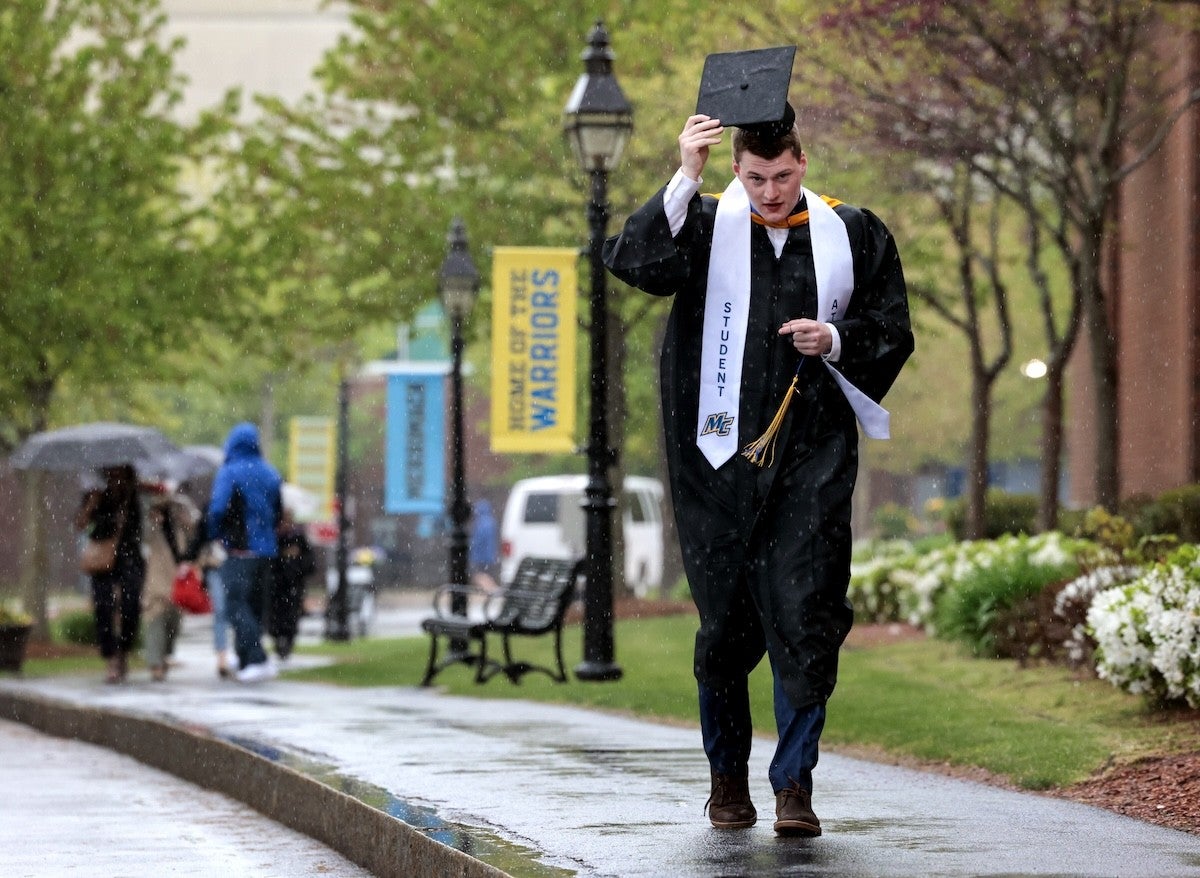
Merrimack College is rolling out a new three-year degree to encourage enrollment. / PHOTO BY CRAIG F. WALKER/GLOBE STAFF
Some other schools in Massachusetts are trying things as well. For instance, the state recently approved three-year degree programs at Merrimack College and Suffolk University, set to launch next year. Ortega believes these accelerated programs could be particularly attractive to mid-career adults who want to “get that credential to go back in the workforce and increase their earnings.”
“They don’t have time to wait four years,” he says.
Of course, three years of tuition brings in less money than four—but the schools are betting their programs will attract enough students to make up for it. The programs launch next year, and we’ll see how the math works out.
The state’s decision to authorize three-year degrees was controversial, with opponents arguing that it will water down the quality of a college education. Proponents pointed to the obvious: Clinging to tradition, today, is a death sentence.
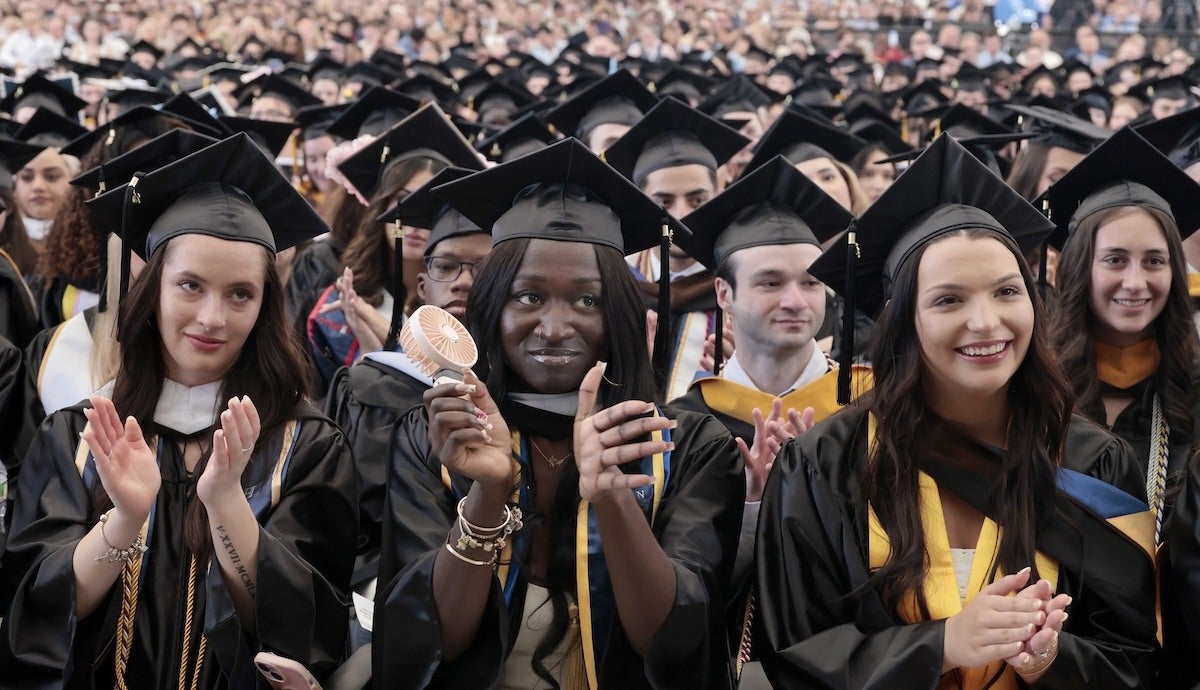
Suffolk College is another local institution piloting a three-year bachelor’s degree. / Photo by Pat Greenhouse/The Boston Globe
Boston’s premier research universities, with their billion-dollar endowments, do not have the same concerns as the Endicotts, Suffolks, and Merrimacks of the world. They are not about to shutter. But Freeland, the former Northeastern president, says that the current short-term pressures facing them—being caught up in the culture wars, Trump’s attacks—are exposing long-term issues. “And the long-term issues are very serious,” he says.
To start with, the demographic challenges go beyond birthrate. “The flow of population and money and economic power out of the Northeast has been under way for quite a while,” Freeland says. In 1970, nearly a quarter of Americans lived in the Northeast, compared to 17 percent in 2024, according to the Pew Research Center. When the federal government began pouring research money into universities around World War II, there was basically a direct pipeline from the treasury to Cambridge. By 1957, 89 percent of the research at MIT was funded by the U.S. government. But over time, political power has shifted away from the Northeast, and research dollars have spread beyond it and California to places like Austin and Boulder and North Carolina’s Research Triangle—a trend likely to continue.
And students are emulating the shift. A 2024 Wall Street Journal analysis found that the number of northerners heading south to attend public colleges increased by 84 percent over the preceding 20 years, including a 30 percent spike between 2018 and 2022. (Sure, warm weather and big-time college sports sound nice, but have these students considered the fortitude and grit that can only be taught by not seeing the sun for the entire month of March?)
The innovation economy may decentralize, too. In 2023, David Staley, an Ohio State historian of design and education, and Dominic Endicott, a Boston-based consultant, published a book called Knowledge Towns, arguing that the rise of remote work and the capabilities of AI—combined with the high cost of living near urban centers—will lead to more tech bubbles developing around colleges and universities outside of traditional hubs. Endicott cites Burlington, Vermont, as an example of a highly livable place, anchored by strong universities, experiencing tech growth. While he doesn’t think Kendall Square will go away, he believes the future will be more spread out. “We’re going to see an explosion in the next 10 years of the micro-innovation districts,” he says.
None of this will happen fast, which is exactly what worries Freeland. Like Healey, he says the danger isn’t an earthquake
overnight. “But we could wake up 50 years from now, saying, ‘Wow, why didn’t we pay attention to that?’”
If the long-term threat is erosion, the short-term one is a cliff. The current crisis exposed just how reliant universities have become on federal dollars. Harvard, for example, took in $686 million in federal funding in 2024, 11 percent of its operating budget. The Urban Institute reported that, in the 2022 to 2023 academic year, more than half of MIT’s funding came from the federal government, about $1.7 billion.
When Trump returned to office in 2025, he launched a campaign to freeze billions of dollars in funding to universities—a direct threat to the Massachusetts economy. The UMass Donahue Institute found last year that in 2024, $8.57 billion in federal research and development funding flowed into the state, supporting 81,300 jobs and creating $16.3 billion of economic activity. Schools have had some success challenging the president in court, but the administration’s efforts are ongoing. Even in a post-Trump world, there’s no guarantee of a return to the status quo. For universities that want to sustain their level of research, the alternatives are unclear. Some new funding will come from industry, but there is widespread doubt that companies will want to take up the government’s traditional role of paying for basic research that’s far from being monetized.
In response to Trump’s cuts, in July of last year, Healey proposed the $400 million DRIVE Initiative to aid the state’s universities and research institutions. “Higher ed in Massachusetts is one of our greatest economic strengths,” she says. “I believe that the state’s role is to make sure that it remains strong and competitive.”
While Healey argues that “these are actual real dollars that will go to fund and support research positions and graduate students,” the fact is, millions from the state can’t replace billions from the federal government. The governor concedes that part of her effort is to “send an important message that Massachusetts is open for business, that we support research, that we support science.” That, she believes, “in turn attracts additional investment.”
But her proposal has moved slowly through the Massachusetts legislature. This July, House lawmakers passed a bill that whittled the figure down to $200 million, while the Senate passed a version with just $100 million. The two houses must now agree on a figure.
Beyond this one-time handout, Freeland believes there should be ongoing state funding for research. So does Healey. “I don’t know that we’re ever going to return to a time where NIH funds at the level that it’s been funding at,” she says. “I think it’s smart for our research institutions, our public and private universities and institutions, to think about how we can together collaborate and support this incredibly important ecosystem.”
“We’ve got to take care of our own,” she says.
If Healey’s initial proposal is any indication, that’s not going to be easy. She had called for $200 million to be earmarked for public institutions and $200 million for private. The Senate version that passed had money only for public universities; the House version had $175 million for public and just $25 million for private. The politics of handing out money to wealthy schools are lousy, no matter how beneficial to the state’s economy. It does not help that, simply put, colleges and universities are not very popular right now.
Which brings us to the final long-term trend that Freeland points out: “Growing skepticism about the value, the return on value, of an undergraduate degree.”
Freeland should know. As president of Northeastern, he oversaw one of the great university transformations of the past several decades. When he took office in 1996, it was viewed, in Freeland’s words, as a “blue-collar, commuter, working-class school.”
“We had to change that for reasons of survival,” he says.
Freeland leaned into the school’s unique co-op program and emphasized its ability to prepare students for the workplace. In 1990, Northeastern had an acceptance rate near 90 percent. By 2006, it was in the 40s. Today? It’s at just over 5 percent.
Northeastern had more than a decade to pull that off. Most schools no longer have that kind of time. After Hampshire announced it was closing this spring, Bloomberg’s editorial board weighed in with a blunt verdict on small liberal arts colleges: adapt or die.
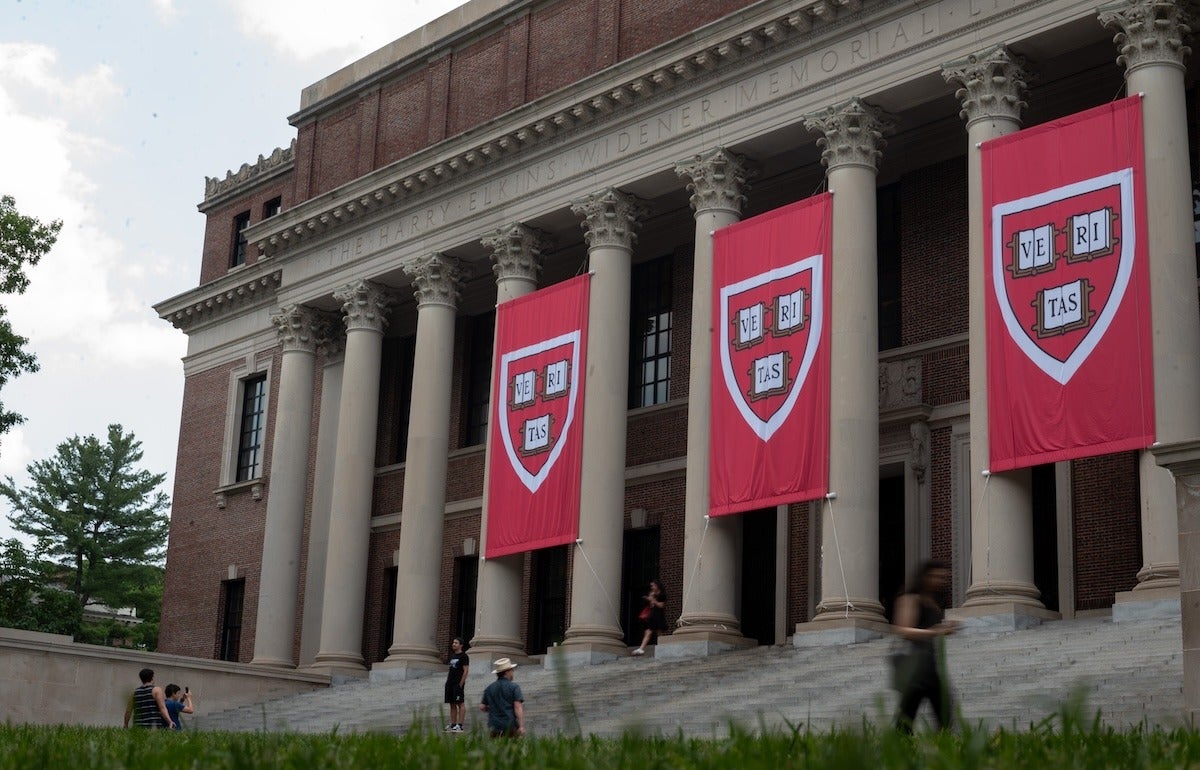
Even Harvard, with its enormous endowment, isn’t immune to the higher education crisis. / PHOTO BY HEATHER DIEHL FOR THE BOSTON GLOBE
That advice hasn’t escaped Levine, the Brandeis president.
He arrived in 2024 having already led Columbia’s Teachers College and the Woodrow Wilson National Fellowship Foundation and written many books on higher education, including The Great Upheaval, about the industry’s transformation. “When I talked to the faculty here, what I told them was our danger isn’t that we close, our danger is that we become mediocre,” Levine says. Brandeis’s enrollment last year—3,342 undergraduate and 1,354 graduate students—was down by roughly 700 students from five years prior. With its $1.36 billion endowment, the school operates in a different universe than, say, Endicott, but it is also no Harvard (endowment: $56.9 billion). Levine believes that, as higher education transforms, the Harvards of the world can afford to wait around and see what shakes out, then copy the best innovations. But Levine told his faculty: “We don’t have the time, and we don’t have the money. We only have one option, which is to lead.”
Levine believes in the liberal arts and their ability to teach students to think critically. Like many others, he thinks that, in the AI future, that very human ability will be imperative. But he also believes that liberal arts curricula nationwide have failed to keep up with the modern world. “When the liberal arts are most successful, they’ve got one foot in the library, getting knowledge of humanity, and one foot in the street,” he says. “When the world changes quickly, we lose traction with the street, and it needs to be restored.”
Last fall, Brandeis announced a plan to “reinvent the liberal arts.” The university redesigned its curriculum and reorganized its schools, attempting to infuse professional development into students’ learning. The new program, set to launch in full this fall, assigns every student both a career and academic adviser upon their arrival on campus. Freshmen will have to take what Levine calls “AI bootcamp,” which starts with studying “the ethics of AI.”
Students will also receive what the school is calling a “second transcript,” which will include badges in “competencies” like “applied statistical analysis,” “foundations of data analytics,” and “sound and video media.” The idea, Levine says, is for employers to see that Brandeis has certified specific skills in their students. He wants the badges to mean something: If Brandeis says a kid can analyze data, they better be able to analyze data. “We’re requiring assessments in order to get the badges,” Levine says. Like Endicott, Brandeis will seek feedback from employers to hone the new program.
Universities are often criticized both for being insular and for caring more about their faculty’s research than what they’re actually teaching students. Levine wants to send the message that he is focused on students and engaged with the world off campus. “What students and parents care about are careers,” Levine says. “The liberal arts have always been a way to prepare for a career. What we’re doing now is we’re making that explicit, and we’re rebuilding them for this era.”
This fall, Levine plans to propose to the faculty another major change for the university: “I want to transform master’s degrees,” he says. Similar to the badges for undergrads, he believes that employers want graduate-level “microcredentials” for discrete skills or abilities. He wants master’s programs to be composed of “stackable credentials” that have value on their own, even if a student does not accumulate enough for a full degree. “I expect that the new majority of higher education isn’t going to be traditional students,” he says. “It’s going to be people who are coming back for upskilling, reskilling, new skilling, or saying they live in a world in which AI is taking part of their job.”
That’s a bigger claim than it may sound: that the 18-year-old on a leafy campus, the image higher education has sold for a century, becomes the minority customer. But many higher ed experts believe that, to survive, schools will have to expand their appeal beyond 18-to-22-year-olds. Levine acknowledges that this approach helps solve the demographic problem, but he also believes it fits our changing world, where technological advancements are requiring skills and knowledge to be updated rapidly.
Consider what that would mean for a city like this one. Boston is in many ways built around the ways of the past: the dorms, the triple-deckers subdivided into student apartments, the September move-ins that clog Storrow Drive and litter Allston’s streets, the bars and burrito shops that live or die on the academic calendar. Some 150,000 students come to the city each fall and rent, eat, and spend accordingly. A 40-year-old earning a certificate between shifts does none of that. If Levine is right about who higher education serves next, the schools may survive the transition in better shape than the neighborhoods built around them.
But that doesn’t mean nobody wins. The adults who are able to add a credential would come out ahead. Rosenberg, the Harvard graduate school professor and former Macalester president, says that if schools were more deliberate in breaking down the walls between their campuses and their communities, they’d quickly see the opportunity in mid-career students. As Ortega points out, accelerated degrees could be just one way to serve them. “You need to go out and talk to the people around you,” Rosenberg says. “Higher education tends to be very inward-looking, and it needs to become more outward-looking, and look at what people are asking for.”
He adds, “We need to stop thinking of ourselves as a place that has 18-to-24-year-olds living on a campus, getting up at 9 o’clock in the morning and walking to a classroom.”
Whether any of this works is an open question. In the year since Brandeis announced its new program, Levine says applications shot up by 40 percent. It is, of course, far too soon to know if the school’s “reinvention” will be a long-term success. But when you start to add up all the evidence—Endicott’s performance, Northeastern’s ascent, Brandeis’s newfound popularity—students and their families are sending a clear message. They want schools to prepare them for careers. They want their college degrees to be valuable.
At a recent meeting of college presidents, Levine says that the head of a big public research university approached him to ask about what he was doing at Brandeis. At the same meeting, he says an Ivy League president asked him, “Can we do this at our school?”
Just as with Endicott, what works for Brandeis may not work for another research university. Schools will need to chart futures authentic to their own identities. Levine believes it can be done.
Healey, too, is optimistic. “I’m super bullish on Massachusetts,” she says—precisely because everyone else is struggling, too. She believes there is a huge opportunity for the state to build a competitive advantage. Other states are facing the same issue around these research cuts and higher ed cuts, but if Massachusetts moves forcefully to continue making college more affordable, while also supporting research, she believes Massachusetts can cement its status as the education capital of the world, instead of losing it. “The states that do it first and do it well are the ones who are going to win,” she says. “And I think Massachusetts is ideally positioned to do that.”
It should be noted that Michael, the doctor with doubts over the cost of college, has been pleased with his sons’ experiences at Babson and Emerson. “They’ve had really tremendous growth,” he says, including their ability to think critically. “And I still think, even in the era of AI, that skill set does exist and is important.”
He believes that schools, in general, should help students prepare more for careers. That wasn’t a concern with Babson, but he’s been pleasantly surprised with the practicality of the media business courses his other son has taken at Emerson. All of this, he says, “makes the bitter pill of tuition a little bit easier to swallow.”
What Michael is describing is, more or less, the education Levine envisions. But nothing, of course, is for sure.
Michael’s younger son has three more years at Emerson, and nobody—not his father, not Levine, not anyone in this story—can tell him what his degree will be worth when he’s done.
Which is more or less where Boston finds itself. The governor asked for $400 million and may end up with a quarter of it. Twenty-two schools have closed or merged in a decade. The ones now reinventing themselves are doing it because the alternative is irrelevance or, worse, closure. For generations, this is where American families sent their kids to find their way—and the place where the future itself was being built. But these days, that future is a lot harder to see. The one thing that’s still certain: Schools will keep asking people like Michael and his wife to write checks. What they’re actually getting for that money? That’s the part nobody can guarantee.
