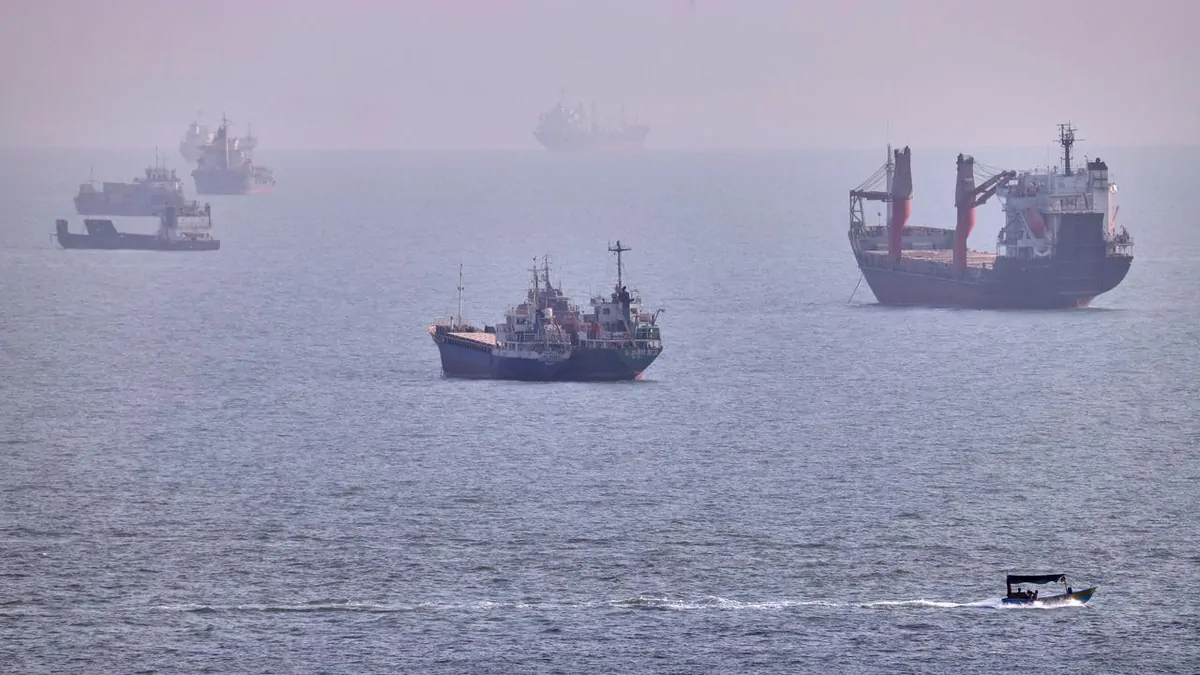
Iran will not allow military vessels to transit through the Strait of Hormuz under an agreement the Islamic Republic is currently negotiating with Oman, Iran’s Deputy Foreign Minister told state TV late on Tuesday night.
The top diplomats of the two countries met to discuss managing commercial shipping traffic in the vital waterway, which remains largely shut down nearly six months after the Iran war began.
The latest development in negotiations came as Israel’s strikes continued in Gaza, testing the already fragile ceasefire with Hamas.
Sign up to The Nightly’s newsletters.
Get the first look at the digital newspaper, curated daily stories and breaking headlines delivered to your inbox.
By continuing you agree to our Terms and Privacy Policy.
Iranian Deputy Foreign Minister Kazem Gharibabadi told state TV late on Tuesday night that Oman and Iran’s new framework for managing ship traffic in the Strait of Hormuz would exclude military vessels from traversing the vital waterway.
“If the understanding becomes binding, no military vessel will be permitted to pass through the Strait of Hormuz,” he said. “No military vessel at all.”
Gharibabadi said the proposed route is temporary, and that Iran and Oman must negotiate within 30 to 60 days on a permanent maritime traffic scheme.
Commercial shipping traffic into the Persian Gulf from the Gulf of Oman would pass entirely through Iranian waters, while the outbound route would pass partly through Iranian waters and partly through Oman’s territorial waters, he said.
The Trump administration told Oman it opposed parts of the evolving deal, including the joint Iranian and Omani management of the exit route out of the passage that’s critical to global supplies of oil and natural gas.
It’s unknown whether the US will accept the emerging deal. US President Donald Trump last week threatened to bomb Oman if it “gets in the way” of American efforts to reopen the strait.
Iran’s president and other senior officials also discussed the strait with a delegation from Pakistan that left Tehran on Tuesday following talks on reviving negotiations to end the Iran-U.S. conflict, the Pakistani military said.
The talks between Iran and Oman came after an oil tanker was disabled in an attack off the coast of Oman, underscoring the ongoing dangers for shipping companies attempting to use the waterway while it’s under Iranian control.
The strike on Monday night off Oman’s coast disabled the ship’s engine, the British military’s United Kingdom Maritime Trade Organization reported. It said all crew were reported safe.
Israel launches deadly strike in Gaza, health officials say
An Israeli strike on a tent for displaced people Wednesday in southern Gaza killed one person and wounded at least four others, according to officials at the territory’s Health Ministry. The Israeli military said it struck a “military operative,” without elaborating.
Even as US efforts to advance the fragile ceasefire in the nearly three-year Israel-Hamas war continue, Palestinians in the strip have reported a surge in deadly Israeli strikes.
Israel has said it targets Hamas and other militants who pose a threat, as well as those who participated in the October 7, 2023, attack that triggered the war. About 1,200 people, mostly civilians, were killed that day in Israel and 251 abducted by militants. Israel’s retaliatory military campaign in the enclave killed more than 73,400 people, according to the Gaza Health Ministry.
The health ministry, part of the Hamas-controlled government, is staffed by medical professionals and maintains detailed records viewed as generally reliable by United Nations agencies and independent experts. It does not distinguish between civilians and militants.