Four near misses between passenger aircraft in less than a month. What’s going on with Sydney Airport, and why isn’t there an immediate plan to fix the crisis?
That’s the question everyone from the pilots’ union to the woman sitting in 14C is asking right now, and the honest answer to the first question is that we did this to ourselves years ago and are only just getting the bill.
The second is anyone’s guess.
Sign up to The Nightly’s newsletters.
Get the first look at the digital newspaper, curated daily stories and breaking headlines delivered to your inbox.
By continuing you agree to our Terms and Privacy Policy.
Are we just going to wait until there is an actual crash involving fatalities? The number of near misses on the ground is frightening. Worse, we know the reason, but the government seems reluctant to do anything about it.
The problem is we simply do not have enough air traffic controllers at Sydney Airport. That started during COVID.
Airservices Australia offered retirement packages to staff aged 56 to 65, and more than 140 experienced controllers and support staff took it and left, between late 2021 and mid-2022.
Planes were grounded at the time, and it looked like sensible cost-cutting.
In reality, it was a catastrophically foolish decision, and we are now seeing the ramifications.
Civil Air, the union representing the controllers in the tower, has warned for years about the lack of staff, telling Airservices that there aren’t enough air traffic controllers at Sydney Airport.
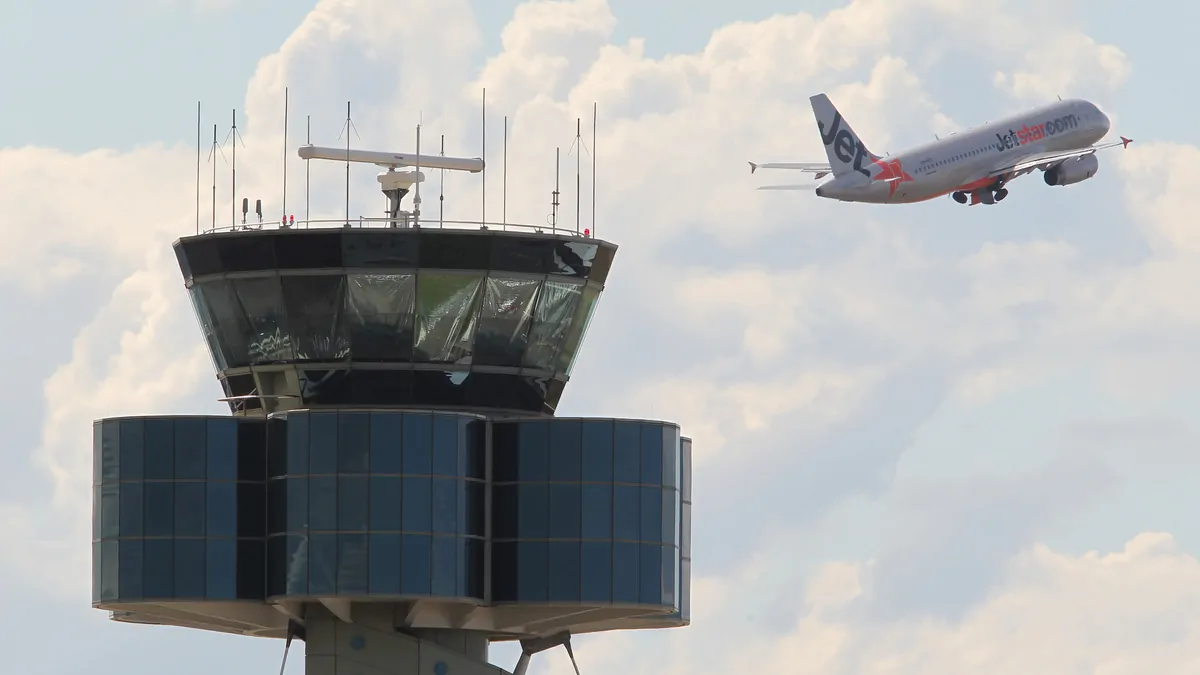
Australia’s aviation industry heads have been summoned for an urgent meeting with the government after two aircraft narrowly avoided a collision at the nation’s busiest airport. A Jetstar flight preparing to depart Sydney Airport for the Gold Coast almost collided with a Qatar Airways plane at 7am on Sunday. The Jetstar Airbus 320 pilot was forced to brake suddenly to avoid a collision with the Qatari plane on the tarmac. Credit: Dani Brown / X/Dani Brown / X
President Scott Nugent, a trained air traffic controller, said staffing shortages were taking a heavy toll on those working on the frontline.
“What I can say is that air traffic controllers in Australia are working very hard, and for a long time they have not necessarily had the resources they need to do their jobs properly,” he told the ABC.
“There aren’t enough controllers in Australia… we’ve seen in the past few days what happened when you don’t have enough air traffic controllers, the impact on industry.”
That statement should send shivers down the spine of every person who flies in or out of Sydney Airport, which is more than 100,000 people a day.
The Government’s response so far has been to hold meetings and point to an “aggressive recruitment drive”, with 91 new controllers endorsed last year.
But you cannot recruit your way out of a hole that deep overnight, and Western Sydney Airport opens for passenger flights in October, which means Sydney’s airspace is about to get busier, not calmer.
Prime Minister Anthony Albanese’s response to the crisis was to state the obvious: people who use aviation expect to do it safely.
“We are very vigilant indeed when it comes to these issues,” he said after the third incident.
Really? When there have been four near misses at the airport in less than a month?
Albanese has so far said nothing about the staffing shortage itself, the thing every other person, including his minister, the unions, and the safety regulator, agrees is the actual problem.
The solution, while we wait for more air traffic controllers to be trained, is to have longer delays or fewer flights.
It’s already happening, just not on purpose. Airservices Australia CEO Rob Sharp admitted as much, saying the agency puts measures in place to reduce traffic levels to ensure safety, which means delays.
To make matters worse, in early July, aviation regulator CASA introduced new Sydney Basin airspace arrangements, restructuring controlled airspace around Western Sydney International, Kingsford Smith, Bankstown and Camden all at once, ahead of Western Sydney’s opening.
According to a Reuters report, Australia’s independent transport safety investigator (ATSB) received a report in June from an air traffic controller warning that Sydney staff weren’t adequately prepared for the complex airspace and procedural changes.
This was before any of the four incidents, which the ATSB is now investigating.
America has already shown what doing this properly looks like. Their Federal Aviation Administration was about 3000 certified controllers short of its staffing target as of June this year.
Its answer wasn’t to hope nobody noticed. At Chicago O’Hare, the FAA capped scheduled flights at 2708 a day from mid-May through to late October, a cut of nearly 15 per cent on what airlines had planned.
The US also had the terrifying warning Sydney hasn’t had yet. A midair collision between an American Airlines jet and an Army Black Hawk helicopter in 2025 killed all 67 people on board. The accident happened after a string of safety incidents at the same airport.
The pattern was identical: an ageing controller workforce forced into retirement at 56, a training pipeline that takes three to five years to produce someone fully certified, and a shortage nobody fixed until people died.
If a temporary cap on Sydney’s movements is what keeps a fourth near miss from becoming a fifth with less luck attached, then the Government should say so and do it.
Tell airlines. Tell passengers. Everyone wants more controllers, eventually. But nobody wants to say out loud that means either more delays or flying fewer planes out of Sydney until then.
Four near misses in a month isn’t bad luck. It’s an invoice, finally arriving, for a decision made nearly five years ago by people who are not the ones standing in the tower.