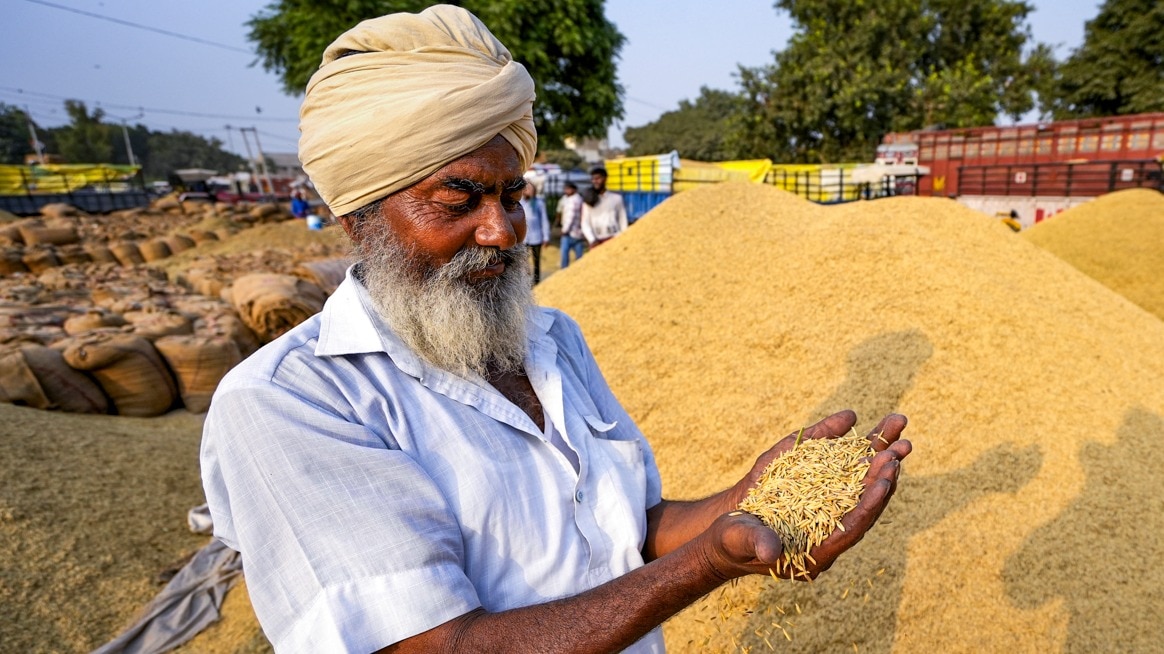
Irony is one among the several layers of India’s ethanol-blending programme. The government’s attempt at energy security is latched on to its food security system with parasitic hooks. Paddy, that the government buys on a minimum support price (MSP) with taxpayers’ money to distribute among the poor, is being sold to distillers at half the cost.
It is a bewildering case where the finished product — rice, after transporting, milling and stocking — is being sold at even lower than the procurement price of the source product — paddy.
We are going to tell you how that is being done and why we are talking about the national food security programme here. We are also going to tell you why the government is doing so.
The government says the national Ethanol Blended Petrol (EBP) programme will help reduce petroleum imports and save India’s foreign reserves. That should make sense because India imports around 90% of its energy needs. There’s just one small problem: the current economics don’t support the plan.
This economics is the primary reason why the government is supplying “surplus” rice from the Food Corporation of India (FCI) godowns to distillers producing ethanol.
The Ministry of Petroleum and Natural Gas in a statement on July 31 clarified that the EBP programme didn’t compromise India’s food security programme. However, it sidestepped crucial questions, the main being: why was rice, bought under India’s food security programme using taxpayers’ money, being given to distillers at a subsidised rate?
“In a country where 80 crore people depend on free rations, the diversion of any item that can be used as food to produce ethanol is a big sacrifice. Food cannot be an alternative energy source in a country like India,” agriculture expert and Lucknow University professor Sudhir Panwar told India Today Digital.
INDIA’S ETHANOL PROGRAMME AND CEA NAGESWARAN’S WORD OF CAUTION
While the need to cut petroleum imports is understandable, the rush to do so with ethanol-blended petrol isn’t.
The government has mandated the sale of E20 petrol, which is a mix of 20% ethanol in a litre of petrol. While the deadline was set for 2030, the capacity to produce enough ethanol for blending with petrol was achieved by 2025, five years ahead of schedule.
That was even as 80% of the vehicles on the road were not E20 compatible.
In an Op-Ed article published in The Indian Express on August 17, India’s Chief Economic Advisor (CEA) V Anantha Nageswaran argued that E10 petrol should be made available for older vehicles.
Nageswaran’s piece, co-authored with Department of Economic Affairs consultant Akash Poojari, also suggests that India shouldn’t move beyond the E20 until India has “thoroughly costed the food-versus-fuel trade-off“.
The government was moving towards E25 and higher ethanol blends, and paused only after public backlash. CEA Nageswaran is cautioning against rushing towards higher blends because some moves around agriculture pattern and distillery capacity might be difficult to undo.
One of the reasons the government is under pressure on the EBP programme is that it has already installed hundreds of factories to produce ethanol.
Investments were made, and big bank loans were taken out to build these plants. The repayments clock is ticking and investors and bankers might find the wait for a gradual move to higher ethanol blends difficult.
Between 2013-14 and 2024-25, India’s ethanol blending in petrol surged more than 12-fold, from 1.53% to 19.24%. (Graphics: India Today Digital/ Sushim Mukul)
HOW DID INDIA GET 700 CRORE LITRES OF ETHANOL SURPLUS CAPACITY?
India’s ethanol production capacity expanded from about 421 crore litres in 2014 to nearly 2,000 crore litres by 2026. The spirited dash has made India sit on a notional surplus capacity of 700 crore litres of ethanol. That means, it can produce more than it can use.
There are 370 operational distilleries while 40 others are coming up, shows data shared by the All India Distillers’ Association (AIDA) with India Today Digital.
Now, ethanol is a biofuel, which means there is a farm component to it. While the scope of expansion of factories is virtually limitless, a steady supply of feedstock, which is agriculture dependent, and therefore not unlimited, has to be maintained. The input price of the feedstock has to be factored in too.
WHAT FEEDSTOCK ARE INDIA’S ETHANOL FACTORIES BEING RUN ON?
While molasses and rotten rice were earlier used to make ethanol, the feedstock has now changed to include millets (corn) and even rice.
Going by the current trend, grain-based ethanol is 67% of the total supply while the rest is from sugarcane-based feedstock. This shows “the strategic role of grain in sustaining India’s ethanol blending programme,” said AIDA.
AIDA president Vijendra Singh told India Today Digital that the government has mandated ethanol distillers to source at least 40% of their feedstock from surplus rice stocks held by the FCI.
Singh said distillers independently procure feedstock such as maize (corn) and sugarcane, while the government supplies broken rice.
“The FCI has a huge rice surplus, including broken rice that is not fit for human consumption, lying in its warehouses. The government has limited avenues for disposing of it, and that is why it has mandated that 40% of ethanol production must come from surplus FCI rice,” AIDA’s Singh told India Today Digital.
But experts say broken rice is perfectly fine for consumption. Also remember, the broken rice being provided to the distillers had been procured by the government through the FCI as part of India’s National Food Security And Nutrition Mission.
The government’s latest data broadly match AIDA’s figures. It shows maize at around 36% and FCI rice at about 25% of the total ethanol supply. AIDA provides a more detailed feedstock-wise breakdown covering sugarcane juice, B-heavy molasses and damaged foodgrains as well. (Graphics: India Today Digital/ Sushim Mukul)
WHAT’S INDIA’S NATIONAL FOOD SECURITY AND NUTRITION MISSION?
India’s historical memory is scarred by famines in which millions of people have been killed. An Independent India inherited food scarcity and used to live from aid ship to mouth. Contaminated wheat, especially from the US, was the hallmark of the largesse of the West.
In the 1960s, India launched the Green Revolution under scientist MS Swaminathan. The increase in grain production, particularly in Punjab, Haryana and Uttar Pradesh, turned India into a food-surplus nation. Cultivation of paddy and wheat, the staples, was encouraged as India built a buffer stockpile in FCI godowns.
India launched the National Food Security Mission (NFSM) in 2007-08 to increase the production of rice, wheat, and pulses. The NFSM was rebranded National Food Security and Nutrition Mission (NFSNM) in 2014-15.
The Manmohan Singh government in September 2013, brought the National Food Security Act (NFSA), a landmark law that was aimed at ensuring food and nutritional security for all in India.
While the government tries to boost foodgrain production under NFSNM, it guarantees their equitable distribution under the NFSA.
So, India’s food security programme has two dimensions — procurement and distribution. Foodgrain, especially paddy and wheat, is purchased under the minimum support price (MSP) system from farmers and distributed through fair price or ration shops.
Around 800 million people in India get free food grains. Every month, 5 kg of grain, of which two-thirds is rice, is given to people below the poverty line.
HOW GOVERNMENT SUBSIDISED RICE FOR ETHANOL PRODUCERS
In just one year, (Kharif Marketing Season 2024-25), the government spent Rs 65,695 crore on paddy procurement.
The government supplied that paddy, bought using taxpayer’s money, to ethanol distillers at around 40% lower than its acquisition price. This was revealed in an answer by the Ministry of Consumer Affairs and Food and Public Distribution Department in the Rajya Sabha on July 28.
The FCI spent Rs 3,889 per quintal (Rs 38.89/kg) on paddy procurement in 2025-26. The cost includes storage, transport and carrying charges. Estimates by experts like Ashok Gulati put that at a higher Rs 44 per kg.
However, the rice was sold at Rs 2,320 per quintal (Rs 23.20/kg) on an average to distilleries for the production of ethanol. This is a difference of almost Rs 1,600 per quintal or Rs 16 per kg.
The government’s justification is that the rice is broken or damaged, and unfit for consumption.
In this 2021 file photo, beneficiaries receive foodgrains at a ration shop in West Bengal’s Malda district during the Covid-19 pandemic, when the Centre extended free rations under the Pradhan Mantri Garib Kalyan Anna Yojana by three months. (PTI Image)
BROKEN RICE FIT FOR CONSUMPTION, BEING DIVERTED, SAYS EXPERT
Agriculture expert Sudhir Panwar said rice being broken doesn’t make it unfit for consumption. “The nutrient composition of broken rice remains the same. It is just that the aesthetic changes,” he explained.
“Broken rice formed a bigger part of the public distribution system. No food went to waste. Whatever broken rice was left, used to be given to African countries as humanitarian aid,” he added.
Panwar says the share of foodgrains in the production of ethanol in India is increasing rapidly every year, and needs to be weighed against the trade-offs like water use and farmland dedication.
The broken rice logic is most likely being used to make the broken ethanol-blending model limp.
OIL COMPANIES PAYING MORE FOR ETHANOL THAN FOR CRUDE?
At Rs 60.32 a litre, ethanol made from surplus FCI rice is the cheapest, data from the Ministry of Petroleum and Natural Gas reveals. Ethanol from corn costs Rs 71.86 a litre while it is Rs 65.61 if produced from sugarcane.
The weighted average ex-mill price of ethanol stood at Rs 66.61 per litre, according to a reply in the Lok Sabha by the government on July 30.
Weigh this against the cost of petroleum imports at around Rs 48 a litre with crude at $91 a barrel. Add the processing cost of Rs 7 to Rs 9, and the total comes to around Rs 55.
Blending ethanol to petrol will turn “genuinely advantageous only when crude climbs into the $120-130 [per barrel] range or higher,” KBS Sidhu, former Special Chief Secretary of Punjab, told Financial Express Digital.
Prices of Brent Crude hit $113 a barrel on April 7, at the peak of the Iran-US war, and was at $86 on August 21. The $120-a-barrel scenario is highly unlikely now.
So, oil marketing companies (OMCs) are adding costlier ethanol to cheaper petrol. If FCI rice isn’t provided, the contrast will become starker.
Ethanol from surplus FCI rice is the cheapest at Rs 60.32/litre, compared with Rs 65.61 from sugarcane and Rs 71.86 from corn. The average price of ethanol is still higher than the refinery gate price of petrol. (Graphics: India Today Digital/ Sushim Mukul)
IS FCI RICE BEING USED TO WORK AROUND ETHANOL PROGRAMME ECONOMICS?
“If distillers start buying rice from the open market at MSP, then the ethanol from that feedstock will be the costliest,” Panwar told India Today Digital.
“Earlier, 25% of broken rice was allowed in PDS supply. The government is bringing it down to 10%, keeping 15% exclusive broken rice for the ethanol distilling industry,” he said.
Food Secretary Sanjeev Chopra said in March that a Cabinet note would be moved, proposing that the share of broken rice in grains distributed through the PDS be brought down from 25% to 10%.
Chopra said that would ensure that ethanol distillers get 90 lakh tonnes of broken rice every year, according to a PTI report.
Panwar said the FCI had created a new category and that is exclusive broken rice, 15% of which had been reserved for the ethanol distilling industry.
Paddy is highly water-intensive. The ICAR estimates rice requires around 1,000-1,200 mm of water over its crop cycle, equivalent to roughly 10-12 million litres per hectare. (PTI Image)
FOOD SECURITY AND ECONOMICS OF ETHANOL BLENDING
There are larger issues of farmland being diverted and water-guzzling crops being planted because of the EBP programme.
The diversion of sugarcane to ethanol production is one of the reasons why India, the world’s second-largest sugar exporter, is removing duty to import sugar. Diversion of maize has resulted in costlier eggs and poultry products. But that is a story for another day.
Farmers, call them annadata, urjadata or anything else, aren’t gaining anything beyond the MSP.
The government has rushed into the EBP programme and committed to creating an ethanol ecosystem with the math not mathing. OMCs are already mixing costlier ethanol with cheaper petrol. Subsidised rice is going to produce costlier ethanol.
The bigger question now is: who is subsidising whom?
Rice bought with taxpayer’s money is being sold at almost half the price to distillers for a dream called ethanol. And millions of people in India are being forced to use that blended petrol in their vehicles that aren’t E20-compliant. Who is actually benefiting? Not the taxpayers for sure.
– Ends
Published By:
Sushim Mukul
Published On:
Aug 24, 2026 07:00 IST