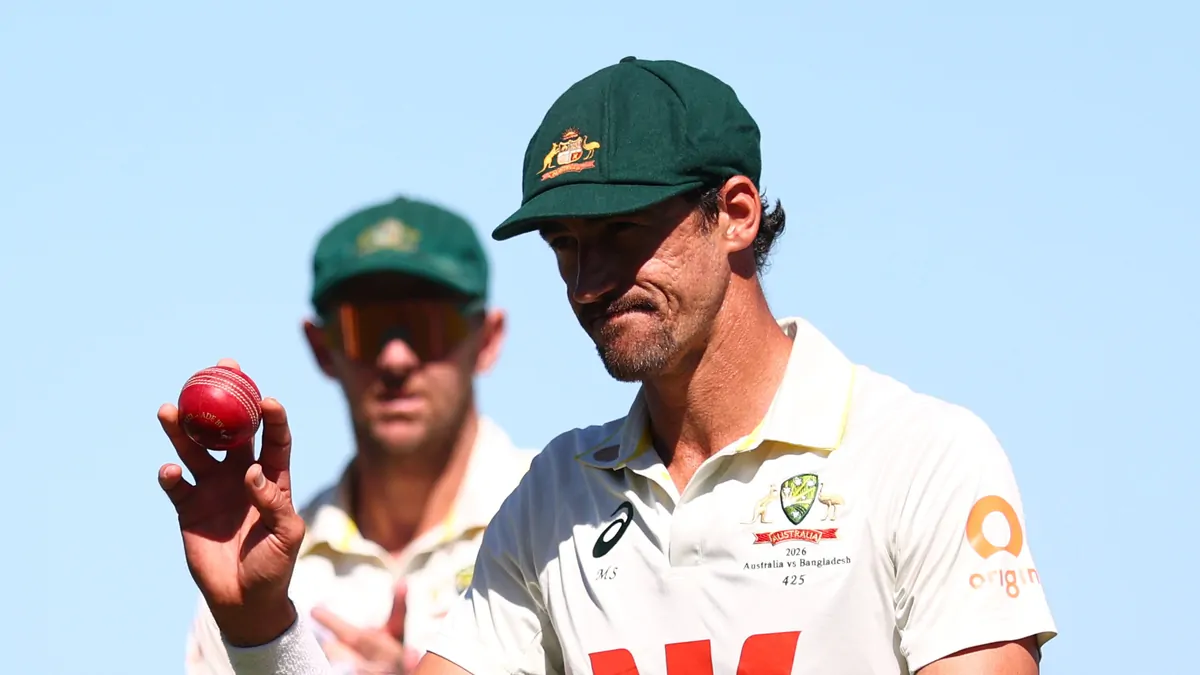
Nothing compares to taking the new ball in a Test match and feeling everything come together.
Your run-up feels right. Your body is aligned. The ball comes out exactly how you want it to. You are not overthinking anything. You are simply doing what you do best, and it is so much fun.
That is what Mitchell Starc produced against Bangladesh in Mackay.
Sign up to The Nightly’s newsletters.
Get the first look at the digital newspaper, curated daily stories and breaking headlines delivered to your inbox.
By continuing you agree to our Terms and Privacy Policy.
After Australia’s disappointing loss in Darwin, the second Test demanded a response. Starc delivered one immediately, taking a wicket with the opening delivery of a Test for the fourth time in his career before claiming five wickets in just 22 balls.
Bangladesh were eventually bowled out for 64, with Starc finishing with 6-12. Phenomenal.
Before the match, I thought Mackay looked like a surface where you might consider bowling first but would probably still choose to bat, knowing you had to get through the new-ball period and the first session or so. From what I had been told, it is normally fairly flat. There may have been a little early stickiness, but conditions alone do not explain what Starc achieved.
Two things stood out, how full he bowled and the fact that his first four wickets were left-handers.
When a left-arm fast bowler bowls to a left-handed batter, the alignment of your body and bowling action can feel more natural. It is similar to a right-armer bowling to a right-handed batter.
Mitchell Starc of Australia celebrates after taking the wicket of Najmul Hossain Shanto. Credit: Robert Cianflone/Getty Images
You can run straight through your action towards off stump, with your hips, shoulders and momentum all working in the same direction. Starc found that alignment early and combined it with pace and late swing.
At times, he was practically bowling half-volleys, but he can get away with that because the ball moves late and arrives quickly. Batters become uncertain, their feet stop moving, and suddenly deliveries they might normally drive are finding an edge or whacking them on the pads.
He was also helped by Josh Hazlewood and Pat Cummins applying pressure from the other end. Bowling partnerships are just as important as batting partnerships, even when only one bloke finishes with the headlines.
Starc has now moved into the top 10 Test wicket-takers, becoming the only left-arm bowler among them. He continues to justify his place because he is still delivering what his role requires: wickets.
That brings us to Marnus Labuschagne.
While Starc continues his career in a manner that gives him every right to be there, the questions surrounding Labuschagne are becoming harder to ignore.
People can argue his dismissal on Saturday was unlucky. Maybe it was. But the scoreboard doesn’t have a column for bad luck.
A bowler’s job is measured in wickets. A batter’s job is measured in runs. How unlucky you might have been does not change the outcome.
Marnus Labuschagne of Australia is bowled by Shoriful Islam. Credit: Robert Cianflone/Getty Images
And if we are going to talk about luck, what about the fortune Labuschagne enjoyed earlier in his career? He was dropped on plenty of occasions, rode that luck and made the most of it.
Nobody wanted to put an asterisk next to those runs because he had been given a life. The scoreboard said he scored them, and that was all that mattered.
The same principle applies when things go against you.
Ultimately, you give yourself the best chance by getting into better positions and making good decisions. Labuschagne has not consistently been doing that, and he has not been delivering the runs expected from Australia’s No. 3.
This is not a personal attack. Nor is it about jumping on him because he has had three innings since returning from a long break.
The concern stretches much further back than this series. Before the second Test, Labuschagne was averaging 25.23 across his previous 42 Test innings and had not scored an international century for almost three years. Those are not the numbers of someone suffering through one unlucky afternoon.
Jake Weatherald was dropped after one Test back. If selectors were prepared to make that call on him, why is Labuschagne being judged differently?
Experience matters. What a player has achieved previously matters. But neither should become a shield against accountability.
Even if Labuschagne comes out and scores a hundred in the second innings, the selectors still need to start thinking seriously about the future. One innings should not automatically erase a much longer pattern or prevent an overdue discussion about where this team is heading.
The counterargument will be that there are not enough Sheffield Shield batters scoring enough runs or averaging enough to demand selection.
That is a fair argument. Runs matter, particularly for established Test players who have already been given every opportunity to prove themselves. But when selectors are assessing the next generation, numbers should not be the only consideration. Potential, temperament and the ability to develop at Test level also matter.
Players cannot prove they belong at the highest level without the opportunity.
Labuschagne has received his opportunity, and then some. Others deserve the chance to show what they can offer alongside the experienced players already in the side.
Australian cricket will go through a difficult period if selectors continue prioritising familiar names and past performances over balancing experience with the next generation.
Honestly, I think they might already have left it a little late.
But that is just my opinion. I hope I’m wrong.