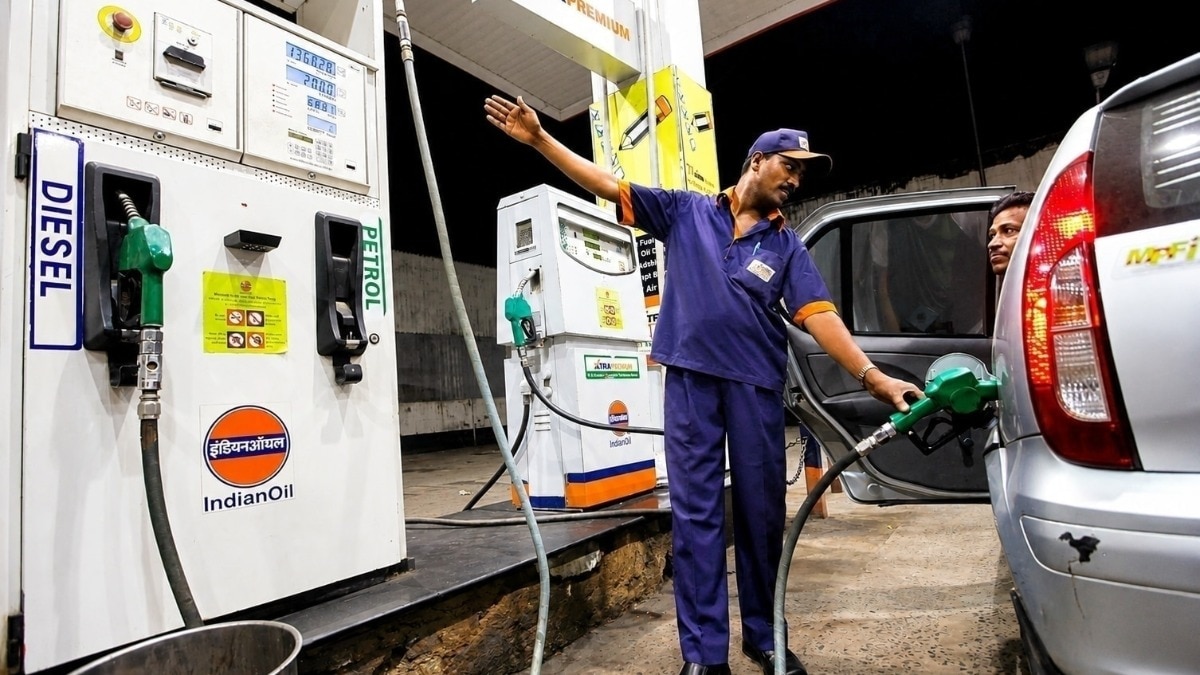
The Centre’s rushed decision to mandate the sale of E20 petrol, which faced resistance from a section of vehicle owners, might now be followed by the return of E10 as an additional fuel option. Days after Chief Economic Adviser V Anantha Nageswaran backed the reintroduction of E10, a report in The Indian Express on Wednesday said that discussions were on within the government to see if E10 petrol could be brought back as an option.
Preliminary discussions have begun within the government and with the automobile and fuel industries on the feasibility of offering E10 alongside E20, The Indian Express reported on Wednesday. The talks come days after Nageswaran backed the reintroduction of E10, particularly for older vehicles, in a piece in the English daily. No decision has been taken yet, and the discussions are at an early stage.
The development is significant because the government had until recently ruled out a return to E10 even as the rushed rollout of the E20 blend — five years before its 2030 — triggered a massive backlash.
E20 petrol contains 20% ethanol and 80% petrol, while E10 contains 10% ethanol. The government said India achieved 20% average ethanol blending in 2025-26 as part of “its efforts to reduce crude oil imports, cut emissions and increase income for farmers”.
However, the E20 rollout led to concerns among owners of pre-2023 vehicles, which aren’t E20-compliant, over mileage and damage to engine components, especially the fuel injection system. Over 80% of the vehicles in India weren’t E20 compliant even as the government mandated 20% blending of ethanol in petrol. People have been demanding an E10 petrol option till their vehicles are phased out.
The government has maintained that there’s no evidence of engine damage caused by E20.
The discussions also come amid growing political criticism of the E20 rollout. Samajwadi Party chief Akhilesh Yadav on Wednesday attacked the Centre, citing Nageswaran’s backing for bringing E10 back as an option for older vehicles.
“Who is right? The government or the adviser?” asked Yadav on X. “E20 petrol is damaging vehicles. The sale of E10 petrol should start again for old two-wheelers,” read a picture attacked in the post shared by the former UP CM.
Congress MP Randeep Singh Surjewala said “the government’s own Chief Economic Adviser had exposed the flaws in the E20 petrol policy.” In a post on X, the Rajya Sabha MP accused the government of “imposing E20 without preparation” and asked why people were being subjected to this “forced experiment”. He asked the Narendra Modi government, “When will normal petrol be available again?”
E10 PETROL RETURN IS BEING DISCUSSED: REPORT
The Indian Express reported that initial discussions were underway to examine whether E10 can again be offered to consumers. The proposal does not involve replacing E20. Instead, the possibility being examined is whether E10 can be sold alongside E20, especially for older vehicles that were designed for lower ethanol blends.
Bringing E10 back would also require the government and oil companies to consider storage, transportation and dispensing arrangements for two different petrol blends.
Nageswaran also urged the Centre to carefully assess the food, feed, land and water trade-offs before pushing ethanol blending further to E27 or E30.
These discussions, which appear to be a step back, mark a change from the government’s stated position.
On July 23, the Petroleum Ministry said, “Having been scientifically validated and accepted by the automobile industry after extensive testing, there is no proposal to revert to E0/E10 petrol. The objective of public policy is to move forward with a superior fuel, not return to an inferior standard.”
The government strongly defended the E20 blend and argued that maintaining different petrol grades would create additional logistical and infrastructure requirements.
The report on the discussions at the government level came days after Chief Economic Adviser V Anantha Nageswaran backed the reintroduction of E10.
CHIEF ECONOMIC ADVISER NAGESWARAN BACKS E10
In a piece in The Indian Express, co-written with consultant Akash Poojari, Nageswaran argued that consumers with older vehicles should have the option of buying E10 while India continues with its ethanol-blending programme.
Nageswaran raised concerns particularly about older two-wheelers whose components were not designed for higher ethanol blends. He suggested that E10 could be offered while a retrofit programme is developed for such vehicles. “India has roughly 75 to 80 million older two-wheelers … older rubber seals that are not rated for ethanol are a separate problem … retrofitting those seals… that way will take years,” the opinion piece said.
New Delhi should “protect the existing fleet while the retrofit programme catches up,” the piece said.
The economist’s intervention was significant because it came from the government’s own chief economic adviser at a time when the Centre has been defending the E20 rollout.
A day later on Tuesday, The Times of India reported that government officials were surprised by Nageswaran’s call to make E10 available for older vehicles.
The officials told the newspaper that there had been no discussion within the government on such a move until then. They said selling E10 alongside E20 would be difficult because it would require additional infrastructure and create issues around pricing and distribution. An official also argued that offering E10 could be seen as an admission that E20 was unsuitable for older vehicles, a claim the government rejects.
WHY E20 PETROL HAS FACED A PUSHBACK
The E20 rollout faced criticism from motorists over reduced mileage and concerns about its impact on older vehicles.
The government acknowledged that vehicles designed for E10 could see some reduction in fuel efficiency when running on E20. However, it has rejected claims that E20 was causing widespread engine damage and said testing and data from the automobile industry did not support such claims.
The Centre has highlighted the economic benefits of ethanol blending. It said that the programme reduced India’s dependence on imported crude oil, saved foreign exchange and provided an additional source of income for farmers. However, the government forcing a single blend on vehicles designed for different fuels, has attracted criticism.
Motorists have also been hit due to the hasty implementation of the E20 blend. Some have complained about lower mileage and others have just highlighted the lack of choice. Meanwhile, a citizens’ pressure group led by political commentator Tehseen Poonawalla, Team Bharat, campaigned against mandatory E20 and demanded choices for consumers, like the availability of E10 for E10-compatible vehicles. The group also held meetings with the Petroleum Ministry over its demands and announced protests. It, however, stressed that it was not opposed to ethanol, but to making E20 the only option, that too, too fast.
Questions have also been raised about the government’s claims on foreign exchange savings, farmer benefits and the economics of ethanol.
So, the government, therefore, is not considering abandoning E20. The discussions are about whether consumers, particularly those with older vehicles, should also be given the option of E10. Now, the return of E10 is under discussion. But with the government’s chief economic adviser supporting the idea and preliminary talks now underway, a fuel blend that the Centre had ruled out could be offered to motorists once again.
– Ends
Published By:
Sushim Mukul
Published On:
Aug 19, 2026 16:26 IST