WARNING: Graphic content and distressing images.
Coming across carnage is the daily reality for livestock farmers dealing with dingoes in rural Victoria.
The predators have extra protections in the state’s northwest where they are endangered, but the distinction between dingoes and wild dogs is part of a long-running debate between conservationists and farmers.
Sign up to The Nightly’s newsletters.
Get the first look at the digital newspaper, curated daily stories and breaking headlines delivered to your inbox.
By continuing you agree to our Terms and Privacy Policy.
The costly problem pulls not just at purse strings but also at heart strings — one one hand, sheep so badly maimed it can move a hardened farmer to tears.
On the other, dwindling dingo numbers straining deep and ancient kinship bonds held by First Nations groups.
It’s a problem with few solutions.
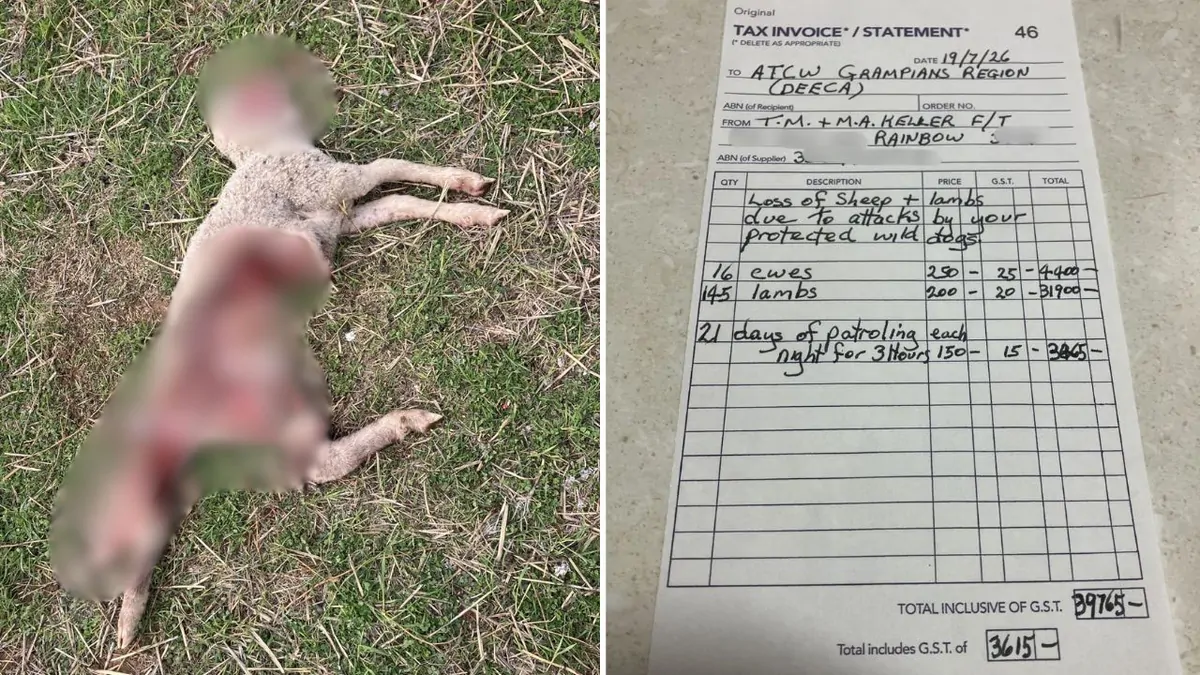
And it’s one which has moved farmer Scott Keller to invoice the Victorian Government for nearly $40,000 over his losses after dogs recently killed more than 160 and sheep and lambs on his property at Rainbow, in the state’s northwest.
Keller has applied for a permit to kill and dispose of three dingoes, which he believes are actually wild dogs undeserving of the native species protection they are receiving.
Amid his fears the permit will not be approved, he struggles to know how to continue farming livestock in the area.
“There was one ewe that had been attacked that we had to put down — it had the udder eaten off of it and its guts were nearly hanging out the back between its legs,” he told 7NEWS.
“At that point my father broke down … that’s a bloke who has been farming for 55-odd years and seen a fair bit of crap in his time.”
Keller’s 72-year-old father had begun spending his nights watching the flock, even purchasing a $3000 thermal monocular when the problem continued to get worse over the past six months,.
But his efforts yielded little results.
“In six weeks we’d lost 33 lambs,” Keller said.
“It’s fairly disheartening.”
Scott Keller has invoiced the government nearly $40,000 for his losses after dingo or wild dog attacks on his farm in Victoria’s northwest, where the at-risk dingo population have extra protections. Credit: Supplied
Keller doubts the dogs are dingoes — he told 7NEWS.com.au “these are nothing like we’ve ever seen before”.
But the debate over the distinction between dingoes and wild dogs has long existed at the intersection of agriculture and conservation in Australia.
Victorian Environment Minister Enver Erdogan acknowledged the “ongoing debate” when Member for the Eastern Victoria Region Melina Bath questioned him about a spike in livestock attacks in areas of her constituency.
“Since coming to the portfolio, I’ve (had) to familiarise myself with the distinction between wild dogs and dingoes,” Erdogan said.
Member for the Eastern Victoria Region Melina Bath questioned Victorian Environment Minister Enver Erdogan over impact of dingoes on livestock farmers in northwest Victoria. Credit: Victorian Parliament
He said genetic testing has revealed “many of the alleged wild dogs in regional Victoria … are, in fact, dingoes”.
“We as a government recognise that dingoes are a protected and culturally significant native species,” he said.
“We also acknowledge the serious impacts they do have on livestock.”
The Victorian Dingo Unprotection Order established in 2024 to remove protections over dingoes where livestock are at risk, thereby allowing certain control methods, excludes the state’s northwest “due to the risk of extinction of its local dingo population,” according to the Victorian Government.
“In the northwest of Victoria the focus is on conservation because the Mallee dingo population is at imminent risk of extinction,” Erdogan said.
“This is a real biodiversity travesty, so we need to take steps to protect them.
“In eastern Victoria the situation is different … I think the settings are appropriate in the circumstances.”
Keller believes the dingoes killing livestock on his property are actually feral dogs or hybrids. Credit: Supplied
Genetic testing in 2023 of a sample of wild dingoes and dogs in Victoria found 87 per cent had pure dingo genetics.
Since then, Bath said in parliament, attacks on livestock have increased by 80 per cent, while the agricultural industry argues the genetics data is out of date.
While Keller has suspicions about the genetic variations of dingoes in the northwest, he has no doubts about the bloodline of his merino flock and the price one pays for purity.
“Our sheep are self-replacing merino. Som this is a bloodline that’s been going for 40 years to 45 years,” he said.
Self-replacing merino farmers use a breeding system that focuses on females. Ewe lambs are monitored and the best are kept to replace the older ewes, to maintain the best traits of the bloodline, rather than buying in replacements from outside flocks.
This means the business losses related to dingo or dog attacks on female lambs do not just include wool sales but also the future of the farmer’s breeding system.
Keller said the constant discovery of mauled sheep is not just distressing, it is destroying his farming operation. Credit: Supplied
As the state government finalises details for a $2 million support package targeting the problem in the northwest, Keller said that, on the ground, the viability of sheep farming in the region is a “hot topic”.
“There’s not many people with stock left up our way,” Keller said.
“Do we just go and sell all the stock and get rid of them all out of the district altogether?”
On the other side of the debate, Erdogan said the dingo eradication risk is a problem which runs deeper than money for some people.
“The dingo, to many Traditional Owner groups that I’ve spoken to, is not just a native species,” he said.
“We’re talking about kinship. It’s a totem animal, it’s part of family for many Traditional Owners.”