

Local News
Rep. Stephen Lynch and his primary challenger Patrick Roath debated topics like healthcare reform, immigration, and more.
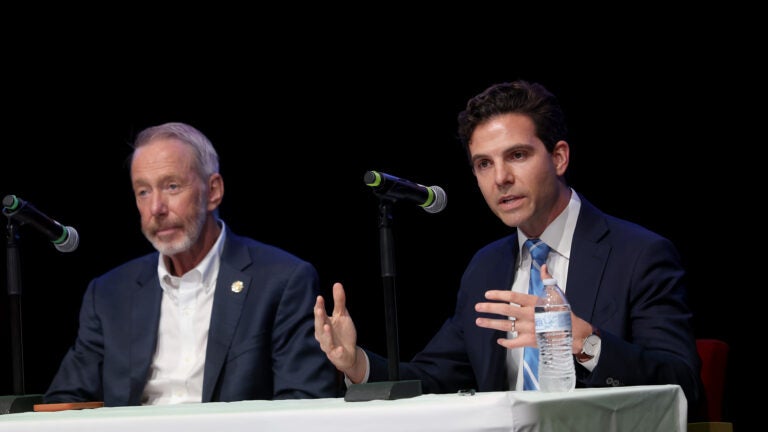
Eighth Congressional District candidates Patrick Roath, right, and Rep. Stephen Lynch took the stage for a candidate forum in Chapman Middle School in Weymouth. Ken McGagh for The Boston Globe
Rep. Stephen Lynch and his challenger, Patrick Roath, shared a stage in front of voters for the first time Thursday, with less than three weeks to go until the primary elections.
The Democratic primary for Massachusetts’ Eighth District pits a longtime lawmaker against a well-funded political newcomer. Both participated in a candidate forum hosted by the League of Women Voters of Hingham at Chapman Middle School in Weymouth this week. While the two share multiple similarities in their policy positions, key differences emerged throughout the forum on a number of topics.
Here are three takeaways.
The need for generational change
Like other high-profile races in Massachusetts and around the country, the Democratic primary between Lynch and Roath is an intergenerational battle. Lynch, 71, was first elected to Congress in 2001. Roath, a 39-year-old lawyer and voting rights advocate who previously worked as an aide to Governor Deval Patrick, is taking his first stab at running for elected office.
Roath emphasized the age difference between himself and Lynch throughout the forum, framing himself as part of a younger generation ready to bring creative solutions to Washington. He decried the Trump administration’s “extremist” agenda and spoke about how that threat necessitates a new kind of proactive leadership.
Roath said he wants to fix the “broken and corrupt” system of politics practiced in Washington by enacting term limits and removing “corporate PAC money.” When asked about his top priority if elected to Congress, Roath spoke about being a new father and advocated for universal childcare.
“I’m convinced that the path forward is going to look different than the past, and we cannot keep just retreading the same thing, we can’t keep sending the same people down, and we can’t trust that the system that got us here is going to continue to deliver,” Roath said.
Lynch portrayed himself as a longtime fighter for the working class. He spoke about his youth in Boston’s public housing and his history as an ironworker and labor leader. Lynch has used his experience to bring back copious amounts of federal funding for the district, he said. These dollars funded ferry service, improvements to Red Line stations, the addition of below-market housing, and the construction of seawalls, he added.
Lynch pitched voters on his ability to accomplish more should Democrats regain control of Congress, like they did from 2021 to 2023.
“I accomplished much of that as a member of the minority party in Congress. You can only imagine what we can do together if the situation changes,” he said.
Lynch said that he is the best candidate to take on the wealthy and powerful cryptocurrency and artificial intelligence industries. He warned about the growing influence of AI leaders in Washington.
“Money in politics is probably the most insidious impact and danger to our democracy right now,” Lynch said.
Healthcare and the role of Obamacare
Healthcare, the Affordable Care Act, and the role of private equity in the industry were all notable topics of discussion.
Roath attacked Lynch for voting against the ACA’s passage in 2010. He praised the “historic” law and said that Democrats need to use it as a building block for the future.
“We made progress with the ACA, and we need to defend it, improve it, push further, not be an obstacle to getting it done,” Roath said.
Lynch said that he had antitrust concerns with the ACA at the time and called for lawmakers to “revisit” the landmark legislation now. He pointed to the relatively low percentage of Americans currently enrolled in ACA plans as proof that the system is too expensive.
“We need something better than the Affordable Care Act,” Lynch said.
“If you want to repeal the ACA, go with the Republicans,” Roath responded soon afterward.
Any sort of reexamination of the ACA “might” involve “Medicare for all” policies, Lynch said.
Roath explicitly said that he would cosponsor legislation that would enshrine Medicare for all. He said that the standard age to qualify for Medicare should be lowered, and that Medicaid should be expanded.
Roath spoke about getting “the private market out of healthcare,” which led to one of Lynch’s most direct attacks of the forum. Lynch criticized Roath for his history working at Ropes and Gray, a law firm that bills itself as “one of the largest and most sophisticated private equity practices in the world.”
“The last 10 years, he’s been advising private equity, and I’ve been trying to clean up the mess afterwards. That’s what infuriates me. This is so rich,” Lynch said.
Lynch pressed for the separation of private equity from the healthcare industry, blaming these firms for buying up hospitals and prioritizing profits instead of patient care.
He sought to tie Roath’s work history to the much-derided Steward Health Care, which filed for bankruptcy in 2024. Multiple hospitals, including two in the Eighth Congressional District, closed in the wake of the bankruptcy. Roath said he has never worked with and has no connection to Steward.
Immigration and ICE
Lynch was the sole member of the Massachusetts Congressional delegation to vote in favor of the Laken Riley Act early last year. The law directs the federal government to detain and deport undocumented immigrants who have simply been accused of certain crimes. Many Democrats and advocates have criticized the law as a cynical exploitation of tragedy for the purposes of expelling more immigrants from America.
Roath called Lynch’s vote “disqualifying” and said that his opponent had bought into the Republican playbook of scapegoating immigrants.
Lynch, like Roath, called for “comprehensive” immigration reform and spoke about his support for the DREAM Act, a longstanding proposal to protect immigrants who came to the country as children from deportation. He used strong language to blame President Donald Trump for increasing anti-immigrant rhetoric in America.
“When Trump says immigrants are poisoning the blood of our nation, your Nazi alarm should go off,” Lynch said.
Speaking about ICE, Roath said the agency should be “dismantled” and that it has “outlived its purpose.” Prosecution and jail time should be on the table for ICE officials, he added.
Lynch blamed Trump for using the agency in illegal ways. He took credit for repeatedly voting to defund ICE, saying that a bill he cosponsored would have “completely reengineered” ICE by forcing agents to remove their masks and use body-worn cameras.
Ross Cristantiello
Ross Cristantiello, a general assignment news reporter for Boston.com since 2022, covers local politics, crime, the environment, and more.
Sign up for the Today newsletter
Get everything you need to know to start your day, delivered right to your inbox every morning.
