Movies
Ahead of a Cape screening Aug. 16 with documentarian Mischa Richter and actor Chloë Sevigny – and more New England dates coming– we sat with Richter to talk Dead.
A still from the documentary “Summer Tour.”
August 13, 2026 | 5:38 PM
10 minutes to read
COMMENTARY
Since our earliest days — faces smeared with pigment and animal fat, bare feet dirty and dancing — music has offered humans the same salve and rapture as religion.
Sound glued us into tribes, moving us in one beat around fire. Did something profound and intangible for our psyche.
I think of Bob Dylan’s “Last Thoughts on Woody Guthrie.”
“You’ll find God in the church of your choice/ You’ll find Woody Guthrie in Brooklyn State Hospital/And though it’s only my opinion/I may be right or wrong/You’ll find them both/ in the Grand Canyon at sundown.”
In covering Dead & Co. over the years, that oft-quoted line from writer/mythologist Joseph Campbell’s 1986 lecture has popped into my head. The late Dartmouth College alum said he was at a Dead concert with 8,000 people “all standing for five hours in a rapture…We had an awakening of the kind that the great religions first intended…This I would say is the answer to the atom bomb.”
And, I think of late Harvard Professor-turned-guru Ram Dass, who said: “I think a Grateful Dead dance is a ritual. It’s a very deep, profound ritual. It’s one of the longest-lasting new religions in this society.”
These three passages swirled in my head watching Cape Cod director Mischa Richter’s doc, “Summer Tour.”
Since the ‘60s, the siren song of the Grateful Dead has tapped that ancient root. Created a nomadic tribe of dancers and makers, a community based on acceptance that outlived the band itself. It is the answer to the atom bomb.
And, it is the crux of Richter’s film, co-produced with his longtime friend /Connecticut high school sweetheart, Chloë Sevigny. The New England native and Oscar nominated actor is a hardcore Deadhead.
In “Summer Tour,” Richter, 54, a Provincetown-based filmmaker/photographer/Deadhead, has created an ode to Dead culture, community, the idealism of American youth, and the power of music. His sophomore doc, which premiered at Telluride in ’25, follows two young Deadheads around the country as they follow Dead & Co’s final tour in ’23.
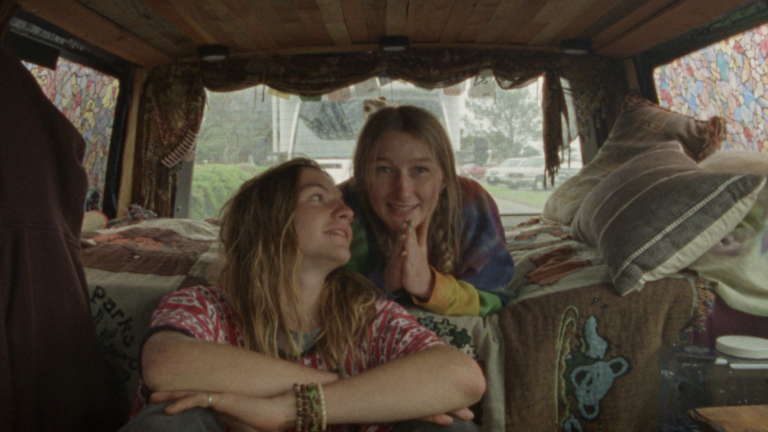
Jeremiah “Jerry” Pierce, and Annie Dunn are 20, all dirty blonde hair, dirty bare feet. They live in a camper van, complete with bed and cat. They skinny-dip near highways and in wooded swimming holes. Jerry plays guitar in a tree, and busks in Boston. In Dead speak, they’re wooks. And, bathed in Richter’s warm light, they look like your parents or grandparents might’ve looked in old Woodstock footage.
I heard echoes of Campbell when Pierce tells us, “Every single male in my family has served in the military. And I was expected to do the same. And I chose a different path.”
Now the lead guitarist in Grateful Dead tribute band Mason’s Children, Pierce says his family went to church, but he never found community there: “I found God in my own way.”
Throughout the film, we see Dead culture brought to life: dreadlocked dancers, harmonic players; people face-painting, rolling thick joints, making “lot cheese.” (Grilled cheese vendors are a Shakedown staple.)
Whether you’re a Deadhead or wouldn’t know lot cheese from green cheese, “Summer Tour” captures what so many of us love and have loved about Dead culture. It’s not too late to get on the bus.
Jerry Garcia died years before Pierce and Dunn were born. But, Dead & Co., lead by late great Bob Weir with Dead drummer Mickey Hart— along with New England’s own John Mayer, Oteil Burbridge, Jay Lane, and Jeff Chimenti — gave us one helluva final tour in ’23, including one last Saturday night at Fenway.
Before he died, Weir spoke of the 300-year vision: that the Dead’s music would be played and enjoyed for that long.
Richter tells me he was “naive” in thinking he’d capture “the drama of the end. This ain’t going nowhere.”
In Jerry and Annie, we believe it.
THE INTERVIEW
Catch Richter and Sevigny in a Q&A Aug. 16 at a film screening at Cape Cinema in Dennis. Tickets here. While the film will likely stream at some point, Richter says, it’s currently playing on a city-by-city basis.
I’m told the doc will also screen Aug. 27 at United Theatre in Westerly, Rhode Island, (stay tuned for ticket info) as well as Sept. 3 at Barrington Hall in Great Barrington. Both will feature Richter in a Q&A.
I called the longtime Provincetown resident to talk all things Dead.
Boston.com: So, you and Chloë dated in high school in Connecticut, and got into the Dead at the same time. I want to ask more about that — but to go back a bit here: you had an interesting childhood. Your dad, Dan, from Connecticut, was a mime and played an ape in Stanley Kubrick’s 2001: A Space Odyssey (1968).
Richter: Yeah, being a mime is how he got the job with Stanley Kubrick. He choreographed the “Dawn of Man” sequence in that movie. My father was also good friends with Yoko and John Lennon in England, and worked for them. So I spent the first 18 months of my life in Tittenhurst [Park], their estate in England.
Then we moved into the Chelsea Hotel. I lived there until I was about 5. Allen Ginsberg, Gregory Corso — I was brought up amongst these filmmakers and artists and writers.
Then my mother left my father and took my brother and I to Provincetown. Again, there were so many artists here. I was very close with my grandfather — a cartoonist and a painter. I went to lots of different high schools — one was in Darien, Connecticut where I met Chloë.
Wow. I can see how you became an artist. You’re also a photographer.
Right, I worked on a pretty intensive project in Provincetown. I was searching for my identity within this town.
That was “I Am a Town,” which you eventually made into a 2020 documentary. I see both of your films as your homes: Provincetown, and the Dead community.
Yes, the Dead community is my second home and family. I see myself more as a visual artist and I tend to talk about things that mean a lot to me. Things I have an understanding of personally.
How did you and Chloë get into the Dead?
The Dead infiltrated our punk /skater/New Wave crew [laughs.] We started getting into the music, taking psychedelics. The first tape I heard was Hartford ’84. There was a Scarlet / Fire on there that just talked to my soul. Then when I heard “One From the Vault” with Bill Graham introducing the band, there was no looking back.
We went to our first show together in September of ’90 at Madison Square Garden. We actually snuck in: Chloë realized that before they took tickets, there were doors without handles— but if you put your hand underneath, you could pull them open. So 20 of us piled in.
[laughs] Amazing. What made you feel “I found my people”?
Once I saw there was a whole community around the music, I loved that the scene was about being kind, acceptance. You could be different, and you were pulled right in and celebrated. At that time, I was looking for a place where I felt I belonged. I loved the idea of this moving community.
It does feel like a nomadic tribe. You said you were 17 when you heard your first tape. Chloë was in your same grade?
No, she was a little younger. We split because of that — she wasn’t done with high school, I was. It was a very sweet breakup, and we stayed in touch. We went to Fair Thee Well [the Dead’s 50th anniversary celebration] together. My wife and her husband agreed it was great that we went together. [laughs] So we’ve stayed in touch all through our lives.
You met Jerry and Annie at a Wolf Brothers [Bob Weir’s other band] show in New Haven.
Yeah, we danced together, didn’t really talk. But we really connected through dancing. Then I went out to San Francisco to Bob Weir’s 75th birthday show, and Jerry and Annie came up and said, “Hey!”
Oh wow, talk about a nomadic tribe.
I didn’t want to make an informational documentary about the Grateful Dead. Amir Bar-Lev did an incredible job with “Long Strange Trip.” He’s done it. I wanted a focus. So when they walked up, I thought, “That’s what it could be!” Because I could tell they were deep in it. I recognized my younger self in them.
How did that work? Just, “Hey guys, I think you’d be great subjects for my movie?”
[laughs] Yeah, I sent them a link to my [first] movie, and explained my style of filmmaking, how I wanted it to be through their eyes, and they thought it was groovy. [laughs] They saw they could trust me.
Jerry sent me clips of him playing, and I realized he really knew the catalog. I thought that was a great vehicle — the music wouldn’t just come from the band, it could also come from Jerry.
A still from “Summer Tour.”
At that point, you asked Chloë to get involved.
She opened quite a few doors— and in the end, she got involved a bit artistically. She introduced me to Jay Rabinowitz, who became our editor. He’s a Deadhead, and the greatest editor — “Requiem for a Dream,” “8 Mile,” “Tree of Life,” the list goes on. He’d edited one of Chloë’s short films, and she clocked he was a Deadhead. He put his heart into this. We’re now brothers.
So in condensing more than two months of footage, what was a narrative you were trying to tell in the editing room? I loved that you went into the makers on Shakedown [the pop-marketplace at every Dead show]. I’ve always thought Shakedown could be its own documentary.
I just wanted to immerse people in the tour experience, which for me is way beyond a band on stage. And within that, there’s this feeling of, ‘Oh, you can be kind to people.” [Deadheads] focus on fun, inclusion, and being kind. What a beautiful thing.
I also wanted to highlight the positive aspects of youth in American society. At these shows, I was dancing and hanging with these kids who seemed so positive and creative and not stuck on their phones.
Also, I’m proud of this country and being American, and this community helps me feel that pride. It’s so American. The catalog is all these genres of American music, and this American idea of hitting the road and traveling and taking the opportunity.
I loved the way the film looked. There’s a certain warm coloring that in itself conveyed that narrative of American idealism, youth, peace. We as viewers tend to understand sepia and warmth as cues for nostalgia. “This is from the ‘60s, this doesn’t happen anymore.” So it was almost like seeing the world through new eyes, or showing people: this world still exists if you see it in a certain light.
Exactly. We did a little bit of coloring to give it warmth and this feeling of being immersed in it. We’re following a band in the year 2023. But then, once you’re immersed in it, I wanted people to feel like: “Wow, this could be then.” That was the other thing I wanted to show: that this is something that started 60 years ago, but it’s still happening. And it’s going to go on.
A still from the documentary “Summer Tour.”
Speaking of that, Bob Weir always talked about the 300-year idea, that the Dead’s music will exist 300 years from now. I interviewed Dead archivist and legacy manager Dave Lemieux, who told me he was determined to make that happen. So it’s a beautiful transition for this story to release right before Bob died.
I hope Bob Weir saw this, but I’m afraid to ask. I’m afraid to know if he never saw it. Because I feel like he would think “Oh yeah, this isn’t going anywhere.”
When they announced the final tour, I thought: “Oh, there’s all this drama! The final tour! It’s all over!” I was looking for a reason to make this film, so I was holding on to that drama. Really, I was being naive. This ain’t going nowhere.
Jerry and Annie are what people might think of as typical hippie Deadheads, but there are so many different kinds of fans. So I appreciated that you had “Tales of the Golden Road” radio show playing in their van: Gary Lambert and David Gans serve as your Greek chorus.
Yeah, we wanted something to narrate you through. With “Tales of the Golden Road” callers, one guy says, “What’s a Deadhead?” And Lambert and Gans are like, “Well, anyone can be a Deadhead.” We thought it was a way to address what you just asked about — there are people from all over.
What do you hope the Dead-curious take from the film ?
That Deadheads are hardworking; they have an understanding of commerce, like learning an art. Deadheads aren’t just burnouts getting high. They have real initiative, they work hard, they understand community, and how communities can sustain, and teach and learn.
Some people have a stereotype going into the film of what a Deadhead is, and I’d like them to come out and think, “Actually, these are pretty resourceful people, welcoming in people that are different and accepting them and helping them. Also this tradition of fun. That spirit continues now with bands like Dark Star, Phish, Billy Strings. I want some young kid that watches their phone screen nonstop to see this and think, “Wow. I want to do that.”
To pick your brain: what are favorite Dead shows you’ve seen in New England?
One of my favorite Dead & Company shows was in Foxborough. There was a big rainstorm.
Oh my god, I was there! It downpoured during set 1, and they had to stop.
I love when the band is forced to do one big long set. I feel like they really go for it. That was one of the great shows from Dead & Co. We also use a track from Fenway, “Dark Star,” in the film. They always delivered in Boston.
Interview has been edited and condensed. Lauren Daley is a freelance culture writer. She can be reached at [email protected]. She tweets @laurendaley1, and Instagrams at @laurendaley1.
Lauren Daley is a longtime culture journalist. As a regular contributor to Boston.com, she interviews A-list musicians, actors, authors and other major artists.
Sign up for the Today newsletter
Get everything you need to know to start your day, delivered right to your inbox every morning.