Local News
The automated license plate reader system is also facing questions in a small Plymouth County town.
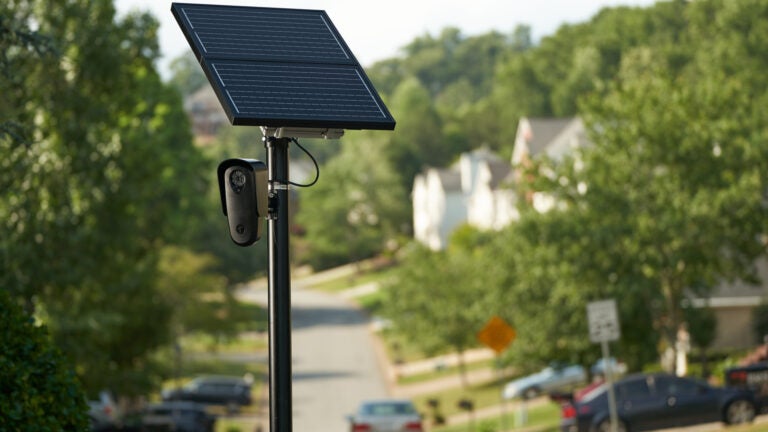
A Flock Safety camera in Providence, Rhode Island. Flock Safety
New Bedford has temporarily suspended its use of Flock cameras as the automated license plate reader system comes under increased scrutiny in many communities.
The New Bedford Police Department has used Flock Safety cameras since 2024. The department will temporarily suspend its use of the cameras and review its use of the system to assess whether it should continue to be used in the community, the department said in an announcement.
“Our responsibility is to ensure that any technology used by the department supports public safety while protecting the members of the community we serve,” Police Chief Jason Thody said. “Flock can be a valuable investigative tool, but we also recognize that technologies like this raise legitimate questions about privacy, access, information sharing, and oversight.”
The review will include an examination of Flock’s use in past criminal investigations and an assessment of the technology’s role in supporting public safety, the department said.
The New Bedford Police Department also said that, “based on recent technology audits,” authorities have opened internal investigations and that one officer was placed on administrative leave. The department is not releasing additional information regarding that investigation at this time, police said.
“We need to make sure that if we continue using this technology, we do so responsibly and in a way that serves the public,” Thody said in the announcement. “This and other emerging technologies can have positive impacts on safety, but must be implemented with caution and due diligence.”
Police did not respond to a request for comment regarding whether the cameras would be physically taken down during the suspension or how long the review process is expected to last.
New Bedford becomes part of a growing debate over Flock cameras
A growing number of Massachusetts communities have reconsidered their relationships with Flock Safety, with some deciding not to renew contracts with the company.
In a recent high-profile incident, the technology was used to assist law enforcement in investigating the December 2025 mass shooting at Brown University and subsequent killing of a MIT professor in Brookline. But, opponents have raised growing concerns over privacy and civil liberties, questioning how the cameras and the data they collect are overseen and accessed.
Last month, Salem abandoned its use of the cameras. Framingham police announced in June that the city would not renew its contract after months of public debate and resident advocacy.
In October of last year, the Cambridge City Council voted unanimously to pause the use of Flock just months after approving them. After Flock installed two more cameras in late November “without the City’s awareness,” Cambridge officially ended its contract the following month.
In other communities, including Natick and Watertown, residents opposed to the cameras’ use successfully pushed back on Flock during installation plans and pilot tests.
Flock Safety has maintained that its system does not use facial recognition and that customers control the data collected by their cameras. Data sharing is not enabled by default, the company said, and data is automatically deleted after 30 days unless a customer changes the retention period.
In a statement to Boston.com on Tuesday, a Flock Safety spokesperson pointed to more than 40 courts across the country determining license plate readers do not violate the Fourth Amendment and said the technology cannot track the entirety of an individual’s movements.
“We understand why residents have questions about data and privacy,” the company spokesperson said. “We believe public safety and privacy must coexist, and communities should have clear rules, transparency, and meaningful oversight as they decide how this technology is used.”
East Bridgewater considers Flock — but residents have concerns
Now, the debate is playing out in East Bridgewater, a Plymouth County town southeast of Boston.
The East Bridgewater Police Department and Select Board first met in June to discuss implementing Flock cameras in the town. The Select Board held another meeting in July to formally discuss the proposal, Police Chief Michael Jenkins said during a public forum Monday evening after residents raised concerns about cameras.
Jenkins, Deputy Chief Michael McLaughlin, and the Select Board attended the forum, which was intended to give residents an opportunity to ask questions about the technology and implementation.
“If I thought it wasn’t a good tool to assist my men and women of my fine department, we wouldn’t have presented it to the board,” Jenkins said. “Now we are here obviously to listen. We’ll answer any questions that we can. This is not going to be a debate.”
The town’s three-year contract would be paid for with federal funds and would not be included in the town’s budget, according to Select Board Chair Carole Julius.
Four cameras would be installed at locations around the town. Jenkins said they would be “strategically placed surrounding the outside” of the community but did not specify exactly where.
Before the meeting, the police department developed a written policy governing the use of the system.
The policy says Flock cameras would be used for official law enforcement activities, including identifying stolen vehicles and missing people. The policy also establishes a 30-day data-retention limit, requires annual audits of system use, and prohibits personal use or discriminatory practices.
“Technology is really problematic when it comes to law enforcement,” Katie McMullen, a resident who spoke at the forum, said to Jenkins. “You feel like you’ve looked at every angle, but you’re looking at it through the lens of law enforcement.”
Peggy Steele, another resident, raised concerns about potential risks associated with the surveillance system, including misuse, government overreach, and data breaches.
“These include, but are not limited to, misuse of the system by bad actors, the threat of government overreach, and the vulnerability of digital systems to leaks and data breaches,” she said, citing examples including an internal audit in Savannah, Georgia, that found 127 “inappropriate” Flock searches earlier this month.
Before installation, Steele asked the town to make additional information about the system and its safeguards available to the public.
“What is the documented procedure for disciplinary action for any person who misuses the system for nefarious purposes or personal gain? Will the public be notified when this occurs?” Steele asked.
Katie Sheridan questioned which agencies have access to the data and whether policies would be in place to prevent “inappropriate searches.” She also criticized what she described as a lack of communication from the police department and Select Board about the contract.
“Communication has been minimal — minimal and inconsistent at best, so we deserve transparent communication,” Sheridan said. “We haven’t gotten that.”
Throughout the meeting, Jenkins maintained that Flock cameras remain a “valuable tool” for law enforcement. McLaughlin also emphasized that, if an officer does misuse the system, they could face termination.
“It’s to see what’s coming in your town and if it’s somebody that shouldn’t be in your town and they’re committing crimes in your town, we can we have a better tool to help prosecute that person,” Jenkins said. “It’s not to track anybody … It’s going to be oversight.”
Sign up for the Today newsletter
Get everything you need to know to start your day, delivered right to your inbox every morning.