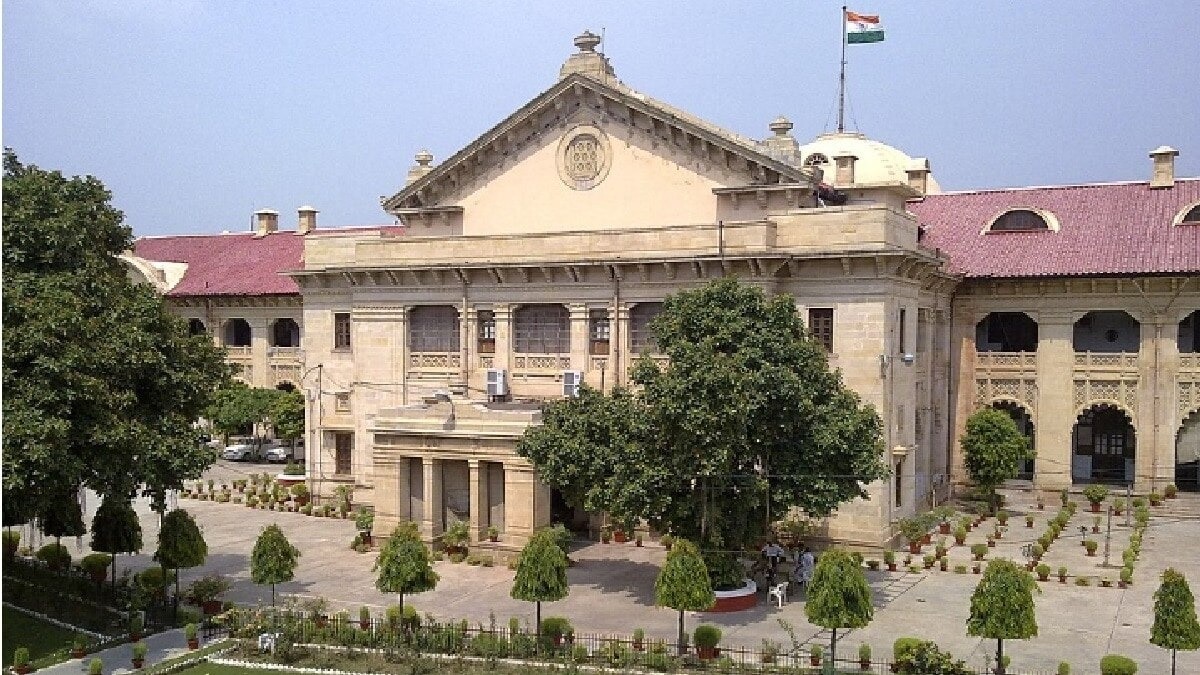
The Allahabad High Court has ordered the father of two adult women and the Uttar Pradesh government to pay Rs 25 lakh compensation after holding that the sisters were illegally confined at their parental home after deciding to convert to Islam. The court said both women were free to live wherever they wished and with any person of their choice, without interference from their father, the state or anyone else.
Allowing a habeas corpus petition concerning Diya Bhatia alias Zoya Diya Bhatia, 20, and Anshu Bhatia alias Amina Anshu Bhatia, 35, Justice Sandeep Jain said the father and the state were jointly and severally liable to pay the compensation within eight weeks. The amount is to be shared equally by the two women.
The order came after the women told the court that they had embraced Islam voluntarily, Anshu in 2020 and Diya in 2021, out of their own faith, conscience, mental peace and spiritual solace. They said their decisions were not the result of force, fraud, coercion, undue influence, inducement or allurement. They alleged that their father then confined them at the parental home against their wishes because they had changed their faith.
After interacting with both women, the court said their responses were “spontaneous, coherent and unequivocal” and that there was nothing to suggest either of them was acting under coercion, fear, inducement or undue influence. The court held that, as majors, both women had full legal capacity to make decisions about their lives.
It observed, “Once an individual attains majority, the Constitution recognises her autonomy to take decisions relating to faith, belief, residence, association and every other facet of personal liberty, subject only to restrictions sanctioned by law.”
The court said such choice was an essential part of individual autonomy, dignity and personal liberty protected under Articles 21 and 25 of the Constitution, and added that neither the state nor the family could ordinarily dictate or interfere with such a personal decision except within constitutionally permissible limits and the authority of law.
The state had opposed the habeas corpus petition, referring to an FIR filed by the women’s father alleging forcible and deceitful conversion from Hinduism to Islam.
The FIR was first registered under Section 87 of the Bharatiya Nyaya Sanhita, and during the investigation other BNS provisions were added along with sections 3/5(1) and 5(2) of the Uttar Pradesh Prohibition of Unlawful Conversion of Religion Act, 2021. The state argued that the alleged conversion was part of a larger organised conspiracy with implications for the “sovereignty, integrity and unity of the nation” and said releasing the women could affect the ongoing investigation.
The court clarified that the investigation into the FIR would continue strictly in accordance with law and would remain uninfluenced by its observations in these proceedings. It specifically found that the women had been unwillingly confined in their parental home and prevented from exercising their independent choice because they had embraced a different faith.
Justice Jain said that once a person attains majority, parental authority must give way to constitutional liberty and individual autonomy. He added, “Any restraint upon the movement or liberty of such person, except lawful authority, would constitute illegal confinement and amount to a direct infringement of the fundamental rights guaranteed by the Constitution.”
In its 22-page order dated August 6, the court also faulted the state machinery for failing to protect women’s liberty. It said the state, instead of securing their release, had allowed the illegal detention to continue under the cover of criminal proceedings and had, through acts of omission and commission, “lent tacit support to the continued deprivation of the fundamental rights” of the women.
Calling it an “exceptionally grave and egregious violation of constitutional rights”, the court said the case warranted exemplary constitutional compensation.
– Ends
Published By:
India Today Web Desk
Published On:
Aug 11, 2026 17:22 IST