Local News
Sebastian, or “Boston,” was a well-regarded member of the community in the eighteenth century.
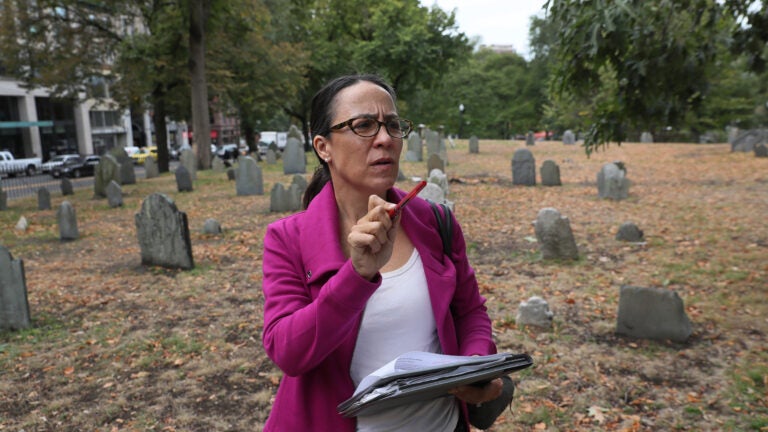
File – Director of Boston’s Historic Burying Grounds Kelly Thomas seen in Boston’s Central Burying Grounds in 2016. David L Ryan/The Boston Globe
Historical preservationists have restored the lost gravestone of a free Black man who died in 1729 after the stone was uncovered at Boston’s Granary Burying Ground, the City of Boston announced.
The grave marker is believed to be the oldest gravestone for a free Black person in the United States. It was discovered by Kelly Thomas, director of Boston’s Historic Burying Grounds during the Boston Parks and Recreation Department’s ongoing conservation project Historic Burying Ground Initiative, the City said in an announcement.
The man, who is identified as being named “Boston” and having died in 1728/29 on his gravestone, was also known as Sebastian in public records, Thomas determined. It seems his name transitioned from Sebastian to Bastian and then to Boston in record books over the years, city officials said.
The gravestone was partially buried, with significant structural damage, and did not appear in a late twentieth-century survey of the grounds, city officials said.
Following its discovery, the gravestone was removed for conservation, and its inscription is now legible for the first time in decades, city officials said. Following repairs and cleaning, the gravestone was returned to the Granary Burying Ground and reset, vertically, in the same place where it was found.
The gravestone of Sebastian, a free Black Bostonian who died in the early 1700s, underwent repairs and cleaning before being returned to the Granary Burial Ground. – City of Boston
“Learning more about Sebastian/Boston’s life illustrates the complex, multicultural and multiracial society that created the conditions from which the American Revolution was born,” Thomas said in the announcement.
Sebastian/Boston was previously enslaved, but obtained his freedom, Gloria McCahon Whiting, author of a 2024 book exploring Sebastian’s life called “Belonging: An Intimate History of Slavery and Family in Early New England,” wrote in the announcement.
He advocated to legally marry his wife, who was also enslaved, in a “years-long campaign,” McCahon Whiting said. He would eventually have six children.
“Evidence suggests that his [marriage] advocacy helped inspire both the publication of New England’s earliest antislavery tract and the passage of legislation in Massachusetts supporting marriage rights for the enslaved,” McCahon Whiting wrote.
City officials shared part of an obituary published in the New England Weekly Journal for Sebastian/Boston on Feb. 24, 1729: “He having born the character of a sober, virtuous liver, and of a very trusty, honest, and faithful servant to all that employed him, and having acquired to himself the general love and esteem of his neighbors by a readiness to do any good offices in his power for everyone; his funeral was attended with uncommon respects, and his death much lamented.”
Sign up for the Today newsletter
Get everything you need to know to start your day, delivered right to your inbox every morning.