Local News
A number of high-profile violent incidents in July has sparked renewed efforts to decrease crime.
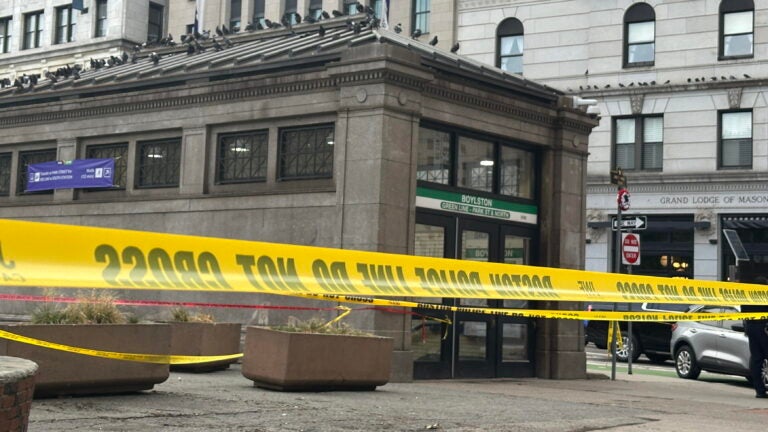
A man was killed near the intersection of Boylston and Tremont streets in July. Bryan Hecht for The Boston Globe
After a string of violent incidents in downtown Boston and a major meeting of local leaders last week, the area is set to see an increased police presence, according to the group that convened the meeting.
Violent incidents, congregant drug use, and other outdoor illicit activity tend to increase during the warmer months. As an influx of visitors came to Boston for events like the World Cup and Sail Boston, the first part of this summer was relatively calm by warm-weather standards. But, as the summer progressed, high-profile incidents continued making headlines.
Three people were shot in the Theater District, a worker was allegedly assaulted near Downtown Crossing, and a fight near the Park Street MBTA station turned into a stabbing attack. Most notably, a Norwood man was killed near the intersection of Boylston and Tremont streets. The murder suspect was arrested after allegedly attacking a second victim with a metal pole near Beach Street.
To address the violence, Mayor Michelle Wu convened a meeting that brought together police, elected officials, and other stakeholders for a closed-door meeting in late July. That led to a larger working session last week organized by the Downtown Boston Neighborhood Association, where 77 attendees representing 48 agencies and organizations met to chart a path forward.
Rishi Shukla, co-founder of the DBNA, credited a similar public safety summit last year with tangible improvements to public safety downtown. But the “regression” seen over the last few weeks made another large meeting necessary, he said.
“We had a great turnaround last season going into the summer, and my hope is that we can finish off August and go into the fall on a high note and hopefully turn this thing back around,” Shukla said.
The most pressing task, Shukla said, is to make people feel safer. To that end, police are stepping up their visibility downtown, with a particular focus on some key areas. This includes Brewer Fountain Plaza in Boston Common, the corner of Park and Tremont streets, the entirety of Winter Street, and the intersection of Summer and Arch streets near Downtown Crossing, Shukla said.
A graphic distributed by the DNBA shows other areas of concern.
A map distributed by the Downtown Boston Neighborhood Association shows “hotspots” of increasing “criminal activity, quality-of-life concerns, and other problematic conditions.”
Spokespeople for the Boston Police Department did not return a request for comment Monday about an increased presence downtown.
On top of the rise in police patrols, the DNBA is working with the city to increase enforcement of city ordinances like those that prohibit encampments in public spaces and the sale of goods on Boston Common without a permit.
The city is removing outdoor furniture on Winter Street and in Liberty Tree Plaza at the intersection of Washington and Essex streets, according to the DNBA. After public programming in these areas lapsed, they became places where open-air drug dealing and other criminal activity could thrive, Shukla said.
The key, not just for certain areas but as an overall mindset for improving public safety, is to pair a robust law enforcement presence with the “activation” of public spaces, he added.
“We know that the single best way to displace these issues and activities is to create positive activation and programming throughout the neighborhood so that it’s not a comfortable place for anybody who wants to commit criminal activities,” Shukla said.
While there are efforts underway to increase the police presence downtown, those could be complicated by BPD staffing shortages. City law requires that the department maintain a minimum of 2,500 officers, but officials said earlier this year that they were down to only about 2,100. Three city councilors filed a resolution last week that called for the city to waive residency requirements for BPD officers, allowing transfers from other municipalities in order to address the staffing shortage. It failed to pass.
On Monday, Councilor Ed Flynn sent a letter to Council President Liz Breadon calling for an emergency session in order to discuss recent public safety concerns and create a plan for the rest of the summer.
“We have to acknowledge the status quo is untenable. Boston is not the safest city in the country. We must include the recommendations and opinions from the public, neighborhood organizations, police and first responders as part of this emergency session and overall strategy,” he wrote.
Ross Cristantiello
Ross Cristantiello, a general assignment news reporter for Boston.com since 2022, covers local politics, crime, the environment, and more.
Sign up for the Today newsletter
Get everything you need to know to start your day, delivered right to your inbox every morning.