Three new law changes – two of which are groundbreaking trials – have been approved and will be implemented this coming season in both the 2026/27 Isuzu UTE A-League and Ninja A-League.
To go through all the slight tweaks, changes and interpretations, Football Australia’s Head of Referees, Jon Moss, sat down with aleagues.com.au’s Senior Reporter, James Dodd.
Check out the brief video explainer below and read on for a full explanation of the new laws and trials.
CLICK HERE TO BECOME AN A-LEAGUES CLUB MEMBER
‘Protocol A’ – Eradicating goalkeeper timeouts
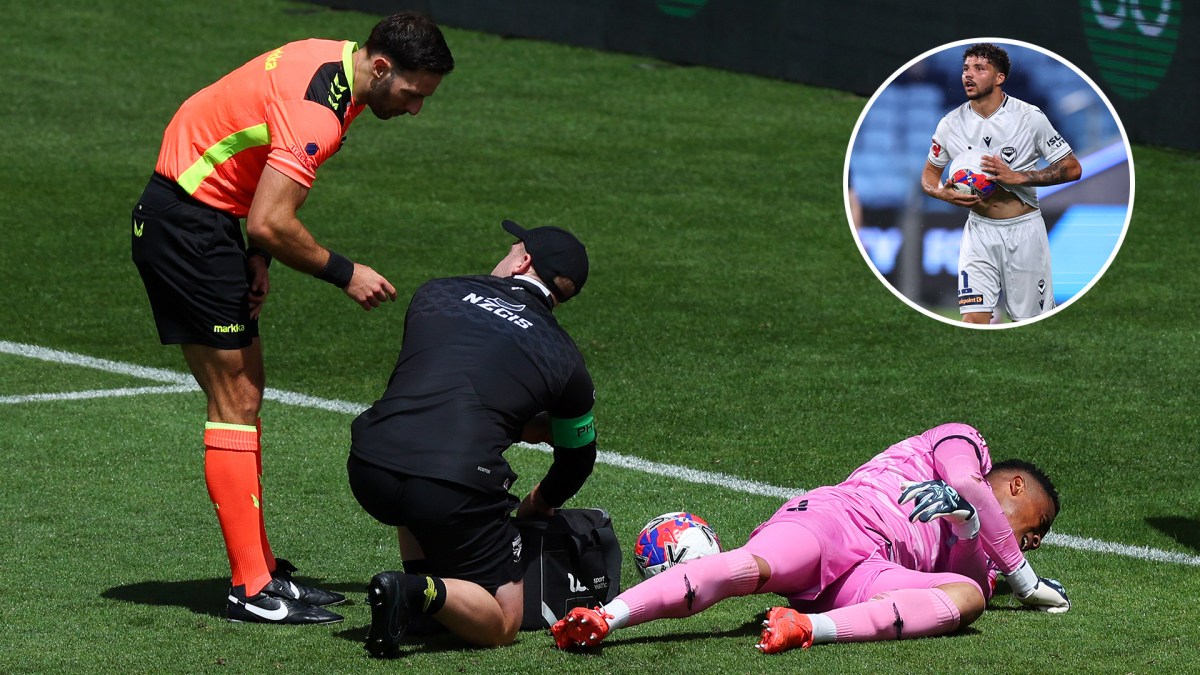
It’s something that’s crept into the game over time but has now become a big issue: goalkeepers deliberately going down with an ‘injury’ in a bid to disrupt the flow of a game and allow teammates to receive tactical instructions.
Well the people in charge of creating, amending, and interpreting the official Laws of the Game – the International Football Association Board (IFAB) – have come up with two solutions, or protocols, in a bid to stamp this out.
One of those will be trialled in the A-Leagues this coming season.
Matthew Sutton of the Glory holds his shoulder following a collision
Protocol B is being used in English football. From the Premier League to the WSL, if a goalkeeper goes down with an injury during the game that isn’t as a result of a foul, then the manager or head coach will have to nominate a player to come off the field for 60 seconds once the game has restarted.
The A-Leagues will be trialling Protocol A, meaning the captain must come off the field.
“So this is when a goalkeeper has an injury, not from impact, (but) just goes down with cramp or something like that which we’ve seen quite a lot in football around the world,” Moss explains.
“When that happens, and the trainer is called onto the field of play, then the captain has to go off the field to play for one minute, and that’s from when play restarts.
“They can then come back on with the referee’s permission after that minute.”
There are exceptions though with regards to whether or not the captain has to go off just because the goalkeeper goes down.
“So when there’s been an infringement and the referee’s given the foul and the goalkeeper stays down injured, then that’s acceptable,” Moss added.
TRANSFER CENTRE: Isuzu UTE A-League 2026-27 Transfer Centre: Your club’s moves
Dean Bouzanis, Goalkeeper for the Brisbane Roar receives treatment
“Obviously there are occasions where the captain could be the goalkeeper. If so, we would ask for the coaches and the teams before kickoff to nominate a player that will go off in that case.
“If the goalkeeper has been injured through a challenge or there’s blood, then obviously the player doesn’t have to go off. It’s more for those times where there hasn’t been any impact.
“But when there’s been a direct challenge or there’s a concussion element to it, or there’s blood on the goalkeeper, the player doesn’t go off.”
This new trial will commence in Matchweek 1 of both the A-League Men and A-League Women competitions.
Five-second throw-ins and goal kicks
As was witnessed in the 2026 FIFA World Cup, A-Leagues officials will this season be clamping down on time-wasting when it comes to both throw-ins and goal kicks.
The equation is simple: As soon as a player taking a throw-in has the ball in their hands the referee will begin a five-second countdown. The same will apply when it comes to goalkeepers taking goal kicks.
“So as soon as the player picks the ball up or the goalkeeper places the ball down for a goal kick, the referee will – like he or she does for when the ball is in the goalkeeper’s hands – there will be a very big verbal ‘5, 4, 3, 2, 1’ countdown,” Moss confirms.
TROPHY HUNT: A-Leagues clubs learn their fate as Aus Cup Round of 16 draw confirmed
Francis de Vries of Auckland prepares to throw the ball in
“And if the ball is not in play at that point, when we get to zero, then the the throw-in goes to the tother team, and the goal kick becomes a corner.
“In the World Cup, we saw very small amounts of of that happening and changing over, so again it’s more just to speed play up and make players aware of that.
SAMBA SIGNING: Melbourne City sign experienced Brazilian midfielder on season-long loan
“We’re not going to be super pedantic about that.
“You saw, I think it was (Scotland’s) Andy Robertson in the World Cup not picking up the ball and therefore thought he could get away with the count. But clearly, if someone is standing there and not picking the ball up, the count will start.
“But primarily it’s when the ball’s in the goalkeeper’s hands and he or she puts it down and similarly, when the throw-in’s ready to take, the referee will start the count at that point.”
Unlike the above protocol, these law changes aren’t a trial and will be enforced by officials as of Matchweek 1 in both the A-League Men and A-League Women competitions.
On Trial: VAR protocol for attacking-team offences before the ball is in play
Another new initiative that is going to be trialled in the Isuzu UTE A-League this season relates to fouls being committed at set-pieces, specifically before the ball is in play.
It’s called the ‘VAR protocol for attacking-team offences before the ball is in play’ and it essentially does exactly what it says on the tin.
Erling Haaland #9 of Norway and Harry Kane #9 of England speak with referee, Clément Turpin
The perfect example of this being enforced was during the 2026 FIFA World Cup quarter-final between England and Norway, where a goal was chalked off due to a foul by Erling Haaland on Elliott Anderson taking place before the ball had been kicked.
Football Australia’s Head of Referees, Jon Moss, explains: “So this is our second FIFA trial, this isn’t into the laws of the game yet.
COACHING CHANGE: Auckland FC appoint new head coach with European pedigree
“It’s the ability for the VAR to look at the phase of play before the corner or attacking free kick comes over.
“So in the incident we mentioned (England v Norway), clearly Haaland pushes Anderson. He gains an advantage from that push. The ball’s then in play there, Norway scores and the defending team hasn’t got its full defensive lineup in place.
Elliot Anderson #8 of England tussles with Erling Haaland #9 of Norway
“So when there’s clear evidence that it’s been impactful, the referee will be sent to the monitor to have a look at that, and if he or she deems it impactful and a clear error, they will correct that.
“The goal would be disallowed, and as you saw in the World Cup, what confused a lot of the players, rather than being a drop ball or a free kick, because the ball’s not in play, it would be a corner kick still.
“So still some defending to do, but the goal would be chalked off.
“It’s to stop the blocking, the direct holding that stops someone – as we’ve seen in many games – stops someone being in the right place to defend a set piece.
“We’re hoping that’s going to have an impact that we’ll have less holding off the ball. We’ll have less things happening before the ball comes in play, because now the VAR has the ability to correct that where they didn’t have that before.”