5 min readJul 30, 2026 01:08 PM IST
“When it rains, the sound on the plastic roof is so loud that we can hardly study. Sometimes, we cannot study at all.”
These words came from Ruchika Diwalkar, a nine-year-old Class 3 student in the Marki-Khurd village of Zari Jamni taluka, Yavatmal district, Maharashtra. Like her classmates, Ruchika knows the struggles of being a student in this Yavatmal village during monsoon season.
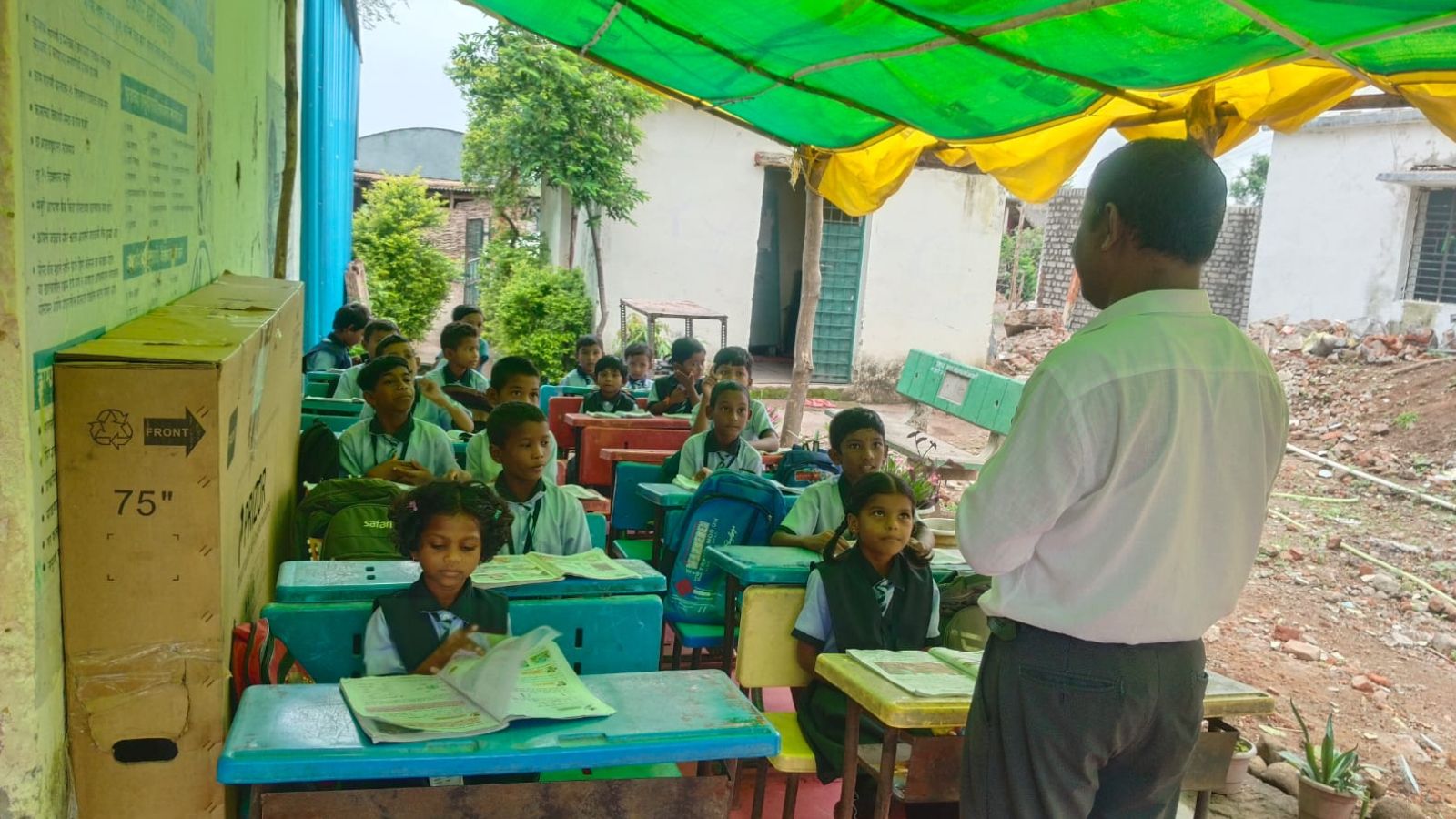
Ruchika does not have a normal classroom with a blackboard and some chalk. Instead, she studies in a temporary shelter at Zilla Parishad’s primary school, with a green shade net and plastic sheets stretching over bamboo poles, tied together to serve as a classroom and keep the rain out.
Inside, some students sit in a circle on the floor with the teacher as multiple bulbs of garlic, a cricket bat, a hula hoop, school supplies, some cardboard boxes, and a stack of plastic chairs lie in the background.
Inside the classroom, some students sit in a circle on the floor with the teacher (Express photo)
Until last year, the Zilla Parishad had two schools, but one of the buildings was declared unsafe and later demolished.
In 2026, when schools are being made tech-enabled, this Yavatmal school continues to seek basic infrastructure to continue education. This is also the district that drew national attention for a number of farmer suicides.
The story of this Yavatmal school
At least 21 students, between Classes 1 and 5, study at this government-run Zilla Parishad (primary school). The school originally had two classrooms in two small buildings. In 2025, one was demolished after being declared dangerous, leaving the two teachers and the students with only one single room.
Story continues below this ad
One room to accommodate students of five grades, teaching materials, and also run a kitchen for the mid-day meal scheme.
“We have Classes 1 to 5 with only 21 students, but after one building was demolished, we were left with just one classroom. The remaining room stores mid-day meal supplies, school cupboards and also accommodates students. To ensure children have enough space to sit, we put up a plastic sheet and green net outside and conduct classes there,” one of the school teachers, Avinash Kudmete, said.
Some students are forced to study outside the only classroom (Express photo)
Since there are only two teachers in this Zilla Parishad School, it has to follow a multi-grade teaching model – some kids are slotted to sit outside the classroom under a green net shed, while some sit inside, depending on the timetable.
“Sometimes one teacher teaches Marathi while the other teaches English, and students of another class solve mathematics simultaneously. This is how we manage multi-grade teaching,” Kudmete said.
Story continues below this ad
The struggles of the children in this region do not end here.
Of the 21, at least two children have to march to the school every day from the neighbouring hamlet of Salebhati as their village does not have a primary school. Reason? Its low population.
Until last year, the Zilla Parishad had two school buildings accommodating two classrooms (varga-kholi), but one building was declared unsafe and later demolished (Express photo)
The situation has, however, remained even as construction of a new classroom has been sanctioned by the authorities.
“We have been told that a new building has been sanctioned, but construction has not started. Even the place where we are currently conducting classes has been marked as unsafe. We have no alternative space,” the teacher said.
Story continues below this ad
‘Tender process is underway’: Zilla Parishad officials
The Indian Express reached out to the Zilla Parishad Additional Chief Executive Officer, Santosh Dhotre, about the delay in construction of another classroom in Marki-Khurd village; he said the tender process is underway.
“The school had two classrooms. A demolition notice for one classroom was issued on March 21, 2025, and it was subsequently demolished. The administrative approval for the construction of a new classroom was granted on January 30, 2026, by the previous Zilla Parishad CEO. The process is in its final stages and the tender process is underway,” Dhotre told The Indian Express.
He told this newspaper that the construction of a new school building is expected to begin within two months, adding that the remaining classroom requires only minor repairs.
Dhotre also said the district administration is compiling proposals for all unsafe school buildings so that repair and reconstruction work can be taken up on priority. Until then, children in the Marki-Khurd of Yavatmal district will continue to attend school, for their basic right to education, under a sheet of plastic, hoping the rain holds off long enough for the day’s lessons to continue uninterrupted.
Expand
Stay updated with the latest – Click here to follow us on Instagram