Former FIFA president Sepp Blatter has launched a blistering attack on Gianni Infantino’s controversial plans to open the commercial future of the World Cup to private investors, insisting “no one has the right to sell our game”.
Blatter, who led FIFA for 17 years before leaving amid the corruption scandal that engulfed world football in 2015, became the latest high-profile figure to criticise Infantino’s proposal to establish a new commercial company for the governing body’s biggest competitions.
FIFA announced this week that it wants to create FIFA Forward Enterprise, a separate business that would oversee the commercial rights to tournaments including the men’s and women’s World Cups and the Club World Cup.
The company is expected to be valued at around $20billion (£15bn), with more than 20 per cent potentially sold to external investors.
The plans have already sparked widespread opposition from football’s governing bodies, and Blatter has now added his voice to the growing backlash.
Posting on X, the 90-year-old questioned Infantino’s relationship with US President Donald Trump while condemning the proposal.
“The close relationship between the FIFA President and the US President has reached a financial dimension that is deeply damaging football,” Blatter wrote.
“No one has the right to sell our game.”
Former FIFA president Sepp Blatter has launched a blistering attack on Gianni Infantino’s controversial plans to open the commercial future of the World Cup to private investors, insisting “no one has the right to sell our game”
|
GETTY
Blatter’s intervention came shortly after details emerged from a leaked letter sent by Infantino to FIFA’s 211 member associations outlining the financial incentives available if the proposal is approved.
According to The Times, member associations have been given 53 days to decide whether to support the plans.
The letter states that approving the reforms would unlock a $10billion funding package from January 1, 2027, compared with the existing $2.7billion FIFA Forward programme if the proposal is rejected.
Infantino told associations they could ultimately access funding worth up to $40million each during the next financial cycle.
The close relationship between the FIFA President and the US President has reached a financial dimension that is deeply damaging football. No one has the right to sell our game. #GianniInfantino #DonaldTrump #FIFA #UEFA #USA #Sellout
— Joseph S Blatter (@SeppBlatter) July 28, 2026
The proposal has also prompted criticism from the Football Association, which revealed it had no prior knowledge of the plans before they were announced publicly.
“We were completely unaware of this proposal and no substantive details, including what the proposition actually is, and what conditions are attached,” the FA said.
“Based on the limited information, we are deeply concerned about the lack of process and governance to get to this point, and the apparent substance and principles involved.
“When the proposal is shared in the full and transparent way now promised by FIFA, we will make our views clear, and comment further.”
Concacaf also criticised the process, saying it only became aware of the proposal through media reports before expressing “deep concern” over what it described as a lack of due process.
UEFA issued perhaps the strongest response, accusing FIFA of attempting to commercialise the governance of football.
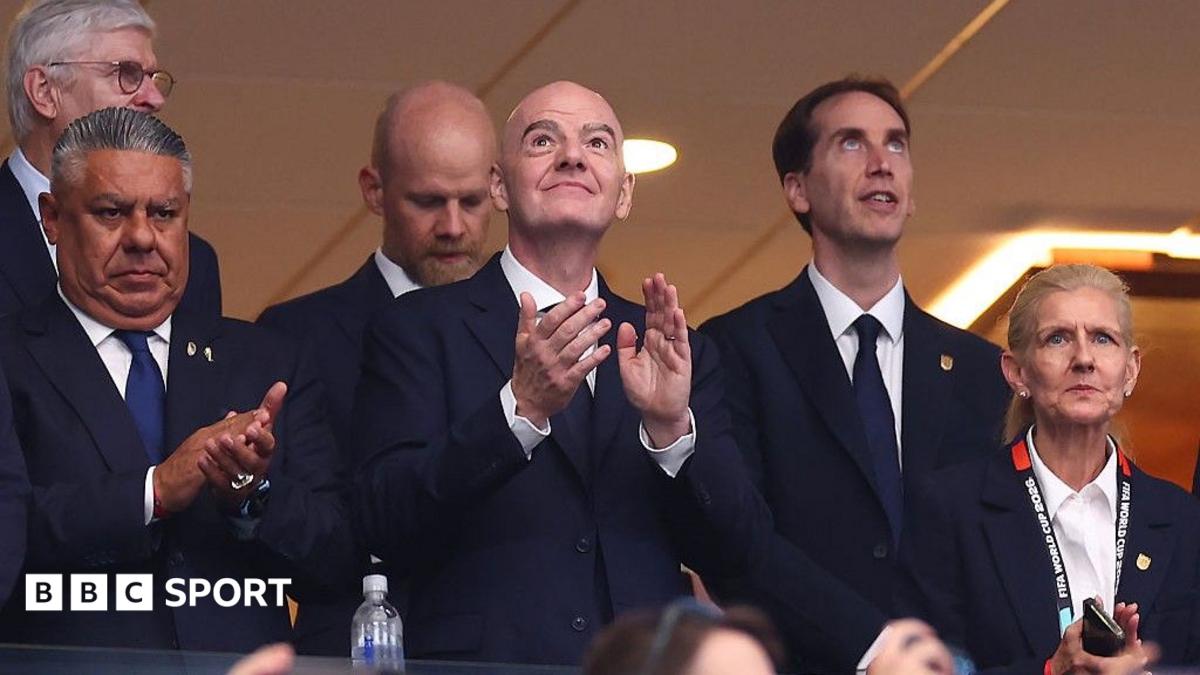
Gianni Infantino is a controversial figure at FIFA | GETTY
“This crosses a line that football’s governing institutions should never cross,” UEFA said.
“The soul and governance of football are not assets to trade – especially with zero transparency as to who gains financially. None of us are the owners of football. It is not FIFA’s to sell.”
The controversy has also drawn political attention, with UK Prime Minister Andy Burnham joining criticism of the proposal after arguing that the World Cup belongs to football rather than investors.
With opposition continuing to build across the game, Infantino faces mounting pressure as he attempts to win the backing required to push through one of the most controversial reforms of his presidency.