Aussies are expected to face fresh fuel pain from this weekend as the federal government signalled an Iran war-prompted fuel excise cut will “discontinue”.
With the August 2 deadline of a 16 cent per litre government absorbed discount at the bowser fast approaching, Labor have repeatedly asked if it will continue.
Senior minister Penny Wong had said “the intention is for that to discontinue as of this weekend”, while leader Anthony Albanese remained coy on their final decision.
Sign up to The Nightly’s newsletters.
Get the first look at the digital newspaper, curated daily stories and breaking headlines delivered to your inbox.
By continuing you agree to our Terms and Privacy Policy.
The Prime Minister instead deferred to spruiking Labor’s other cost-of-living measures when he was asked about the fuel excise at a press conference in WA on Tuesday.
“We are conscious of the pressure that families are under and that is why we continue to put forward cost-of-living relief,” Mr Albanese said.
The government had first reduced the excise by 32 cents as the cost to fill up a tank skyrocketed, however, it only partially kept the relief when the initial round expired.
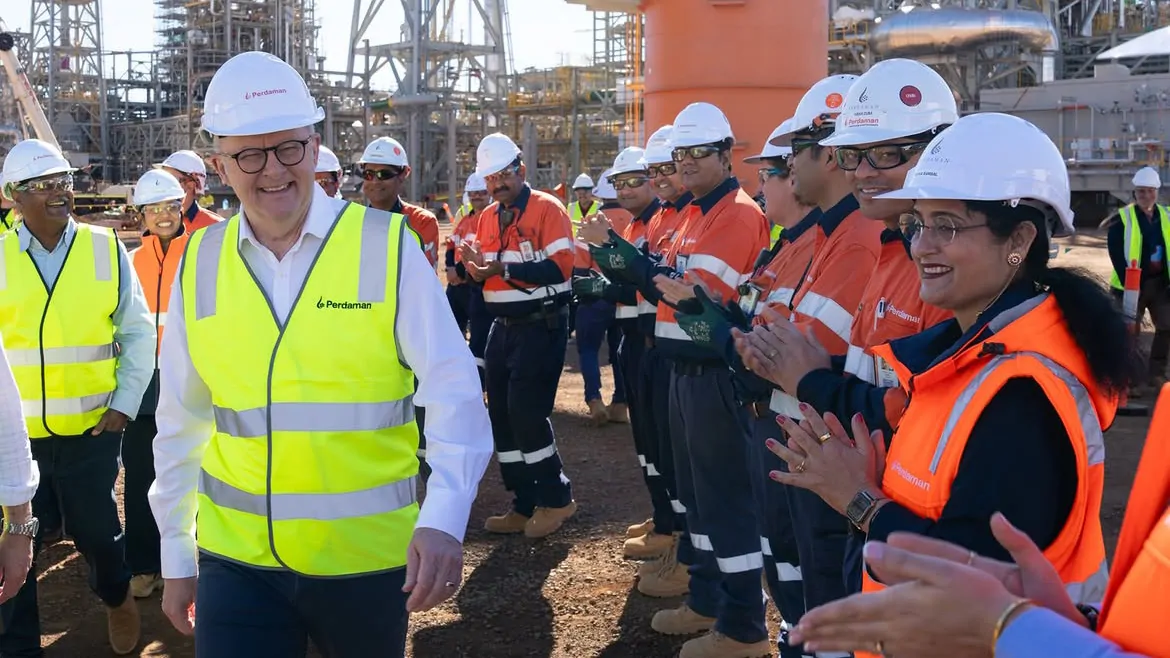
The PM was asked about the excise cut during a visit to Karratha in WA’s north on Tuesday to spruik his government’s efforts on boosting Australia’s energy sovereignty.
He announced that the Federal and WA governments would jointly fund a pre-feasibility study into whether it’s viable to build Australia’s first new oil refinery in decades at the Perdaman facility.
The visit coincided with the six month anniversary of the initial United States and Israel strikes on Iran, which induced a global energy shock.
The nation’s low fuel reserves by international standards and reliance on refined imports had become a focal point in the wake of US-Israel strikes as usual supplies were compromised.
Australia has been left with just two refineries, in Brisbane and Geelong, after the closure of four refineries on home soil in the past decade.
Mr Albanese and Treasurer Jim Chalmers set aside a $15 billion package in the May Federal Budget for fuel security with $10 million allocated to help feasibility studies into new or expanded fuel refining capabilities.
Liberal Senator James Paterson said while he welcomed steps towards greater fuel security, he expressed scepticism that Labor would actually support a project to get off the ground.
“I would love to see a new oil refinery built, whether it’s on the East Coast or the West Coast. But I seriously doubt the sincerity of the government here,” Senator Paterson said.
“I mean, they’re not even allowing companies to drill for oil onshore and get some of the oil resources we have, including in Queensland.”
Already since the start of July, prices at the bowser have begun to rise since the war restarted — with the national average retail price of unleaded increasing from $1.55 per litre to about $1.90 while diesel has jumped from $1.80 per litre to $2.30.
Motoring peak body NRMA estimates motorists will also be hit with a further 1.5 to 2 per cent increase in fuel excise rate from August 3 when the rebate is withdrawn — “in line with the inflation increase for the first two quarters of 2026”.
NRMA said the average regular unleaded prices of 186.8 cents per litre this week had risen 34.6 cents per litre since June 30.
The government has promised fuel reserves are secure into the month and above pre-conflict levels but consistently warned of a “tail” impact well after the war ends.
It’s understood Australia’s March-appointed “Fuel Supply Taskforce Coordinator” Anthea Harris has also continued to meet with State and Territory counterparts after her contract to June 30 was extended.
Australia has also continued to cosy up with key trading partners to secure refined fuel imports following Mr Albanese initial diplomatic blitz across the Asia-Pacific.
Australia’s Defence, Foreign and Trade Ministers welcomed their Singapore counterparts in South Australia on Monday.
The ministers signed a new treaty to safeguard their supply chains amid global disruptions.
The “Protocol on Economic Resilience and Essential Supplies” bilateral agreement comes after Mr Albanese and Singaporean Prime Minister Lawrence Wong in April signed a joint statement to pledge to work together.
Defence Minister Richard Marles said the pact essentially embodied the “trust” between the countries and insisted that a close partnership was vital after “one of the biggest energy shocks to the world”.
Singapore Foreign Minister Vivian Balakrishnan said the meeting was a great way to brainstorm and act on ideas and insisted Australia were always “tough negotiators”.
He said supply chain resilience cannot be taken advantage of in the current “fragile and fractious” global environment and it was important to “double down” on the Singapore-Australia relationship.
Mr Balakrishnan said Australia held a “truly unique relationship” and described Australia’s “increasing strategic role” in the region as a “tough but worthwhile and dependable” partner.
Trade Minister Don Farrell pointed out that “Singapore is our largest source of fuel” and said he was pleased the two nations could continue their partnership to ensure energy can be “guaranteed” during worldwide disruptions.
“Now more often than not there will be times of trouble,” he said.
The South Australian Senator expressed hope for an open and connected relationship going forward in all areas of trade.
“If you keep supplying us with petrol we make sure we can keep supplying you with that wonderful South Australian wine,” he joked.
Their friendly exchange on energy cooperation comes after Labor’s National Conference bypassed debate on a possible gas export tax, instead opting for general language about securing a fair return on natural resources.