Local News
The Bay State beach dwellers helped Tufts researchers solve a decades-old mystery.
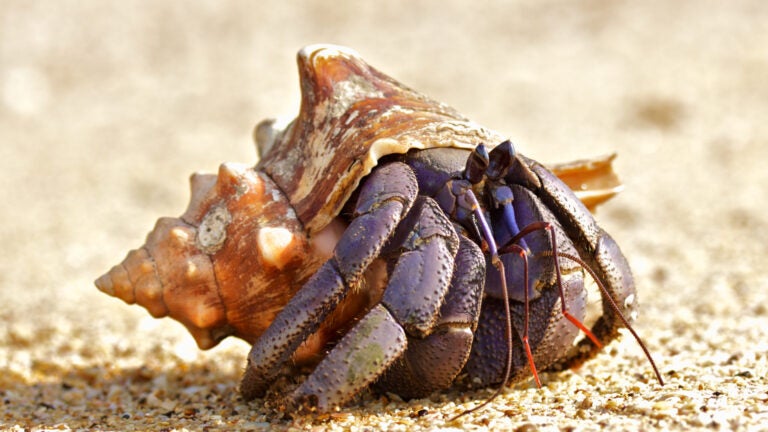
Hermit crabs will line up in hopes of trading up to a bigger shell. Adobe Stock
Why do hermit crabs stop growing when they outgrow their shells? Tufts University researchers say the answer, based on a study of crabs collected along Massachusetts’ North Shore, comes down to poop.
According to a study published in the journal Invertebrate Biology, hermit crabs collected in Beverly helped scientists answer a decades-old question about how the crustaceans slow their growth when they’re forced to live in shells that are too small.
The study found that the crabs don’t grow more slowly because they eat less. Instead, they poop more often, expelling nutrients their bodies would otherwise use to grow.
To investigate, researchers collected long-wristed hermit crabs at low tide and compared animals living in comfortably sized shells with others placed in shells that were too small.
“Hermit crabs depend on empty snail shells for protection, and the right size shell isn’t always available,” lead author Caitlin Ball, who conducted the research as a graduate student in Tufts University’s Department of Biology, said in a report by Tufts Now. “When they’re stuck in shells that are too small, they grow more slowly. The question was: what’s the mechanism?”
The team expected the crabs in undersized shells might simply eat less. Instead, they found the animals consumed about the same amount of food but defecated more frequently.
“What we’re seeing is consistent with something subtle — the crabs appear to regulate growth by adjusting nutrient assimilation,” senior author Phil Starks, an associate professor of biology at Tufts, told Tufts Now.
Researchers say the findings point to a broader biological principle: growth isn’t determined solely by how much an animal eats, but also by how efficiently it converts food into body mass.
“We wouldn’t want to imply that hermit crabs are a model for human metabolism, or that this study directly explains human weight variation,” Starks said. “But the broader biological principle does extend beyond crabs.”
Morgan Rousseau is a freelance writer for Boston.com, where she reports on a variety of local and regional news.
Sign up for the Today newsletter
Get everything you need to know to start your day, delivered right to your inbox every morning.