Crime
“The key issue in this case will revolve around mental state. It’s not a ‘whodunnit?’ case, right?”
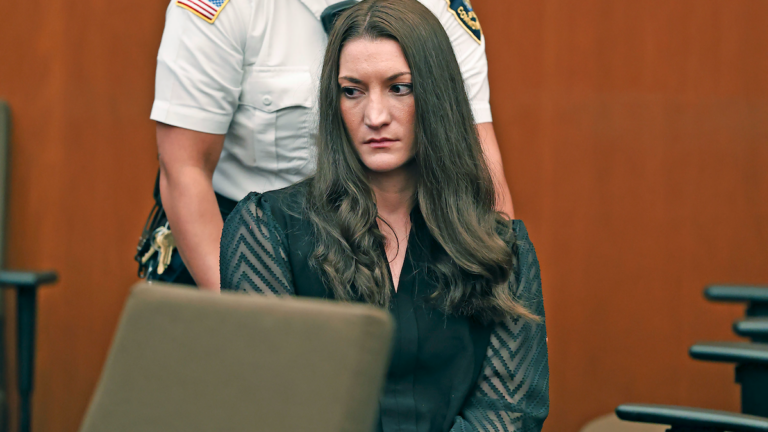
Lindsay Clancy appears in Plymouth Superior Court for a pretrial conference, Thursday, June 18, 2026. Greg Derr / The Patriot Ledger, Pool
July 20, 2026 | 5:00 AM
8 minutes to read
The voice in Lindsay Clancy’s head demanded action, her lawyers say.
For months, the Duxbury mother tried in vain to seek help for the postpartum mental illness that plagued her following the birth of her third child in 2022. She consulted mental health care providers and took the medications they prescribed, called crisis hotlines, and admitted herself to a psychiatric hospital when her suicidal thoughts reached their peak.
Family and friends watched as the picture-perfect young mother slipped further into insomnia and racing thoughts. By the time she allegedly began hearing the insidious voice in her head, Clancy was a shell of the labor and delivery nurse former coworkers remembered as a caring friend who “lived to be a mother.”
As her husband ran errands the evening of Jan. 24, 2023, the voice in Clancy’s head became a steady drum beat, her lawyers say: “This is your last chance. Kill the children so you can kill yourself.”
In the brief time Patrick Clancy was gone, prosecutors allege Lindsay Clancy strangled 5-year-old Cora, 3-year-old Dawson, and 8-month-old Callan with exercise bands before cutting herself, swallowing prescription psychiatric medications, and leaping from a second-story window in a suicide attempt.
As the 35-year-old heads to trial this week on first-degree murder charges, jurors will be left to decide between two dueling narratives: Was Clancy a cold, calculating killer, as prosecutors allege? Or was she caught in a revolving door of medications and postpartum mental illness, as her defense attorney argues, rendering her too sick to be held responsible?
“I think the evidence of what happened is pretty clear, and we’re never going to really be able to get in our time machine and know what was in her head in the moment,” said Rosanna Cavallaro, a professor of criminal law and evidence at Suffolk University.
“That’s all we care about: that one frame of that movie strip, if you will,” she explained. “And I think that’s where the tension is going to be, is really keeping the jury’s focus on that and keeping the jury open to that understanding that it is possible for people to be ill to the point that they cannot, truly cannot, comprehend the wrongfulness of what they’re doing in the moment that they’re doing it.”
Duxbury police parked outside Lindsay Clancy’s home in January 2023. – John Tlumacki / The Boston Globe, File
‘Troubled soul’ or methodical killer?
The night of the killings, Clancy alleges she entered a dissociative “dream-like state” as she strangled her children in the basement of their Duxbury home, telling them, “Go to God, baby.”
“I lost all control. My body started acting without any control on my part,” she recalled in a malpractice lawsuit she filed against her mental health care providers in January. “I was just following commands, ‘all action.’ This voice demanded action.”
The lawsuit alleges Clancy’s medical providers misdiagnosed her bipolar disorder and prescribed her a slew of psychiatric drugs that ultimately triggered a psychotic break — a “catastrophic failure” of the mental health system. Patrick Clancy leveled similar accusations in a separate wrongful death suit, having previously hinted at his wife’s struggles just days after the killings in a plea for others to “forgive Lindsay.”
Patrick Clancy is expected to testify at his wife’s trial, and jurors will hear the 911 call he made upon arriving home on Jan. 24, 2023, to find his wife badly injured on the ground outside. According to prosecutors, he can be heard on the recording “screaming in agony and shock” as he discovers his children’s bodies.
“I think it’s going to be quite a challenge for both sides to find a fair and impartial juror,” said Margaret McLean, a true crime podcaster and former prosecutor who taught at Boston College. Jurors “are going to have to listen to the horrific 911 call, listen to all the evidence and the testimony from first responders and Patrick Clancy, and see autopsy photographs, and see this horrific case of these three young children. Do you pick mothers, fathers [for the jury]? I don’t know.”
Added veteran defense attorney Janice Bassil: “These are really little kids, and so I think that’s going to be hard for the jury, let alone autopsy pictures or crime scene photos. Just the fact that it’s children — I mean, everybody just sort of takes a sort of deep breath about it.”
Clancy’s defense attorney, Kevin Reddington, will argue she can’t be held criminally responsible for the killings due to her mental health, more commonly known as an “insanity defense.” But contrary to Reddington’s description of a “troubled soul” so numbed by mental illness she could no longer feel emotions, Assistant District Attorney Jennifer Sprague has painted Clancy as a methodical killer who “executed” her children “one by one.” To hear Sprague tell it, Clancy sent her husband out on errands the night of Jan. 24 and mapped his route to give herself more time to kill.
“Based on that, I think the prosecution is going to really anchor the jury to the physical timelines,” McLean said. “They’re going to look at the digital footprint, evidence of premeditation and planning, the calculated errands that she sent her husband on to give her enough time or a window to kill the children, the mapping of distances, to argue that those actions required highly rational, logical planning.”
However, Bassil noted, “Just because someone plans something, it doesn’t mean they’re not mentally ill. If their planning is based on delusional disorders or psychotic beliefs, they can do a lot of planning, but it doesn’t mean that they’re criminally responsible.”
While prosecutors aren’t required to prove motive to secure a conviction, Bassil said many aim to do so as a way of helping jurors make sense of the unthinkable.
“But from what I’ve read in the paper, [Clancy’s] devotion to her children, her care of them, her love of them is in such stark contrast to what happened that it really is a huge dichotomy, and it would be hard to explain that as something someone deliberately chose to do,” Bassil added.
Still, the mundanity of Clancy’s day prior to the killings may be difficult for jurors to grasp, McLean said, pointing out that Clancy built a snowman with her children and brought her daughter to a doctor’s appointment earlier in the day.
“I think [the defense] is going to have to show that somebody like this can seem normal in one moment and then completely snap,” she said.
An undated photo of Lindsay Clancy from her Facebook profile.
Insanity defense in Massachusetts
While many states place the burden of proving insanity on the defendant, Massachusetts puts the onus on prosecutors to prove criminal responsibility when a defendant has introduced evidence to the contrary, explained Daniel Medwed, a criminal law professor at Northeastern University.
“In Massachusetts, the term ‘insanity defense’ is a little bit of a misnomer; it’s called ‘lack of criminal responsibility,’” he said. “So I think the key issue in this case will revolve around mental state. It’s not a ‘whodunnit?’ case, right?”
According to McLean, there’s a two-pronged legal standard at play: did Clancy know right from wrong when she allegedly strangled her children, and could she have stopped herself even if she did?
“I think the evidence is going to boil down to all of her medical records and how she tried to help herself, and the testimony from her husband, who’s on her side, saying that, ‘Yes, I took her here. I took her there. She went to McLean [Hospital, a psychiatric facility]. This is what they gave her,’” she explained.
Notably, judges in Massachusetts aren’t required to provide a list of acceptable mental illnesses or defects, or even to define the term, according to an analysis from Jolie Bodner Zangari, a professor at the Touro University Jacob D. Fuchsberg Law Center. Rather, it is left up to jurors to decide what qualifies.
In theory, that should make it easier for Massachusetts defendants to successfully argue an insanity defense. The reality, however, is far more complicated.
“We know that historically, juries are not really open to that; they’re kind of hostile to it, for a bunch of reasons,” Cavallaro said. “Part of it, I think, is the sort of deep cultural biases that still linger about mental health and whether people really couldn’t help themselves, or just wouldn’t. I think that’s the critical line for criminal responsibility versus no criminal responsibility.”
There’s also a pervasive attitude that someone with mental illness could be faking it, or hasn’t done enough to help themselves, she said.
“We would never say somebody should ‘try harder’ when they have cancer or diabetes, but somehow we still feel that with mental illness,” Cavallaro said. “That it’s not real; it’s a choice.”
In Massachusetts, insanity defenses have proven especially dicey in emotionally charged first-degree murder cases. Less than a month before the Clancy children died, the Plymouth County District Attorney’s Office — the same prosecutors trying Lindsay Clancy — convicted another mother, Latarsha Sanders, of first-degree murder for killing her children.
Sanders had also raised an insanity defense, and a neuropsychologist testified that the Brockton woman was “in a very severe psychotic state” when she stabbed two of her sons to death in a “ritualistic” killing in 2018. Prosecutors, meanwhile, branded her “evil” and accused her of playing “the crazy card” to get off scot-free.
A school bus drives past a makeshift memorial outside the Clancy home. – Matthew J. Lee/Boston Globe Staff, File
What comes next?
When weighing an insanity defense, jurors may also opt for a guilty verdict due to anxiety and uncertainty about what happens to defendants who are found to lack criminal responsibility, Cavallaro said.
“I think because jurors don’t always know that, they feel like, you know, ‘I can’t be the one who lets this person loose. I can’t be the one who makes it that this person could ever hurt someone else again,’” she explained. “And so they err on the side of finding people guilty, even where there is a very powerful case of mental illness.”
But contrary to popular perception, a successful insanity defense doesn’t amount to an acquittal, Medwed pointed out.
“In TV and in the media, you think insanity is essentially a key to an acquittal, but it’s not. It’s one reason why these defenses are really rare,” he said. “For one thing, it’s hard … to prove them, but for another, even the outcome of a successful one is being dispatched to a secure mental health facility, often for an indefinite period of time, and it’s not always clear that that’s preferable, depending on the state, depending on the nature of the facility.”
When a defendant is committed to a mental health facility following a successful insanity defense, a judge may later order them discharged if they are no longer a danger to themselves or others. Bassil, for example, said she had one client who was able to graduate to a halfway house after receiving care at a state hospital.
But for parents accused of killing their children, the emotional toll lingers long after the court battles are said and done.
“It never goes away, especially where it’s your children. Even if someone was found not guilty by reason of mental illness, this never, ever goes away,” Bassil said. “It’s just a torturous thing that will haunt anybody for the rest of their lives.”
Abby Patkin is a general assignment news reporter whose work touches on public transit, crime, health, and everything in between.
Sign up for the Today newsletter
Get everything you need to know to start your day, delivered right to your inbox every morning.