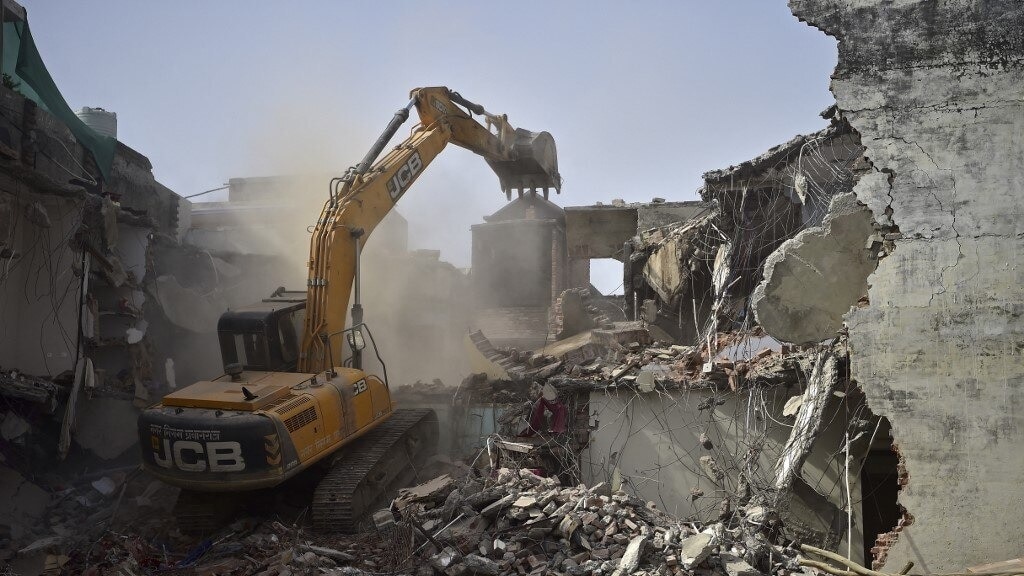
The Supreme Court on Thursday, while declining to entertain a batch of contempt petitions against alleged “arbitrary” demolitions using bulldozers, made a clear observation that while it cannot impose a blanket ban on “bulldozer action”, there should not be cherry-picking targets to punish people.
The top court was hearing pleas alleging that authorities violated its landmark November 2024 directions. Rejecting the pleas, the Supreme Court held that such disputes should be examined by the respective High Courts.
The bench led by Chief Justice of India Surya Kant and also comprising Justice Joymalya Bagchi and Justice V Mohana, said each case involved disputed facts requiring detailed scrutiny, making the High Courts the appropriate forum to determine whether the safeguards laid down by the top court had been breached.
“Yes, bulldozers need to be used when the rule of law is throttled by comfortable corruption between authorities and illegal encroachers. But in the guise of implementing law, there should not be characterisation of individuals. It runs against basic tenets…. The question is whether a person had authorisation and procedure of law was followed?”, Justice Bagchi said.
The question, he said, was whether the person had legal authorisation and whether due process had been followed. He added that the judgment should be read along with its stated exceptions rather than as a standalone statute.
The bench also observed that the court could not adjudicate factual controversies arising in every demolition case through contempt proceedings.
It consequently transferred the petitions to the concerned High Courts, leaving all legal and factual issues open for consideration.
Notices issued earlier by the Supreme Court in some contempt matters would not preclude the High Courts from deciding the cases independently.
During the hearing, Senior Advocate Huzefa Ahmadi argued that the Supreme Court should intervene in cases involving what he described as “egregious violations” of its directions.
Referring to a petition concerning the demolition of certain mosques in Somnath, he submitted that the alleged breach was evident from the affidavits and could be demonstrated within minutes.
Ahmadi contended that the demolition amounted to targeted action, saying it followed a politician’s public objection to the presence of a large mosque in the state and asserting that the structure did not stand on public land.
Senior Advocate Chander Uday Singh, appearing in a Maharashtra matter, argued that demolitions were often preceded by public announcements from political leaders promising “bulldozer justice”.
According to him, the state’s own affidavit showed that the mandatory procedure prescribed by the Supreme Court had not been followed. He submitted that several demolitions appeared punitive, citing their speed and celebratory public statements made after the action.
Senior Advocate Sanjay Hegde referred to another case involving the demolition of his client’s fruit juice stall, claiming a television anchor was present on the bulldozer while the demolition was broadcast live.
However, the bench maintained that such allegations required factual determination. Chief Justice Surya Kant pointed out that the November 2024 judgment itself excluded certain categories, including encroachments on public land and roads.
Once authorities claimed that a structure fell within those exceptions, the dispute became one of fact that could not be resolved in contempt proceedings alone.
The Chief Justice remarked that every case would require examination of records, including whether notices had been issued, by whom and on what date.
He questioned why the Supreme Court should undertake such inquiries when High Courts were equipped to summon records and examine evidence.
Justice Mohana similarly observed that factual disputes could not be conclusively decided in contempt jurisdiction and asked whether every such matter from across the country should come directly before the top court.
The Bench also dealt with a petition from Madhya Pradesh after Senior Advocate S Muralidhar submitted that the High Court had declined to entertain the matter on the ground that the district collector was unaware of the Supreme Court’s earlier judgment.
The top court set aside that order and remitted the matter for fresh consideration.
In its final order, the Supreme Court directed that records in all pending contempt petitions be transferred to the respective High Courts, which may call for official records or seek evidence through district courts if required.
The bench clarified that it had expressed no opinion on the merits of the allegations.
It also ordered that the interim protection granted earlier would continue until the High Courts considered the matters, while leaving it open to the parties to seek modification of those interim orders before the respective High Courts.
– Ends
Published On:
Jul 16, 2026 16:38 IST