Education
If signed into law, the bill will enforce new literacy programs, educator preparation, and screenings for potential learning disabilities.
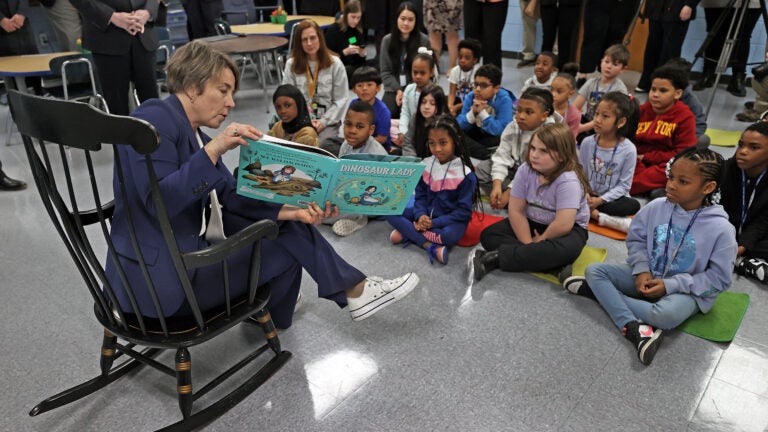
Gov. Maura Healey reads to second graders at Young Elementary School in Randolph to highlight literacy programs in 2024. David L Ryan/The Boston Globe
Massachusetts legislators reached an agreement Tuesday on a bill that aims to address dropping statewide literacy rates by revamping early reading programs.
The deal would standardize literacy programs to ensure that students in kindergarten through grade 3 learn through curricula backed by scientific research. Rather than being taught words through memorization or context clues, student literacy will be based on phonics and vocabulary skills, according to the bill text.
The deal merged two proposed bills as a compromise between the Senate and the House of Representatives. It stems from longstanding research showing that evidence-based literacy programs are more effective in the classroom, according to State Sen. Sal DiDomenico, who recommended that the final bill be passed.
“In many ways, we’ve been using the outdated model of curricula, which has not been working,” DiDomenico told Boston.com. “Right now, we have 4 out of 10 students in third grade, which is the critical indicator of reading success and academic success going forward… are at the benchmark. That means 60 percent of the kids in third grade are not reading at grade level.”
School districts will be required to select a curriculum that includes instruction in five research-based areas, including phonics, phonemic awareness, fluency, vocabulary, and comprehension. Specific mandatory comprehension skills include oral reading, oral communication skills, and reading comprehension, the deal states.
The new curricula will permanently do away with several currently-used literacy strategies, such as “implicit or incidental instruction in word reading.” Visual memorization of whole words or guessing from picture cues, also known as “three-cueing,” will also be eliminated, according to the deal. These strategies are currently used in an estimated 118 districts statewide, according to DiDomenico.
While some districts’ programs will face a complete makeover, others that already meet established quality standards will be allowed to continue at the discretion of the Department of Elementary and Secondary Education (DESE). Essentially, districts must be able to demonstrate that their programs are evidence-based if they wish to keep them as is, the bill text states.
“As long as they are evidence-based and show the effectiveness of that curriculum, they will be able to continue using that curriculum that they currently have,” DiDomenico said.
The goal is for these new programs to act as a course correction to prevent students from falling behind. Though Massachusetts is number one in the nation for education, DiDomenico said that current reading levels in young children leave “much to be desired.”
Districts that lack adequate funding to completely revamp their programs will be offered a free curriculum curated by DESE, according to DiDomenico. This evidence-based curriculum, which is already offered for students in kindergarten through second grade, will be offered to third grade students under the terms of the bill.
The state will also create new guidelines on how to align educator preparation programs with students’ evidence-based literacy programs, according to the deal. Data on approved educator programs will now be published annually.
Beyond these new programs, the act will require districts to develop screening protocols for students who exhibit signs of learning disabilities, such as dyslexia. DESE will be responsible for issuing guidelines to assist districts in creating these programs. Schools will also be required to annually report the findings of these screenings.
The bill will be accompanied by a trust fund to support the programs for both students and teachers, according to DiDomenico. The funds for these programs will be allocated by the Legislature.
The deal is currently awaiting approval from the Senate and the House before it goes to Gov. Maura Healey to be signed into law. If it is made a state law, the programs it includes will take effect starting in fall 2027.
Sign up for the Today newsletter
Get everything you need to know to start your day, delivered right to your inbox every morning.