The Red Sox are one win away from completing a surprising four-game sweep of the first-place Yankees after knocking off their longtime rivals, 4-1, Saturday afternoon at Fenway Park.
Boston has now taken the first three games of the series, thanks in large part to an early offensive barrage against veteran right-hander Gerrit Cole. The Red Sox homered twice in the first two innings and chased Cole after 5 1/3 innings, tagging him for four runs on seven hits.
Masataka Yoshida set the tone immediately, leading off the bottom of the first with a home run into the Red Sox bullpen on a 93.6 mph four-seam fastball. It was just his second homer of the season.
The blast also put Yoshida in exclusive company. He became just the ninth Japanese-born player in major league history to hit a leadoff home run and the third active player to accomplish the feat, joining Shohei Ohtani and Jung Hoo Lee.
Yoshida finished 2-for-4 with two runs scored, recording his ninth multi-hit game of the season and his first since the Red Sox’ series against the Rangers two weeks ago.
Anthony Seigler added to the early onslaught in the second inning, crushing a 97 mph fastball from Cole over the Green Monster for the first home run of his major league career. The blast also extended his hitting streak to a career-high five games.
There was some extra meaning behind the moment, too. Seigler was originally selected by the Yankees with the 23rd overall pick in the 2018 MLB Draft, making his first big league homer against the organization that drafted him all the more memorable.
After the game, Seigler said he was able to get the baseball back and plans to give it to his mother.
“It was amazing,” Seigler said. “I mean, words can’t describe it, really. Just try to get a good pitch to hit, got a good pitch to hit, and then like I said, just trying to put good at-bats together. I think we were doing that this whole series. Just got a pitch to hit and just went for it.”
Boston added two more runs in the third inning after Yoshida and Ceddanne Rafaela opened the frame with back-to-back singles. Willson Contreras then scorched a 114.4 mph double into the left-center field gap, driving in both runners to stretch the Red Sox’ lead to 4-0.
It proved to be more than enough against Cole.
Making just his seventh start since returning from Tommy John surgery that sidelined him all of last season, Cole settled in after the third but never recovered from Boston’s early damage. He allowed only two more hits the rest of the way, but the four-run outing marked the third time in his last five starts, dating back to June 3, that he has surrendered at least four runs. Cole also continues to struggle at Fenway Park, where he owns a 5.52 career ERA.
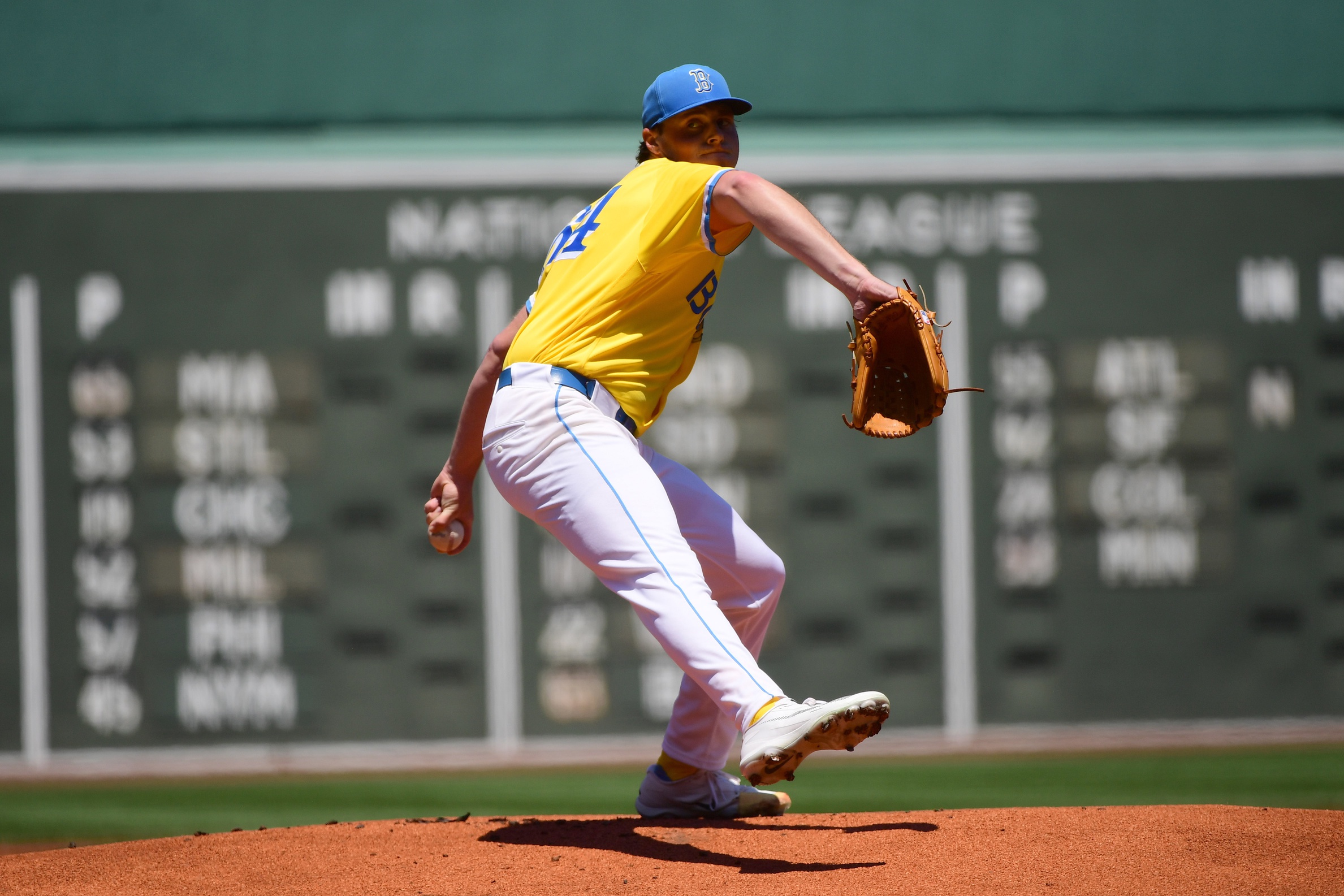
Opposite Cole, Jake Bennett turned in another impressive performance, building off Payton Tolle’s dominant outing the night before.
The rookie left-hander didn’t allow a hit until the fifth inning and kept the Yankees’ lineup quiet all afternoon. Bennett worked 6 1/3 innings, allowing one run on three hits while walking two and striking out three on 87 pitches, including 59 for strikes.
Jake Bennett twirled a 💎 for the @RedSox against the Yankees at Fenway Park.
Boston’s No. 6 prospect kept a no-hitter into the fifth as he whiffed three over 6 1/3 frames of one-run ball. pic.twitter.com/D9apKBGQIE
— MLB Pipeline (@MLBPipeline) June 27, 2026
The outing lowered Bennett’s ERA to 3.27 and gave the Red Sox their 10th consecutive quality start from a starting pitcher, an impressive run for a rotation that has become one of the club’s biggest strengths.
“He was awesome,” Red Sox interim manager Chad Tracy said. “Another one added on to the quality start list. He was really good, minus maybe the second inning where he uncharacteristic got behind in the count. … And then about start of the third inning, locked in and was back in the zone and was very, very effective. Did it with a lot of ball in play, only a few strikeouts. But a lot of weak contact, ball in play, used his defense.”
Stuart Cahill/Boston Herald
Red Sox starting pitcher Jake Bennett throws in the first inning as the Red Sox took on the Yankees at Fenway Park.
Bennett came out attacking from the opening pitch, needing just eight pitches to retire the top of the Yankees’ order in Paul Goldschmidt, Ben Rice and Amed Rosario in the first inning.
After issuing a leadoff walk to Cody Bellinger in the second, the rookie left-hander found another gear.
He got Jasson Domínguez to pop out before striking out José Caballero and Max Schuemann, kickstarting a stretch in which he retired 11 consecutive hitters. Bennett was especially efficient in the fourth, needing only six pitches to breeze through the inning. Rice grounded out on the first pitch, Rosario popped out and Bellinger flew out to center.
The Yankees finally broke through with two outs in the fifth when Schuemann drove a solo homer just inside the boundary where the Green Monster meets the center-field wall, ending Bennett’s no-hit bid and trimming Boston’s lead to 4-1.
NYY – Max Schuemann Solo HR (1)
📏 412 ft | 💨 103.6 mph | 📐 24°
⚾️ 93.3 mph sinker (BOS – LHP Jake Bennett)
🏟️ Out in 17/30 parks
NYY (1) @ BOS (4)
🔺 5th#RepBX pic.twitter.com/xtpUyccOO6
— MLB Home Runs (@MLBHRs_) June 27, 2026
After walking Goldschmidt with one out in the sixth, Bennett