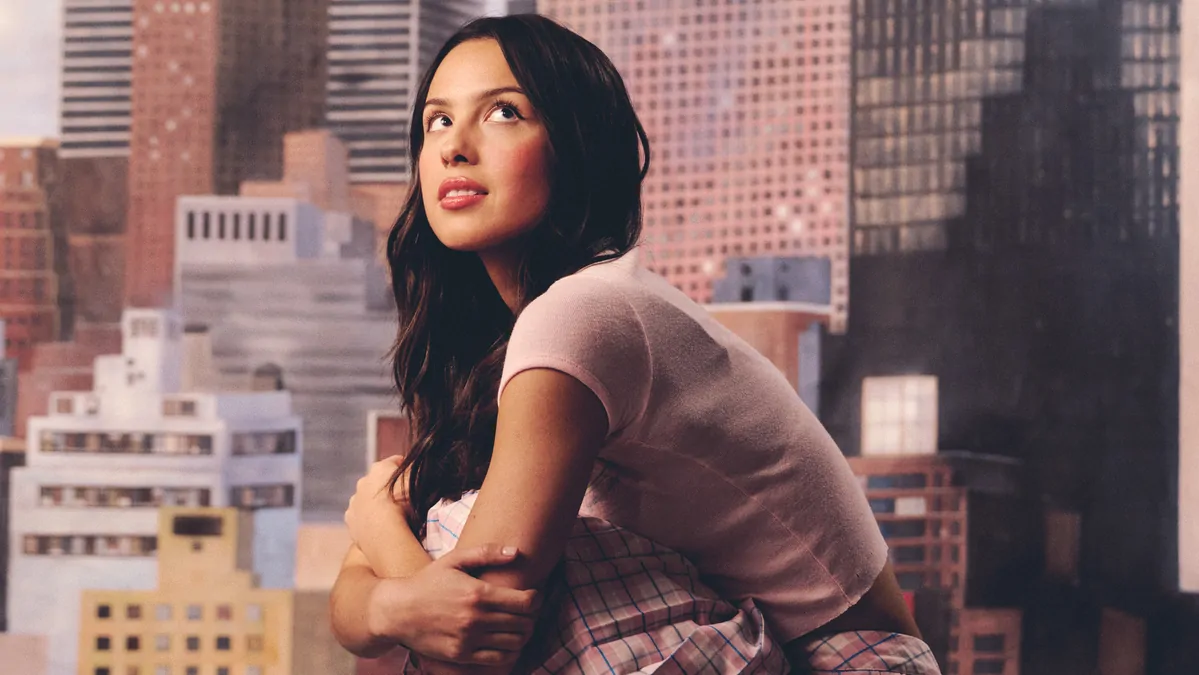
Olivia Rodrigo was the first breakthrough pop star of this decade, a one-time Disney Channel star who set a fresh template for specific, confessional songwriting on a mass scale.
On billion-stream smashes like Drivers License and Good 4 U, Rodrigo, now 23, built a career on the back of two complementary musical impulses: exasperated power balladry and exasperated pop-punk. On her first two albums, Sour and Guts, her songs had targets; the fury she channelled nailed a frequency that activated a legion of young female fans.
Now on the other side of what Rodrigo calls her first “big-girl relationship”, the singer-songwriter’s third album, You Seem Pretty Sad For A Girl So In Love, out on June 12, takes a step back and then zooms in. Over 13 songs, Rodrigo assesses an ultimately doomed relationship from beginning to break-up in real-time detail — the raw thrill of a new connection (Drop Dead, which debuted at No.1), the abandon of falling hard (Stupid Song, U + Me = <3), the unexplained itches (Maggots For Brains, My Way), the stomach-churning realisations (Begged), and the acceptance of the end (Cigarette Smoke).
Sign up to The Nightly’s newsletters.
Get the first look at the digital newspaper, curated daily stories and breaking headlines delivered to your inbox.
By continuing you agree to our Terms and Privacy Policy.
Initially, she had hoped to write about newfound contentment in a way that wasn’t dull. “That was a daunting task for me,” Rodrigo tells Popcast, The New York Times pop culture show, in her first in-depth interview about the album.
As “someone who was very known for writing break-up songs and being angry and sad,” she says: “I wanted to prove to myself that I didn’t have to be miserable to write a song that I liked.”
The singer Olivia Rodrigo, in the New York Times studio on May 14, 2026. In conversation with PopcastÕs Jon Caramanica and Joe Coscarelli, Rodrigo discussed the many ways her creative process intersects with the extracurricular noise of pop superstardom. (Caroline Tompkins/The New York Times) Credit: CAROLINE TOMPKINS/NYT
About halfway through the album-writing process, her personal story took a turn. Working on a third straight LP with Dan Nigro, a producer and songwriting collaborator, Rodrigo went back to tinker and tell a truer story.
“After writing break-up songs, we had the fun challenge of going back and actually tweaking some of the love songs on the record and making them a little more honest and more sad and creepy,” she says.
Rodrigo cites both Simple Passion by Nobel Prize-winning author Annie Ernaux, and Sex And The City — specifically the relationship between Miranda and Steve — as touchstones. “I was really inspired by just all of the ways in which love makes you insane and miserable,” Rodrigo says. To match the feeling, she opted for a 1980s new wave palette that has a more vibrant and complicated range than the hard-charging rock she’s relied on until now.
In conversation with Popcast’s Jon Caramanica and Joe Coscarelli, Rodrigo discusses the many ways her creative process intersects with the extracurricular noise of pop superstardom, whether its managing relationship drama; accusations of pilfering songwriting gestures from Taylor Swift, her one-time idol; being targeted for the way she dresses; or her willingness to speak up about political and social causes in a way many of her peers won’t.
These are edited excerpts from the conversation.
CARAMANICA: This album strikes me as a chronological, structured mini-narrative. Are you writing those things in real time as the experiences are happening? Is that how you apply creativity to a lived experience?
RODRIGO: For the most part it is chronological and in the order in which it happened in my life and it’s the first time that’s happened. I write songs to process my feelings, so every day when I come and I sit at the piano or I go to the studio, it’s like, ‘What is burning in me to say right now?’
COSCARELLI: When did you realise you had an ending?
RODRIGO: I was always kind of curious about trying to mine these more depressing feelings out of these love songs. I think initially I thought that was what the record was going to be, just all love songs but trying to inject some sadness into them. And then obviously sadness in a real or more whole way crept its way into the end.
COSCARELLI: You talk about the destabilising nature of love and have mentioned Sex And The City in relation to the album. There’s a song, Maggots For Brains — that was one where I’m like, this is a very Miranda song.
RODRIGO: Yeah, it’s from the scene where Miranda is getting back together with Steve and she’s like, “Anytime something funny happens, I want to tell you,” and it’s one of the lyrics in the second verse. That’s one of my favourite songs on the record. I think when we made that one, sonically, I was like, ‘Oh yeah, this feels right’.
I love rock music and I have such a reverence for rock music, and that’s all that I really listen to. But I think going into it, it didn’t feel exciting to me — rock in the traditional sense of like, power chords, distortion. But a song like that feels alternative to me without being like, I Love Rock ‘n’ Roll by Joan Jett. It was in a more subtle way, and that was more exciting to me than writing some really banger thing.
Olivia Rodrigo performs live on stage during the 5th Lollapalooza Paris Festival on July 18, 2025. Credit: Kristy Sparow/Getty Images
CARAMANICA: There are certain moments on this album that are really living in the 82-85 world. You’re getting The Cure, you getting maybe a little Talking Heads, Devo. What does that sound and style signal to you that the pop-punk that you’ve been playing with previously doesn’t?
RODRIGO: There was something about the restraint of it that felt nice. I was just really obsessed with that type of music while I was making it. I did Glastonbury with Robert Smith, which was insane. And I’d always been a fan of The Cure but since meeting him and getting to hang out with him, I went back and listened to all those new wave bands. I was living in England at the time so obviously you get a lot of English band inspo. For me, in songwriting, the sentiment always comes first. And so I knew that I wanted to write songs about how it felt to be in love. And love feels like that to me — that vibe, the emotional quality of it.
Olivia Rodrigo performs with Robert Smith of The Cure on the Pyramid stage during day five of Glastonbury festival 2025. Credit: Samir Hussein/WireImage
COSCARELLI: You also used a clever trick where you connect the new wave of the 80s with music influenced by new wave. There’s some No Doubt on My Way and there are some songs that sound like Le Tigre instead of Bikini Kill.
CARAMANICA: Big Olivia fan, Kathleen Hanna.
RODRIGO: (whispering exaggeratedly) I love Kathleen Hanna.
COSCARELLI: The Cure, who span both of those eras, are a through line in the album. You allude to Just Like Heaven in Drop Dead, the first song. Then there’s a song called The Cure. What does that song mean to the album story?
RODRIGO: That song is the thesis statement of the album. I remember making that and feeling so excited, like, “OK, I know what I’m trying to say.” I think that for so long when I was younger, I was always reaching for something. Like, “Oh, if I have this thing in my career I’ll be happier”, “If I have this guy and he loves me the way I always thought he would love me, I’ll feel better about myself”. And slowly throughout the course of my life and this relationship that I’m talking about, I realised that the issues that you have aren’t going to be solved by some other person.
I also think that falling in love actually makes those issues even clearer to you. You know yourself so deeply and so intimately by falling for people and being raw and gross and making mistakes. And so I was also figuring that out. I was in a relationship that was actually real and intimate for the first time and being like, “Whoa, this is holding a mirror to me and I’m seeing (expletive) that I don’t like about myself”. That was a tough realisation, and I think that that’s embedded in The Cure. I think that’s the apex of the album. I think in all the love songs leading up to it there’s a hint of like, dissatisfaction, and when it gets to The Cure, all the artifice is stripped away.
COSCARELLI: How do you look back on Guts, your second album? I was struck by the fact that this album, even less than the previous two, doesn’t feel like you’re searching for smash hits necessarily. It felt like you wanted to make a capital-A album with a beginning, middle and end. And I wonder if any of that came from either how Guts went or didn’t go for you.
The cover of Olivia Rodrigo’s debut studio album Sour. Credit: Olivia Rodrigo
RODRIGO: Looking back, I have so much compassion for myself. Sour, that was crazy. At the time, I didn’t realise how crazy it was. And I was 17 when it all happened. So I have a lot of compassion for myself. That was so much pressure. I think putting out (Guts), I felt a little like, “Oh God, I’m never going to make anything as big and as good as Sour”, and blah blah blah. But looking back, I am so proud of so many of those songs. I think All-American Bitch is my favourite song I’ve ever written. Bad Idea, I remember thinking at the time, “Oh, it’s too weird’. And I love that song so much now. Just having a little space totally changes your perspective on it. I’m really proud of both of those records. I don’t think I’ll ever regret writing honestly about where I am in my life.
Olivia Rodrigo performs onstage for the kick off of GUTS World Tour at Acrisure Arena on February 23, 2024 in Palm Springs, California. (Photo by Christopher Polk/Billboard via Getty Images) Credit: Christopher Polk/Billboard via Getty Images
CARAMANICA: What is the most difficult thing that’s happened to you in your personal life that your career prevented you from dealing with properly?
RODRIGO: I’ve led a very charmed life. I haven’t had anything really awful happen. This is in no way “woe is me” but I think I feel really sad that I didn’t really have a childhood.
CARAMANICA: Well, that’s basically huge.
RODRIGO: It’s fine, it was fine. I’m totally OK, but yeah, it’s a little sad. It reveals itself in certain ways over time — types of interactions, types of relationships. It’s just a push and pull, like I live one of the most amazing lives, I get to travel the world and have all these incredible experiences, but I wasn’t in high school, I didn’t have a good group of friends in high school.
CARAMANICA: Was it tough to form friendships?
RODRIGO: Super hard. I have a wonderful group of friends now that I’m really lucky and grateful for, but I do feel like I’m so ahead in certain areas of my life and then maybe like in some social areas I’m a little behind. Because I was a homeschooled only child, it was a very lonely upbringing and I think that’s why I wrote so many songs, too. It made me feel less alone and it made me feel understood.
COSCARELLI: You’ve been so forthcoming about your influences and people who are your heroes and what you’re trying to live up to. Not all artists are like that — some people are very stingy with giving credit or citing influence. But it’s come back to bite you a couple times, in terms of songwriting credits or album covers, people trying to call you out for borrowing a little too much. How have you pushed through what I assume were pretty hard times, with your creative vision being called into question?
RODRIGO: Yeah, it was a really hard time just personally, but I don’t know, I’m a fangirl, I love music, and nobody can take that away. It sounds so cheesy, but I love music and I feel so lucky that I get to do what I do, and I love so many songs and I’ve grown up being surrounded with awesome music and awesome bands. I would be writing songs if nobody listened and everyone hated it because it’s what I love to do.
The singer Olivia Rodrigo, in the New York Times studio on May 14, 2026. In conversation with Popcast’s Jon Caramanica and Joe Coscarelli, Rodrigo discussed the many ways her creative process intersects with the extracurricular noise of pop superstardom. (Caroline Tompkins/The New York Times) Credit: CAROLINE TOMPKINS/NYT
CARAMANICA: Recently you were at a Paul McCartney concert in Los Angeles. There is a lot of public speculation about your relationship with Taylor Swift. In pictures (from that concert), you guys are walking out at the same time, and then there’s people on the internet being like, “Are they facing each other? Are they facing away?” How do you view that layer of scrutiny?
RODRIGO: Yeah, I don’t know, I really don’t read too far into it. I think if I dove into every internet detective sleuth that got things right or wrong about my life or any of my relationships, I think I would just go crazy. There’s just not enough time in the day.
CARAMANICA: Is there a frost between you and Taylor? How do you view that now that you’re a few years removed from the initial ruptures?
RODRIGO: I don’t know. I think I try to not let it get to me or upset me. I just try to keep on truckin’. It was so long ago, there’s no use in harping on it. I just try to make songs that I love and try to be kind and good to other people and supportive of other people. And at the end of the day, I think that’s all you can do.
Taylor Swift and Olivia Rodrigo at the 2021 BRIT Awards Credit: Instagram @taylorswift/TheWest
COSCARELLI: One of the other things you’ve been a lightning rod over, bringing back a conversation from 20, 25 years ago, is the idea of the babydoll dress and what it means to riot grrrl and what it means to dress subversively, versus other people who say it’s infantilising.
RODRIGO: That’s been making me so upset. What’s really disturbing is I feel like I have worn outfits that are revealing onstage — I’ve been onstage in a sparkly bra and little shorts. I felt cool and comfortable in that and that wasn’t inappropriate, but me fully covered up in a dress that people deem to be childlike was inappropriate.
I just think it just shows how we normalise paedophilia in our culture. It’s just this rhetoric that we’re fed as girls since we’re so little, which is like, “Don’t wear that because then a man is going to sexualise your body and it’s your fault”. I didn’t think that I looked sexy in that at all. I was like, “This is so cool”. I feel like Kathleen Hanna or Courtney Love, all these people who are my heroes. And I felt cool and comfortable in it.
I just think if we start dressing in a way that’s like, “Oh I don’t want some (expletive) freak to think that I’m sexy like a baby” or like something crazy thing like that, I just think it’s losing the plot a little bit. I’m just very protective of younger women and girls and I don’t ever want them to be fed that rhetoric. You shouldn’t be responsible for some guy sexualising you in a way that was never your intention.
COSCARELLI: Speaking of that audience and the platform that you have, I think one thing that separates your generation of pop star from the ones that immediately precede it is your comfort being explicitly political and using that stage to speak to young, impressionable fans. You memorably spoke out when Roe v Wade was overturned, you’ve since come out against the use of your music by the Trump administration, you’ve talked anti-ICE, you’ve spoken about Gaza. Have you received any pushback behind the scenes telling you that that’s a risk to your business?
RODRIGO: Honestly, I feel like I’m surrounded with people who are very like-minded, and I really appreciate that. No one has ever been like, “Don’t do that”, no. I really try to stay educated on things, but I don’t know everything. I am an artist, and what I do for my job is “This is how I feel”, and present it to people. And I think it would just be disingenuous to be like, I don’t feel heartbroken about what’s going on in Gaza. You know what I mean? I always feel like I could be doing more and saying more.
© 2026 The New York Times Company