TW/CW:
TW: slavery, shackles, torture, violence
The stories of rebellion by enslaved peoples has been largely erased or occluded from history, and when these stories are told, they usually center men. In Cuba, however, two women became legends because of the leadership roles they took in rebellion. Carlota and Fermina were decisive, brave, and brutal. Both women were kidnapped from the Yoruba Nation and given the last name ‘Lucumí’, a word which refers to Afro-Cubans of Yoruba descent.
The Triunvirato sugar plantation was a fucking hellscape. By the 1840s, one third of Cuba’s population consisted of enslaved persons, almost all of whom worked in the sugar trade in some capacity. The 1840s saw Cuba utilizing steam-powered mails and railroads and engaging in massive deforestation as the economy became reliant on sugar. The Triunvirato Plantation was one of many that subjected enslaved people to a starvation diet and horrific working and living conditions.
We know very little about Carlota and Fermina. We do know, however, that on November 6, 1843, Carlota and others launched the Triunvirato Rebellion, the last in a series of uprisings across Cuba. Carlota used talking drums to communicate with other plantations, bringing the neighboring Acaná plantation, where Fermina was enslaved, as well as several others into the plan.
Carlota Leading the People (after Eugene Delacroix’s Liberty Leading the People by Lili Bernard, 2011
Fermina had recently escaped from Acaná and may have planned a June rebellion, but it didn’t happen. She was recaptured and shackled for months. Her tormentors released her from the shackles just a few days before the Triunvirato Rebellion, which she helped lead on the Acaná Plantation. In all, the enslaved people on five plantations rose up against their oppressors on or near November 6.
Here is a good overview of what we know about Carlota:
The series of rebellions that took place in 1843 (including uprisings in March and May, as well as a thwarted uprising in December) were collectively referred to as La Escalera. In response, slavers tortured and murdered so many people that 1844 became known as “The Year of the Lash”. Fermina was tortured and then killed by a firing squad. Carlota died at some point during the Trinuvirato Rebellion. Slavery in Cuba wasn’t abolished until 1886.
However, Carlota’s memory was preserved in oral legend. She became a famous symbol of resistance in Cuba. In 1975, when Cuba sent troops to support the People’s Movement for the Liberation of Angola (MPLA), they called the operation ‘Operation Carlota.’
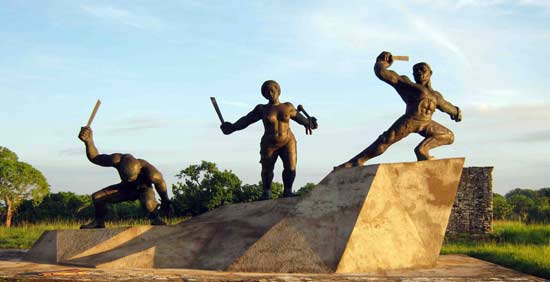
Monument to Carlota’s Rebellion, located at Triumvirato, erected in 1991
Writing about history is a messy business. For one thing, many historical figures, especially women, and most especially women of color, have been so systematically erased that the stories we still have of them are murky. This is certainly true of Carlota and Fermina. We don’t even know their real names – only the names their slavers forced them to bear. We know for sure that they existed, and everything else is a matter of sifting various stories together and trying to figure out where they overlap.
In this column, there is also the matter of who to choose as ‘Kickass.’ Carlota and Fermina were both said to have done terrible, violent things.
CW/TW
In Carlota’s case, she is accused of having killed or tried to kill a child.
Their story can be seen as one in which brutality begets brutality, and it can also be seen as a human being refusing to break or to become passive with despair in the face of massive crushing forces. Carlota and Fermina were clever, resourceful, determined leaders. I only wish I knew their real names.
Sources: