There is no World Cup without iconic moments, with the majority of them coming from the star-studded players on the pitch.
But during the 2006 World Cup in Germany, one of the tournament’s most unforgettable moments belonged not to a player, but to a referee.
His name was Graham Poll.
At the time, Poll was considered one of the best referees in the world, having spent years building a reputation for handling the biggest matches in football.
Confident, experienced, and respected, he arrived in Germany expecting to officiate deep into the tournament.
Some even believed he had a chance of being selected for the World Cup Final.
Then came a group-stage match between Croatia and Australia on June 22, 2006.
The game itself was tense from the start, with both teams fighting for qualification to the knockout rounds.
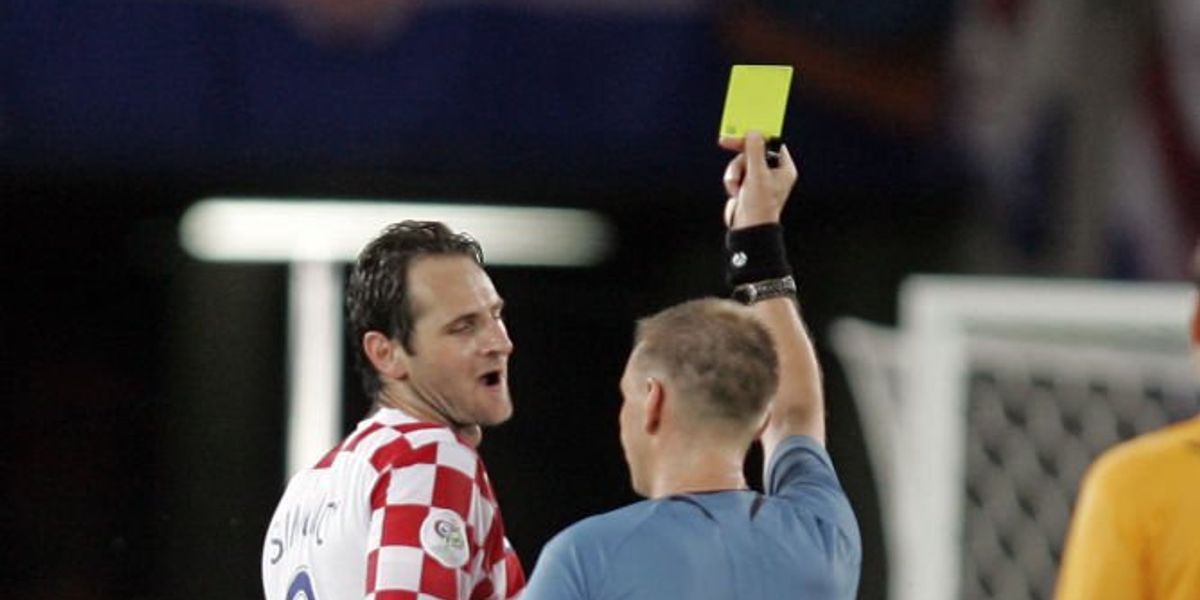
Poll showed Simunic received three yellow cards in the group stage match
|
GETTY
With challenges flying in and the atmosphere building, Poll had his hands full trying to keep a lid on proceedings.
One of the key figures in the drama was Croatian defender Josip Simunic, a tough, physical centre-back known for his aggressive style of play.
In the 61st minute, Poll reached into his pocket and showed Simunic a yellow card for a foul for a late challenge.
The match continued with Australia desperately trying to find a result to go through to the round of 16.
Simunic was shown two yellow cards in the game and one after the full time whistle
|
GETTY
Then came the moment that would change football history, as Simunic committed another foul.
Poll immediately produced another yellow card, as fans anticipated the red to be dished out and saw the centre-half depart the field of play.
Yet somehow, amid the chaos of a high-pressure World Cup match, one of the world’s most experienced referees had forgotten he had already cautioned the Croatian defender.
Once Poll blew for full-time, Simunic began arguing with the English referee, who, clearly frustrated, dished out another yellow card.
Poll explained his system of booking players had failed, which led to the blunder
|
GETTY
This finally triggered the red card, as Simunic became the first player in World Cup history to pick up three yellow cards in one game.
In his biography, Seeing Red, Poll explained how the complication occurred, writing: “My system had always been to identify teams in my notebook by their colours and not the team name. It is a system which I had found prevents confusion, believe it or not.
“So, in Stuttgart, I put ‘red/white’ for Croatia at the top of my left-hand column and listed the numbers of the players underneath. In the right-hand column, I put ‘yellow’ for Australia and listed their numbers. So when I cautioned Simunic that first time, I correctly put a ‘C’ for caution against Red/White number three in the left-hand column and noted the time – ’16/2′ (which meant 16 minutes of the second half).
“In stoppage time, I cautioned Simunic again – but I didn’t realise it was again. He fouled Australia sub Joshua Kennedy, and I showed him the yellow card, but this time, as I now realise, I recorded it wrongly.
“I put the ‘C’ beside the yellow three, in line with the red/white 3, which already had a ‘C’ against it. I didn’t note a time or offence. Although I have replayed the incident a thousand times in my head, I don’t really know why I did what I did.
“I cannot fully understand why I got it wrong and why I failed to send off Simunic. Aussie Joe certainly speaks with a broad Australian accent. Maybe, just maybe, that is where the confusion set in.
“Simunic began having a go at me. ‘You’re unbelievable,’ he said. I told him: ‘Any more of that and you’ll be off…’ As he ran away, he said: ‘That is unbelievable.’ We all know now what he meant.”