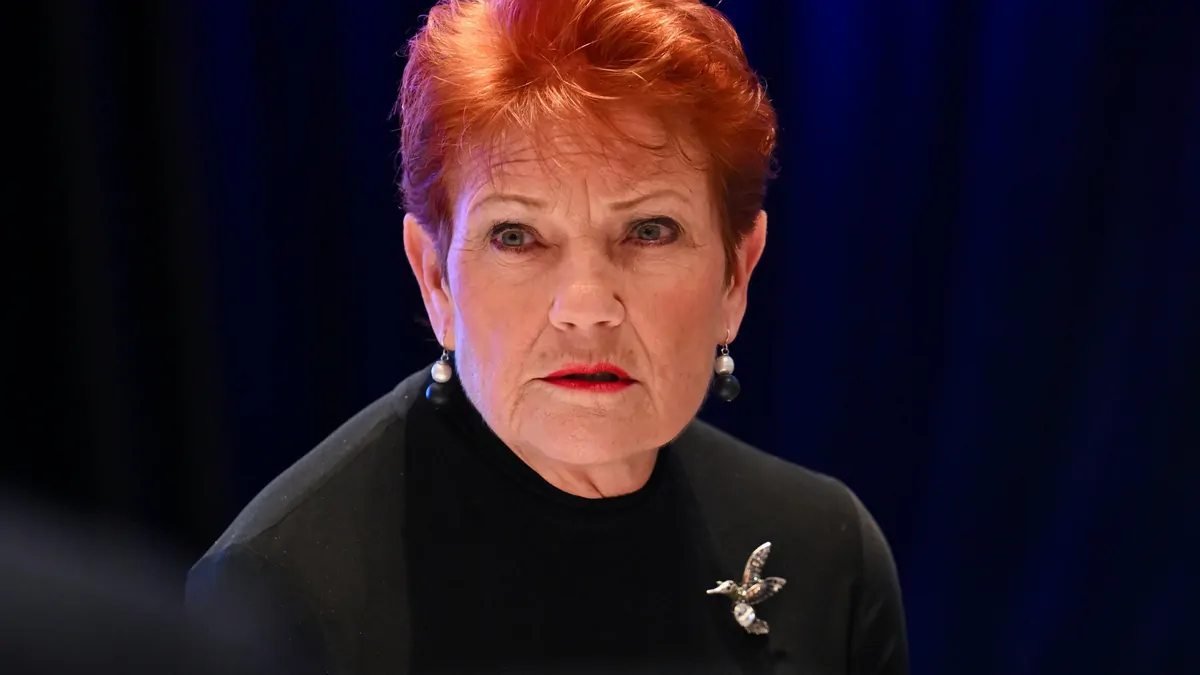
For most of her career Pauline Hanson has been dismissed as a bit player in Australian politics — a woman without substance, subtlety or guile.
This week the populist politician received a backhanded compliment in the form of a long essay by the doyen of political journalism, Paul Kelly, who said, bluntly, that Senator Hanson is not fit to govern Australia.
American author Robert Greene once wrote, “being attacked is a sign that you are important enough to be a target”.
Sign up to The Nightly’s newsletters.
Get the first look at the digital newspaper, curated daily stories and breaking headlines delivered to your inbox.
By continuing you agree to our Terms and Privacy Policy.
If that’s true, Senator Hanson has suddenly become very important. Among the Canberra cognoscenti, there is a new-found respect for the One Nation leader. Or perhaps the establishment’s contempt has been put away.
Even big media outlets on the left are scrambling for access. The ABC is complaining about being excluded from One Nation events, much to the delight of party insiders.
Policy prescriptions are being taken seriously. As is the prospect of the senator switching to the Lower House, where she would be eligible to become leader of the opposition, or even prime minister, the topic Kelly addressed seriously in his column this week.
As attention swirls around a woman used to being ignored, ridiculed or caricatured, Senator Hanson this week displayed an insight into her late-stage political popularity.
“Have I really changed?” she told a Nine podcast. “No, because the rest of the country’s caught up with me.”
With One Nation the preferred party of somewhere between 24 and 31 per cent of voters, she can’t credibly claim to have the whole country behind her.
In another sense she is correct. Over the past year, Australians have shifted rightwards and embraced One Nation’s proud nationalism. There are many reasons, but one of the most important might be a sense they were deceived about immigration.
For decades, the main parties participated in a non-aggression pact over what critics, including some in the Coalition, now call “mass migration”.
Filling the gaps of a below-replacement birth rate, the millions of new Australians kept the economy driving forward. They also accelerated property prices, made roads and streets busier and reshaping Australia’s ethnic complexion.
Last year, not long after Labor’s easy election win, conservatives began their own migration, from the Liberal and National parties to One Nation. For a Coalition trying to work out how to recover from the failure of the short Dutton era, the loss of its right flank was a psychological shock that it has not recovered from.
This week a former NSW Liberal minister Pru Goward said she believed 75 per cent of Liberals in her home town of Goulburn near Canberra would vote for One Nation. She was certain about one of the causes.
“Australians have never liked immigration,” she told the Sydney Institute this week. “It is just that they were never asked.”
Senator Hanson’s 30-year anti-immigration crusade has turned her into, by one measure, Australia’s most-popular political leader. Support for the senator among One Nation voters is 91 per cent, far ahead of the 60 per cent of Labor voters who admire Anthony Albanese, according to a RedBridge/Accent poll published this week.
For a politician famously inarticulate — her “please explain” exhortation became a cultural icon — the devotion of her fans is unmatched in modern Australian politics.
Potently, women are turning to her too. The RedBridge/Accent poll puts One Nation’s support at 28 per cent of women voters compared with 22 per cent who support the Coalition.
Women with children at home are the most sought-after by political parties because of the influence they wield over their families. They are difficult to reach through conventional media, which may help One Nation, which invests heavily in digital advertising.
The central question for Senator Hanson and One Nation is whether the party can convert the surge in support into Federal seats.
As a founder-led party, One Nation is a very centralised organisation. If it wants to become a major force in Parliament, it will have to build stronger campaign infrastructure, including teams of reliable volunteers who can help candidates communicate with community groups, media outlets and individual voters.
The party’s policies will naturally come under greater scrutiny over time too.
On Thursday One Nation MP Barnaby Joyce reversed a policy on air after initially stating that permanent residents would be forced from their homes if they did not sell them within two years.
The number of permanent residents is unclear, but there are probably more than 1 million, and the biggest group are British. After Mr Joyce’s comments, The Nightly reported that Senator Hanson had made similar comments two weeks earlier, although she said foreigners would be forced from their farms, which would be seized by the government.
On Friday morning, Senator Hanson said permanent residents would not be forced to sell but other foreigners would. That might catch the 730,000 New Zealanders among the 3 million foreigners living in Australia temporarily, immigration expert Abul Rizvi said.
The prospect of government agents, potentially escorted by armed police, seizing property from foreigners is a new idea for many Australians.
“This policy is formative,” Mr Joyce told Andrew Bolt on Sky News.
So too is One Nation’s polling ascendency. Now Pauline Hanson has convinced Australians to take her seriously, she will have to convince them that her policies can work too.