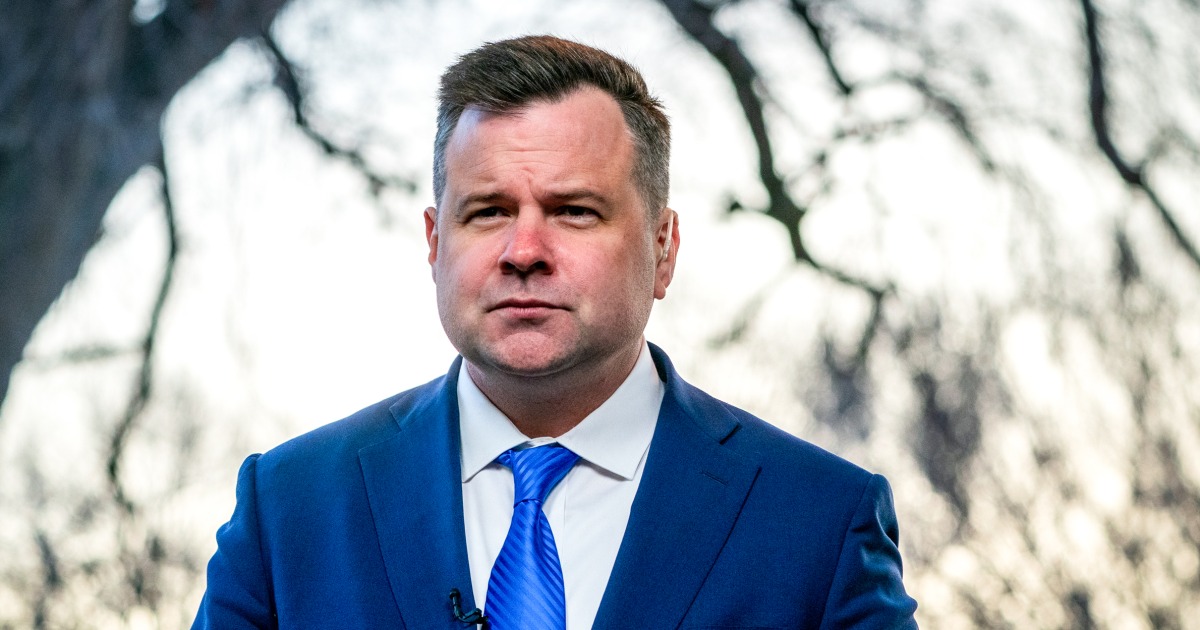
WASHINGTON — The partisan warrior named to serve as the country’s top intelligence official is part of a small circle of trusted allies who won President Donald Trump’s confidence by taking swift action against his prominent Democratic critics, according to three people with knowledge of Trump’s decision.
Subscribe to read this story ad-free
Get unlimited access to ad-free articles and exclusive content.
Bill Pulte, the administration’s chief housing regulator, who is due to take over as acting director of national intelligence by the end of the month, has Trump’s ear, shares his sense of urgency and is a regular presence at the White House and at Trump’s properties in Florida, the people told NBC News.
“Trump is always with Pulte and always saying we’re running out of time to get things done,” one of them said.
Pulte, who will keep his current role as head of the Federal Housing Finance Agency, has no known work experience in intelligence, the military or national security. Yet he will oversee some of the world’s most sophisticated and powerful intelligence agencies, equipped with an array of surveillance tools and a global network of spies.
Former intelligence officers who served in both Republican and Democratic administrations worry that Pulte will have unfettered access to a trove of intelligence that could be used to target political opponents or justify possible federal oversight of elections, as Trump has called for. They say that by choosing someone with no background in intelligence or national security, Trump has sent a message that he doesn’t value those who work at the spy agencies.
The White House defended Trump’s choice despite skeptics from both parties in Congress, who cited his lack of relevant experience and his partisan record.
“The President chooses the best and most talented people to serve in his Cabinet,” Davis Ingle, a White House spokesman, said in a statement. “That is why this Administration has achieved record successes for the American people. Bill Pulte is a great selection and he will do a great job on behalf of the American people.”
Trump’s supporters heaped praise on Pulte, saying the appointment showed Trump was rewarding a loyalist as he grows impatient with efforts by others in his administration.
“He gets things done and brings ideas to the president,” Steve Bannon, a longtime adviser who shaped Trump’s 2016 campaign and served in his first administration, told NBC News. “That’s what President Trump is looking for.”
Pulte’s mandate is to pick up where his predecessor, Tulsi Gabbard, left off as national intelligence director, Bannon said. Gabbard resigned after her husband was diagnosed with cancer.
That will mean focusing on foreign threats to U.S. elections, investigating the so-called deep state, coordinating intelligence work and offering up alternatives to what is coming out of the CIA, Bannon said.
“He’s going to go after everything with a heightened urgency,” Bannon said.
Although the Constitution gives states the authority to hold elections, Trump has called for the federal government to oversee voting in some states, because, he says, local authorities can’t be trusted. Trump still falsely claims Democrats stole the 2020 presidential election, even though members of his own Cabinet have said there was no widespread voter fraud.
Democratic lawmakers and civil rights advocates were already concerned that the Trump administration might try to use intelligence agencies to allege a foreign threat to elections that could provide a potential rationale for federal interference.
Those fears were reinforced after the National Intelligence Director’s Office obtained and examined voting machines from Puerto Rico and after Gabbard was on hand when FBI agents seized ballots from the 2020 election in Georgia.
A former senior intelligence official said he expected Pulte to focus heavily on foreign threats to previous and current U.S. elections, possibly as a way of questioning the security of vote counting in some crucial states. “I bet that’s probably close to the top of his agenda,” the former official said.
Pulte hasn’t commented publicly, but he has shared online support from the White House, Vice President JD Vance and other administration officials.
Pulte will oversee a network of 18 agencies, including the CIA and the National Security Agency, in a position created after 9/11 to consolidate and better share intelligence.
“Bill Pulte will very much be an ODNI director in the mold of Gabbard who is committed to releasing the truth and is loyal to the president,” longtime Trump ally Roger Stone said.
At the housing agency, Pulte levied mortgage fraud allegations against several of Trump’s perceived political enemies, including New York Attorney General Letitia James, Sen. Adam Schiff, D-Calif., and former Rep. Eric Swalwell, as well as Federal Reserve Governor Lisa Cook.
Former CIA officer John Sipher said Pulte’s track record “suggests he’s meant to run a detective agency for the president using the director of national intelligence” office.
With access to a vast amount of intelligence, someone with a political agenda could choose to selectively declassify some documents to support a particular false narrative or conspiracy theory while withholding other information that might provide caveats or context, Sipher said.
“The problem with the intelligence community is that it’s all classified, so they can choose to put stuff out, and there’s no way for anybody to challenge it or question it, because they’re choosing what’s public and what isn’t public,” he said.
In an interview with the New York Post, Trump described Pulte as “very talented” and said he would accelerate the declassification of intelligence — though he did not elaborate. Trump also praised Pulte’s oversight of Fannie Mae and Freddie Mac, government-sponsored enterprises created by Congress to support the mortgage market.
Pulte “has deep experience managing the most sensitive matters in America,” Trump posted online.
Sen. Mark Warner of Virginia, the top Democrat on the Intelligence Committee, warned that Pulte will use his position to go after Trump’s enemies, especially ahead of the midterm elections in November.
“Think what he can do with all of the information from the intelligence agencies,” Warner said. “Our intelligence work has always been bipartisan. Are we going to finally hit the gag reflex? I hope.”
Pulte has been named only as the acting director and so far hasn’t been nominated to fill the job permanently, which would require confirmation by the Senate. Several Republicans made it clear that he would face an uphill fight to secure approval from the Senate.
“I see no evidence of any qualifications for that job,” said Sen. John Cornyn, R-Texas.
Sen. Bill Cassidy, R-La., told NBC News: “He doesn’t seem very qualified.”
Other Republican lawmakers have voiced support for Pulte, including Sen. Bernie Moreno of Ohio, who said on X that he believes Pulte “will lead the DNI with integrity, cripple the deep state, state, and always prioritize America’s national security.”
Sen. Thom Tillis, R-N.C., said Pulte wasn’t fit for the job and criticized the timing of his appointment, just as Congress was preparing to vote on renewing a controversial law enabling the government to conduct electronic surveillance of foreign actors and terrorism suspects. As a new arrival to the national security realm, Pulte could make it more difficult for some lawmakers to support the law’s renewal, he said.
“The timing of this nomination couldn’t have been worse,” Tillis told NBC News.
In particular, Tillis is concerned about the reauthorization of Section 702 of the Foreign Intelligence Surveillance Act, which allows spy agencies to collect overseas electronic communications without warrants. The surveillance tool means intelligence services can incidentally scoop up communications of U.S. citizens speaking with targeted foreign actors.
U.S. officials argue the authority is crucial to prevent terrorist attacks and track foreign adversaries. But civil liberties advocates say it violates privacy rights.