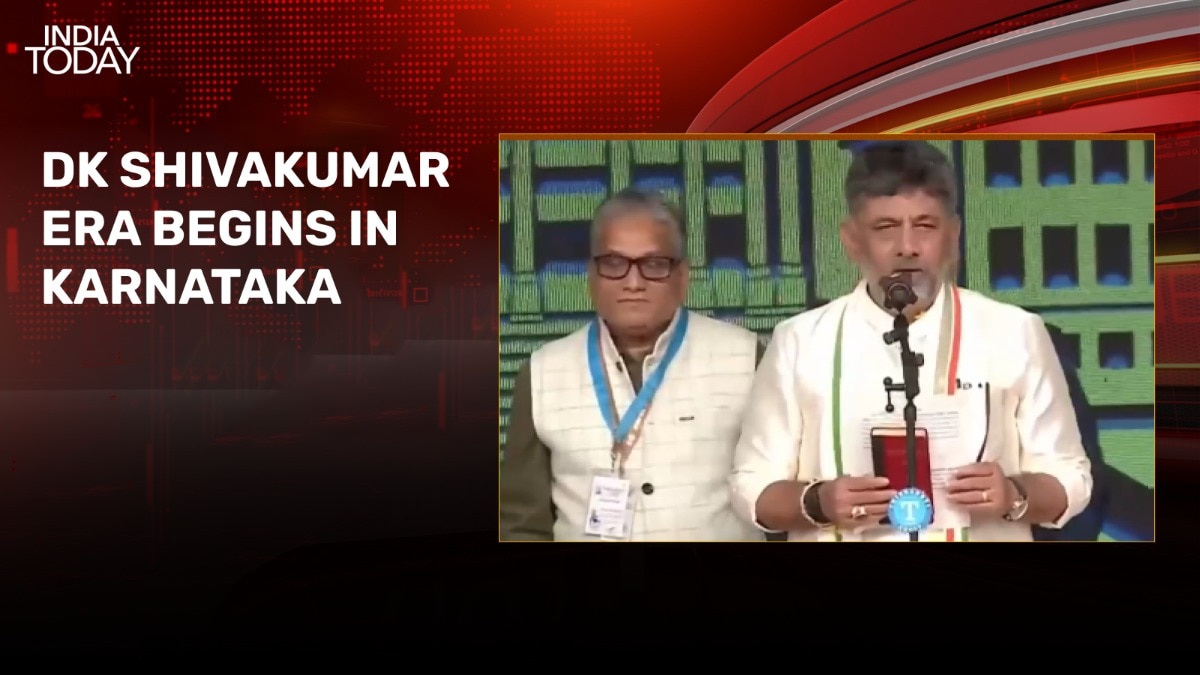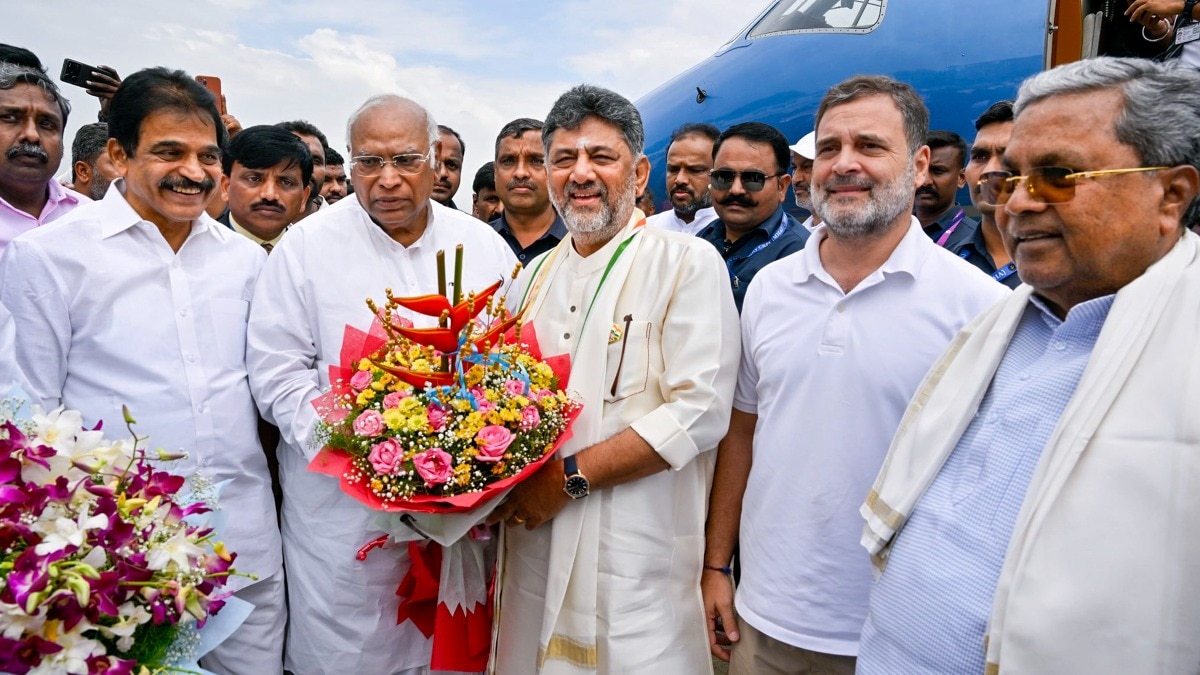
After years of tussles, intense speculations, multiple breakfast meetings, and carefully crafted images of public bonhomie, the Congress party in Karnataka finally took the most difficult decision. The high command gave its green signal for a leadership change, asking the outgoing Chief Minister Siddaramaiah, the state’s tallest leader of the AHINDA (a coalition of Backwards Classes, Dalits, and minorities) politics, to step down. With his resignation, DK Shivakumar, a strong loyalist of the Gandhi family, took oath today, fulfilling a dream that he has long harboured.
As an enthusiast of Karnataka politics, I find a distinct caste arithmetic underlying this surprising move. By elevating Shivakumar to the Chief Minister’s post, the Congress aims to achieve two strategic goals. First, it sends a powerful message to the historically loyal Vokkaliga community that the party continues to champion their interests. Second, it directly counters the rising electoral threat from the BJP-JD(S) alliance, neutralising their hold over the Vokkaliga vote bank.
Let’s dive deeper into the two. One by one.
CASTE AND KARNATAKA: A NEVER-ENDING LOVE STORY
Caste has historically played a significant role in determining the state’s political and electoral outcomes. Often taking centre stage, it shaped the dominance of political parties over the years. The 2023 assembly election is a testimony to that.
Carefully crafted social engineering by Congress helped the party deliver one of its greatest performances in history by securing a staggering 135 seats. Drawing a broader social coalition, involving the Vokkaligas, Lingayats, and AHINDAS, it tried to stitch together both socially advanced and marginalised communities. The party fielded 46 Lingayat candidates, and 34 of them won their respective constituencies. Among the 42 Vokkaliga candidates, 22 emerged victorious, and lastly, among its 36 Dalit candidates, 25 won in their respective constituencies. Among the 15 Muslim candidates, nine also won.
In terms of total vote share, Congress bagged 29% of Lingayat votes, 49% of Vokkaliga votes, 63% of Dalit votes, and 70% of Muslim votes. The numbers depict that its experiment of bringing together the castes–which shared hostilities against each other–proved to be successful.
Two veteran Congress stalwarts can be attributed to this major success. One, Siddaramaiah, the tallest AHINDA spokesman, whose efforts galvanised nearly all the marginalised Dalit and OBC communities, including the Madiga community, which earlier, largely voted for the BJP. Second, DK Shivakumar, the state unit chief of the Congress party, who was considered the main man behind the ground-level organisational revivalism after the party’s back-to-back setbacks in the 2018 assembly and 2019 Lok Sabha polls.
Shivakumar’s (also known as DKS in political circles) rise also paved the way for the Congress to portray itself as the party solely championing the Vokkaliga interests. Since the emergence of the Janata Dal (Secular), led by the family of the former Indian PM HD Deve Gowda, the Vokkaligas have swayed between the JD(S) and the Congress, with the former often outplaying the latter. However, Shivakumar’s rise pushed Deve Gowda’s son HD Kumaraswamy to the margins, at least in the 2023 elections, where the number of seats for the JD(S) in 46 Vokkaliga-dominated constituencies drastically declined to just 11 from its previously held 25 in 2018. In Mandya, JD(S) won just two out of seven seats. In Hassan, the party won five, less that seven that it held in 2018. HD Deve Gowda’s grandson Nikhil Kumaraswamy lost in the party stronghold Ramanagara.
THE RISING THREAT
The honeymoon period for the Congress with its dream social coalition lasted only for one year.
The party witnessed a major reality check in the 2024 Lok Sabha polls, where it won just nine seats. Much lower than what Shivakumar had promised to the high command.
So, where did it fail? The AHINDA support for the Congress remained intact, with the Dalits and the Muslims largely rallying behind the grand old party. However, it was the shrinking JD(S) that sided with the BJP in the NDA coalition and helped make a dent in Congress’s poll future in Vokkaliga votes. Besides, the Lingayat votes also shifted to the BJP, bringing a major halt to Congress’s unchallenged run in Karnataka.
In the Mandya seat, which is known as the heart of Vokkaliga politics, HD Kumaraswamy won by a margin of more than 2.5 lakh votes, sending a strong message to the Congress that JD(S) still held the power to galvanise the Vokkaliga votes behind him. In Bengaluru Rural, another Vokkaliga-dominated seat, Shivakumar’s brother DK Suresh suffered a major blow as he lost by a margin of 2.6 lakh votes against HD Deve Gowda’s son-in-law and famous cardiologist CN Manjunath. The seat is also dominated by a large Vokkaliga population, and DK Suresh held the constituency three times.
In Southern Karnataka, where Vokkaligas formed 11–17% of the total population, the Congress won only two out of 14 seats it contested. The JD(S) significantly helped its partner, the BJP, to secure Tumakuru, Chickballapur, Chitradurga, Mysuru, Bengaluru North, and Bengaluru Rural, by transferring a significant amount of votes.
In terms of total vote share, Congress saw a rise. However, they were closely followed by the NDA coalition. In 2023, Congress secured 49% Vokkaliga votes, against BJP’s 24 and JD(S)’s 17. Although the tally for Congress shot up to 56% in 2024, the NDA secured 44%, narrowing the gap. The alliance between the two parties seemed to be pivotal.
As the threat seems to be widening, former journalist Arun Antony believes that elevating Shivakumar might benefit the Congress in the long run. “Karnataka’s politics, most of the time, has revolved around the rivalry between the Vokkaligas and the Veerashaiva Lingayats. The politics of the BJP and JD(S) is mostly dependent on this. JDS has strong footing among Vokkaligas; the BJP has strong support among Veerashaiva-Lingayats. However, the elevation of Shivakumar can assure Congress a strategic benefit. A Vokkaliga CM potentially weakens the BJP-JD(S) alliance by reducing HD Kumaraswamy’s value as the primary vehicle for community mobilisation.”
He also added that although the Vokkaligas were not completely unhappy with Congress, there were wider demands for Shivakumar as the Chief Minister. “DK Suresh, metaphorically, started asking Siddaramaiah to hand over the power when the government hit 2.5 years of rule. And there were more people like him.”
ANGER OVER CASTE CENSUS
If the temporary setback in the Vokkaliga-dominated seats indicated that not everything was in fine tune, the Backwards Classes Commission’s Socio-Economic and Educational Survey (caste census) report sparked a major row among the members of the Vokkaliga community, with several bodies openly protesting about the survey data for allegedly misrepresenting them.
Key Vokkaliga bodies like Rajya Vokkaligara Sangha openly questioned the legitimacy of the data, calling it unscientific. The institutions also said that the ‘outdated’ data underrepresents the population.
The anger was witnessed even among the lawmakers. Some of the Vokkaliga legislators called the survey a ‘grave injustice’ to the community, prompting DK Shivakumar to mention that the issue would be raised before the cabinet.
LEARNING FROM THE VEERENDRA PATIL MISTAKE
In 1989, Veerendra Patil delivered the greatest poll performance for Congress as he led the party to a massive victory with 178 seats.
Patil, a strong Lingayat leader, was elected as the Chief Minister. However, his tenure lasted for only one year as Rajiv Gandhi removed him from the Chief Minister’s post in 1990. A move that haunted Congress for the three decades, as the party lost the vast section of Lingayat votes, which switched over to the BJP.
Three-and-a-half decades later, the party is at the same juncture, with a potential risk of losing the votes of the Vokkaligas if Shivakumar was not elevated as the Chief Minister. However, this time, learning from the previous mistake, the party did a major course correction to prevent the threat.
“Vokkaligas might be loyal to Congress, but there has always been a Deve Gowda factor. JD(S) would be part of the NDA alliance in the 2028 assembly election, which would have swayed a section of Vokkaliga votes. Hence, they needed a Vokkaliga leader at the helm. Shivakumar is hence a good choice,” said author, publisher Karthik Venkatesh.
But would not the move hurt AHINDA sentiments? The Dalits, who have rallied behind the Congress, might feel the same anger and can switch their loyalties to the NDA coalition. Venkatesh believes that the Congress has solved the Dalit question by elevating G Parameshwara, the tallest Dalit leader in the state. “Parameshwara might be elevated as the next Deputy Chief Minister. Besides, there is Mallikarjun Kharge. Siddaramaiah’s son can also be inducted into the cabinet. So, as of now, there is not a direct threat from the AHINDA votebank,” Venkatesh says.
Beyond caste lines, Antony also highlighted another angle behind this possible move. Elevation of DK Shivakumar, who is hailed as a business tycoon in the state, can promise a lot of infrastructural projects. “Alongside the caste politics lies a governance challenge. Karnataka, particularly Bengaluru, has little by way of transformative infrastructure projects to showcase after three years of Congress rule. Siddaramaiah’s welfare programmes have political value, but welfare rarely answers the electoral question: what did you build?” he said.
“This is where DKS becomes central to Congress’s strategy. His political identity is closely tied to infrastructure, real estate and large-scale development. The party is betting that he can create a visible achievement narrative for Bengaluru within the next two years, something that welfare politics alone cannot provide,” he added.
– Ends
Published By:
Akash Chatterjee
Published On:
Jun 3, 2026 16:27 IST