Local News
The Inspector General’s office released a 190-page report Monday revealing the extent of the sheriffs’ offices’ financial mismanagement.
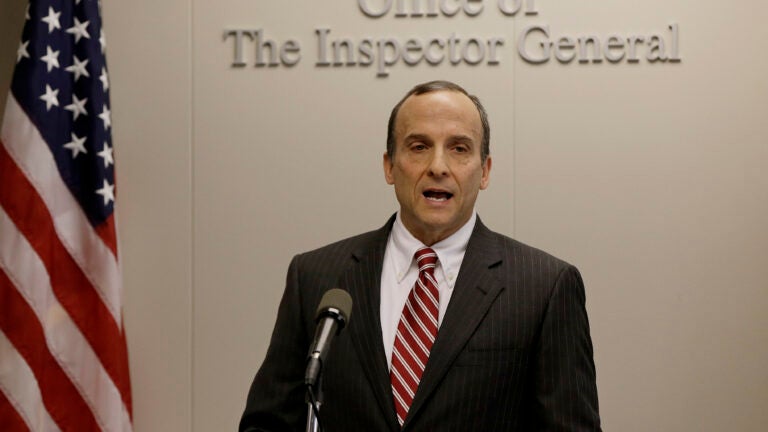
The Office of the Inspector General released a 190-page report Monday about sheriffs’ offices mismanagement of finances. Stephan Savoia/AP Photo
Massachusetts sheriffs’ offices have stirred up financial chaos that a state watchdog compared to “the wild west,” according to a new report.
The Office of the Inspector General (OIG) released a report Monday on budgets and expenditures at the state’s 14 county sheriff’s offices that painted the agencies as suffering from underfunding, overspending, and lack of oversight. These issues came to a head at the end of Fiscal Year 2025 (FY25), which the offices closed with a historic combined deficit of $110 million.
In the 25 years since sheriff’s offices became Commonwealth agencies, they have suffered from mismanaged finances, insufficient oversight, increased costs, lost revenues, and an “inconsistent understanding” of the sheriff’s role, the OIG said in a press release.
“To put it in sheriffs’ terms, it’s a bit like the wild west,” Inspector General Jeffrey Shapiro said in the release.
Some of the sheriffs’ offices’ poor practices have escalated to the level of blatant violations of state finance laws, Shapiro’s office said. In its investigation, the OIG identified more than 120 private bank accounts operated by sheriffs “outside the oversight and knowledge of the Commonwealth’s Treasurer and Comptroller.”
More than $42 million was paid out from these accounts in FY25, and at the end of the year, they held balances of more than $36 million, according to the OIG. However, the agency couldn’t tell if the sheriffs running these accounts followed through with their legal requirement to remit the accrued interest.
Sheriffs were also found to be regularly taking funds from payroll accounts to cover other expenses, making it impossible to identify the true cause of their deficits. The OIG noted that recent executive mandates have resulted in “additional financial demands” but said that these factors still don’t explain the offices’ large deficits.
The OIG further found that the sheriffs’ offices neglected recommendations to operate civil process programs under the Commonwealth’s oversight and record all fees and expenditures in the state accounting system. The agency described the civil process laws as “grossly out of date and needlessly complex.”
Worse still, some sheriff’s departments indicated during the investigation that they don’t believe that typical controls apply to civil process funds because they are “not taxpayer money,” the OIG wrote in the report.
“While it is true that the funds are not ‘taxpayer money’ in that they are not taxes, they are most definitely public funds,” Shapiro said in the press release. “Any funds collected by a public entity, whether they be taxes, fares, fines, or fees, are public and accordingly should be treated as such.”
Shapiro noted that these issues don’t all apply to every sheriff’s office in Massachusetts. However, he said the concerns raised in the report are widespread enough to warrant being addressed on a larger scale.
“It is important to appreciate the difference between receiving a partial reimbursement for a mandatory program late in the fiscal year as compared to purchasing unnecessary equipment to perform a strictly discretionary activity. Both cause a deficit, but they are not the same scenario,” Shapiro said in the report. “We have done our best to make those distinctions and to not always paint these 14 offices and the sheriffs that lead them with one broad brush.”
The OIG made short-term, medium-term, and long-term recommendations that are designed to ensure that all sheriffs’ offices statewide have a “common understanding” of their “mandatory and discretionary functions.” The Massachusetts Sheriffs’ Association told The Boston Globe that, going forward, it will work to standardize practices across departments.
“The Sheriffs will carefully evaluate the report’s findings and recommendations and will study and deliberate them as part of our continued efforts to strengthen operations, enhance accountability, and ensure responsible use of public resources across the Commonwealth,” Carrie Hill, executive director of the sheriffs’ organization, told the Globe.
Sign up for the Today newsletter
Get everything you need to know to start your day, delivered right to your inbox every morning.