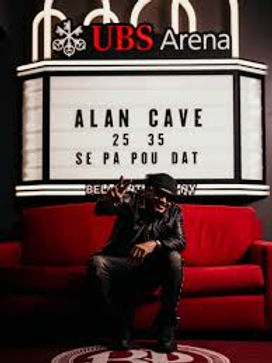
Alan Cave won the attendance battle at UBS Arena. After a strong Boston turnout of about 5,000, drawing close to 10,000 in New York is a crowd win by any fair measure.
That matters because HMI rarely gets nights this big without debate about whether the market can support them. Alan proved the audience is there. Still, a packed building is only part of the story.
The larger question is what the night meant for Haitian live music as a whole. A major concert should give fans more than songs they love. It should give them one moment they still talk about years later.
Alan Cave proved he can draw a major crowd at UBS Arena
Getting that many people into one room is hard. It takes more than name value. It takes trust from fans, a catalog people still care about, and enough reach to move casual listeners and loyal supporters at the same time.
Alan has that reach. The jump from Boston to UBS Arena says his name still carries weight across cities, age groups, and eras of Haitian music. That kind of turnout does not happen by accident.
What the turnout says about his popularity and staying power
A big room can expose an artist. If the demand is weak, you see it fast in the empty seats. Alan avoided that problem. The near 10,000 figure, especially after Boston, says he still has staying power.
The Boston date already hinted at this. Coverage of the Boston concert framed it as proof that Haitian artists can push past old limits in the U.S. UBS Arena pushed that point further.
Why classic hits still bring people through the door
Most fans came to hear the songs they already carry with them. That is not a weakness. It is part of Alan’s strength. When an artist has years of beloved material, nostalgia becomes a ticket seller.
People want the singalongs. They want the songs tied to old dances, old relationships, and old versions of themselves. Alan delivered that. The crowd knew the words, and that shared memory kept the room alive even when the show itself did not always rise with the same force.
The show delivered songs, but not the big wow moment people remember
This is where the night gets more complicated. Alan gave people the hits, and for many in the building, that alone was enough. Yet the concert still felt one step short of being unforgettable.
A strong set can satisfy a crowd. It does not always create a story that lives beyond the building. That was the gap.
A packed arena proves demand. A lasting concert memory proves vision.
What makes a wow moment at a live show
A wow moment does not need to be expensive. It needs to feel surprising, earned, and impossible to ignore.
It can also be a stage choice. A walk through the crowd, a stripped-down version of a classic, or one daring production move can shift the night. Fans remember moments because they break the pattern.
Why a strong setlist is not always enough
A good setlist keeps people happy. An arena show needs more than that because people do not talk for years about a concert that was simply good. They talk about the one section that made time stop.
That is where many HMI shows still fall short. The songs hit, but the memory fades too fast. You leave saying the artist sounded good, not saying you witnessed something special.
Why this is a bigger HMI issue, not just one artist’s problem
It would be too easy to pin all of this on Alan Cave. The bigger issue sits across the Haitian music scene. HMI has gotten better at drawing crowds for major dates, but it still often treats attendance as the final prize.
Attendance matters, of course. Big rooms need bodies. Promoters need results. Artists want proof that they can headline a major stage. But once that part is won, the standard has to rise.
Big venues bring bigger expectations
Fans do not experience an arena the same way they experience a club or a ballroom. The room is larger, the ticket price is higher, and the sense of occasion is stronger. Because of that, people expect scale.
Even the legacy concert announcement leaned into celebration, history, and anticipation. That kind of framing raises the bar. People expect production, emotion, surprise, and flow that fit the size of the event.
Sometimes younger fans say the quiet part out loud.
“How come I paid the same amount of money for a Carimi concert as I paid for the Usher concert, but totally different productions? The visuals were night and day.”
That comparison may be harsh, but the point is fair. No one is asking HMI to match Usher’s budget. Fans do want to see effort. If ticket prices ask for arena-level money, the show should show some arena-level thought.
How some HMI shows feel more like crowd counts than true experiences
Too many big HMI concerts still feel built around one headline, “look how many people came.” That is a real achievement, but it is not the same as building a full concert experience.
A show can sell well and still leave an artistic opening. When fans leave talking more about attendance than artistry, the night was successful, but incomplete. HMI has already shown it can fill seats. Now it needs to create the kind of moments that shape culture, not only ticket counts.
What Haitian bands can do to create moments people will still talk about
The fix is not to copy pop stars or turn every concert into a circus. Haitian bands do not need to lose the heart of the music. They need to plan for one or two moments that feel larger than the normal run of songs.
That takes intention. It takes rehearsed transitions, tighter pacing, and a clear emotional arc. Most of all, it takes asking one simple question before show night, “What will people remember when they get home?”
Use surprise, storytelling, and special guests with purpose
Surprise works best when it means something. A guest should connect to the artist’s story. A tribute should fit the night. A spoken intro should set up a song, not stall the room.
Alan’s show already hinted at this. The motorcycle intro got a strong reaction. A duet with his father added warmth and intimacy. Richard Cave’s surprise appearance also gave the crowd a jolt. Those moments stood out because they broke the routine.
Build more emotion into the live performance
An arena set should rise and fall with purpose. If every song lands at the same level, the night can start to feel flat even when the music is good. Fans need peaks.
That means fewer dead spots between songs, less drift in the middle, and more connection with the crowd. The best live shows make you feel carried somewhere. They do not simply stack songs one after another.
The show itself had real highs, but the pacing hurt it
When I bought my ticket, I got the last seat in my row. So when I arrived around 9 p.m., I was the first person sitting there, and I watched the slow traffic in that section up close as people kept filing past.
The show did not begin until around 10 p.m., though many expected a 9 p.m. start. That delay changed the energy before the first note. Even so, the room came alive when Alan made his entrance on a motorcycle. That was the clearest big-stage image of the night.
After that, he went into hit after hit, and the crowd responded the way you would expect. The UBS Arena event promo promised a major night, and the turnout gave it that scale. The duet with his father added a personal touch, while Richard Cave’s surprise appearance brought real excitement.
The Zin moment showed the value of stage presence
Alan’s roots with Zin gave this part of the night extra meaning. It should have been one of the sections that fully opened up the stage.
Nia stood out right away. She owned the stage from the moment she stepped in and used the full width of it. That matters in a large room. Movement helps connect the far seats to the performance, and she understood that instinctively.
Alan, by contrast, stayed near center stage for most of the night. From the crowd, that made the performance feel more fixed than it needed to be. Georgie brought less energy, at least from where I sat, and the chemistry with Alan did not feel as natural as Nia’s. Alex Abellard added a welcome spark with sharp guitar work.
The pros and the cons were easy to spot
The biggest pro is simple. The audience came for the old songs, and Alan gave them exactly that. He fed the nostalgia they wanted, and that is a major reason the night worked.
The biggest con was the flow. Too much talking, too many cuts, and too many pauses between songs made parts of the concert feel more like a “bal” than a true arena show. By the middle stretch, many people had gone back to their seats.
That is the next task for Alan, and for every HMI artist aiming at major venues. Filling the room is no longer the dream on its own. The next step is creating one big moment that outlives the night.
The promoter learned from the last event
Compared with Boston, the media approach looked much tighter this time. The first Alan Cave concert in Boston felt almost like a media conference, with many promoters and media people present. This time, that footprint looked sharply reduced.
I barely noticed out-of-town media beyond Carel Pedre, KitKat, and comedian Atis Panch and they were part of the show. That choice cuts cost, and the turnout proves the event did not depend on heavy Haitian media promotion to sell tickets.
Still, that move comes with a trade-off. You save money, but you also lose some of the broad post-show coverage that helped extend the Boston event’s buzz. Arly Lariviere faced a similar silence after his theater show at MSG.
Alan Cave had a successful night at UBS Arena. The crowd size alone proved that his music still moves people and that HMI can support large-scale concerts in the U.S.
Now the standard has to move higher. Big rooms ask for big ideas, and fans deserve memories as strong as the songs. HMI has shown it can fill arenas. The next challenge is creating big moments that people will still be talking about 5 or 10 years from now.