Boston Bruins
“I will do whatever I can to make sure nobody else has to watch their loved one deteriorate like that.”
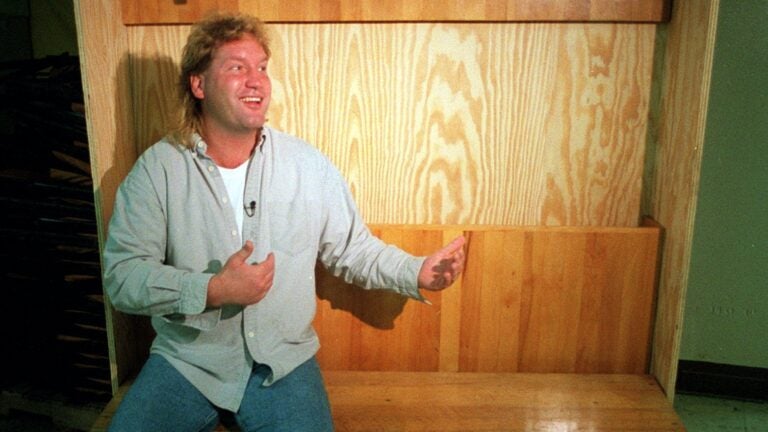
Lyndon Byers was a fan favorite during his nine seasons in Boston. Michael Robinson-Chavez
May 28, 2026 | 7:47 PM
2 minutes to read
Former Boston Bruins scrapper and longtime radio co-host on WAAF’s “The Hill-Man Morning Show” Lyndon Byers was posthumously diagnosed with chronic traumatic encephalopathy (CTE), his family announced on Thursday.
Byers died last July at 61 years old, with the former NHLer pledging to donate his brain to the UNITE Brain Bank at Boston University’s CTE Center for further testing prior to his death.
Byers’ family said they authorized the results of that testing to be revealed in order to raise awareness about the effects of CTE.
Dr. Ann McKee, director of the Boston University CTE Center and chief of neuropathology for the VA Boston Healthcare System, said that Byers suffered from Stage 3 (of 4) of the progressive, degenerative brain disease, which has been linked to athletes in contact sports, including football and hockey.
“With stage 3 disease like Lyndon Byers had, individuals almost always report cognitive symptoms, and 50% develop dementia,” Dr. McKee said. “We thank the Byers family for this contribution to research, which brings us closer to our goal of diagnosing CTE during life and develop effective treatments for those still living.”
Byers played 10 seasons in the NHL, including nine with the Boston Bruins. A fan favorite in Boston, the pugnacious Byers was a punishing force on the ice, ranking 11th in Bruins franchise history with 959 penalty minutes.
Byers’ widow, Anne Byers, noted that Byers’ personality shifted dramatically at times after his playing career.
“He was so fun and vibrant but towards the end it got to the point where didn’t want to socialize or even leave the house. He battled severe depression, had episodes of hallucinations, and his struggles with short-term memory loss made it difficult for him to navigate the day on his own,” she said. “I will do whatever I can to make sure nobody else has to watch their loved one deteriorate like that.”
According to the Concussion & CTE Foundation, 19 of the 20 former NHL players studied at the Boston University CTE Center were posthumously diagnosed with CTE — including Bobby Hull, Ralph Backstrom, Stan Mikita, Bob Probert, Derek Boogaard, and Byers.
“The NHL can do better to protect its players’ safety,” Anne Byers added. “Athletes deserve to know what head injuries can do so they can make informed decisions about their bodies and work in an environment that supports their health first.”
Conor Ryan is a staff writer covering the Bruins, Celtics, Patriots, and Red Sox for Boston.com, a role he has held since 2023.
Sign up for the Today newsletter
Get everything you need to know to start your day, delivered right to your inbox every morning.