Boston Red Sox
They have their lowest batting average since 1968 and lowest ERA since 1992. What should we make of that?
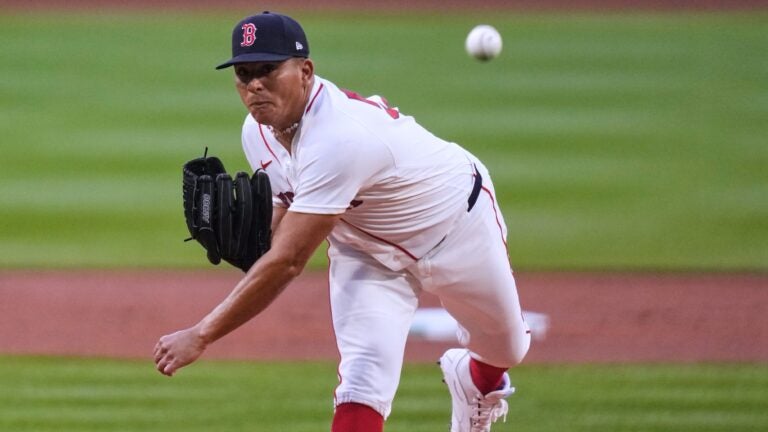
Ranger Suárez pitches during a game against the Yankees. Charles Krupa/AP Photo
May 21, 2026 | 2:51 PM
4 minutes to read
On the surface, Wednesday’s 4-3 win over the last-place Kansas City Royals may seem like just another game in a long and winding season with many twists and turns.
Dig a little deeper, though, and this was a particularly significant victory for a Red Sox (22-27) team that appears to be finding its footing.
Heading into the game, the Red Sox were 15-22 against left-handed starters. They’re now 16-22. They were 4-20 when their opponent scores first. They’re now 5-20. They were 2-23 when trailing after six innings. Now, they’re 3-23.
OK, so it’s still a little bleak, but you have to start somewhere. In a season that has largely followed a repetitive pattern to this point, the mission for the Red Sox is simple: score at least four runs, and they’re going to give themselves a chance.
They’re 8-21 when scoring three runs or fewer and 14-6 when scoring four or more. It sounds straightforward, but with one of the best rotations in baseball, the offense will ultimately dictate how this season unfolds.
Since Theo Epstein has become a part of FSG, we’ve wanted to hear him speak publicly on the Red Sox. He did that a few days back.
“The pitching and defense have been fantastic and that’s not an easy feat… having to figure out the offense and fix it midstream is important.” pic.twitter.com/nD4iSPQgeg
— Tyler Milliken (@tylermilliken_) May 20, 2026
If the offense can generate some consistency, and take a bit of pressure off the pitchers, this team is capable of making some noise. The lineup isn’t going to magically turn into one of the best in baseball, but if it can avoid remaining one of the worst, that would be a win. If not, it could be a long season.
With that in mind, let’s explore the matter further to find out whether or not this formula is sustainable.
Let’s start by comparing the Red Sox to last year’s playoff teams. So far this season, Boston is hitting .240 with 36 home runs (.73 per game), and 181 runs (3.69 per game). The Red Sox have a 3.68 ERA (crazy how close it is to the runs per game), a WHIP of 1.23, and 18 quality starts (36.7 percent).
Of course there are many other factors at play as well, but this should provide a big-picture view of how this team compares to others before it.
Last year, the Toronto Blue Jays led the Majors with a .265 batting average and hit 191 home runs (1.18 per game) en route to 798 runs (4.93 per game). Their ERA was 4.19, WHIP was 1.27, and they had 57 quality starts (35.1 percent). As a whole, the Red Sox are, unsurprisingly, lagging well behind a team that made the World Series at the plate and lapping them on the mound. Toronto did it with hitting and good-enough pitching.
The Red Sox pitching staff overall is second in ERA (2.56) in May. The rotation is third (3.09).
Ranger Suarez (0.66)
Sonny Gray (1.06)
Payton Tolle (1.35)
Connelly Early (4.03)
They’ve been getting it done and without Garrett Crochet pic.twitter.com/yJzKlcdfFv
— Pesky Podcast (@pesky_podcast) May 21, 2026
What about a team that’s built to win on small ball and pitching? The Milwaukee Brewers, who made the National League Championship Series, posted a 3.58 ERA, WHIP of 1.23, and had 46 quality starts (28.3 percent). At the plate, Milwaukee’s numbers were far superior, with a .258 average, 166 home runs (1.02), and 806 runs (4.97). The Brewers didn’t mash like the Yankees or Dodgers, but their lineup had much more pop.
The American League Central-winning Cleveland Guardians may be the best example. Cleveland hit just .225, with 3.96 runs and 1.03 homers per game, with a 3.70 ERA, 1.26 WHIP, and 55 quality starts (34 percent). Sound familiar? It’s doable without hitting for average or significant power, but it’s important to note that the Guardians fizzled in the playoffs. It’s also worth noting that the Guardians did score more and generate more power. Unlike the Blue Jays or Brewers, though, those numbers are well within reach for this year’s Red Sox team.
Next, how do they stack up against themselves? Last year, the Red Sox posted a .254 average, 186 home runs (1.15), and 786 runs (4.85). Unsurprisingly, last year’s Red Sox have a major edge offensively. On the mound, Boston posted a 3.70 ERA, had a WHIP of 1.29, and compiled 72 quality starts (44.4 percent). Slight advantage to this year’s team in some areas (very similar ERA), with last year yielding a higher percentage of quality starts.
Now, let’s compare this year to Red Sox teams of the past. Warning: It’s not pretty. The .240 batting average is the lowest for the franchise since a .236 mark in 1968. Before that, the last time they hit .240 or lower was 1907 (.234). Their runs per game (3.69) is the lowest it’s been since 1943 (3.63).
No Red Sox team in the past century has made the playoffs while hitting .240 or lower or scoring fewer than four runs per game. Yes, the game has changed significantly over the years, with averages and home runs plummeting across the board in the past decade-plus, but it’s still an alarming trend.
The last time they scored fewer than four runs per game and posted a winning record was that 1968 season, when they scored 3.79 per game to finish 86-76. On the flip side, this is their best ERA since 1992, when they finished 73-89 – more proof that while ERA matters, it isn’t everything.
The 2017 team, which posted 93 wins and won the division, has some similarities to this year’s team. That group posted a 3.70 ERA, allowed the exact same number of home runs per nine innings (1.18), and posted a WHIP of 1.247. That team, however, had a much better batting average (.258) and scored 4.85 runs per game.
History says that in order for this group to take the next step, something has to change offensively. While pitching at a high level is important, the offensive output is not sustainable if they want to return to the playoffs.
MLB teams hitting under .240:
1998: 0
1999: 0
2000: 0
2001: 0
2002: 0
2003: 0
2004: 0
2005: 0
2006: 0
2007: 0
2008: 0
2009: 0
2010: 1
2011: 2
2012: 5
2013: 5
2014: 4
2015: 0
2016: 1
2017: 1
2018: 8
2019: 4
2020: 11
2021: 12
2022: 14
2023: 8
2024: 11
2025: 9
2026: 15 so far
— Codify (@CodifyBaseball) May 20, 2026
Having said that, there is potential for a turnaround. If they can get the average up to, say, .245, and the runs per game up to around 3.8, that would go a long way. While .250 and four-plus would be ideal, it may not be realistic for this year’s group given how much of a hole they would have to dig out of collectively.
As they showed Wednesday, reaching that magic number of four per game is critical. Tuesday’s seven-run explosion and Wednesday’s come-from-behind win were both steps in the right direction.
It’s up to the offense to determine whether or not this team plays in October. Time will tell whether believing in this team will pay off or is simply a fool’s errand.
Trevor Hass is a sports producer for Boston.com, where he writes and edits stories about Boston’s professional teams, among other tasks.
Get the latest Boston sports news
Receive updates on your favorite Boston teams, straight from our newsroom to your inbox.