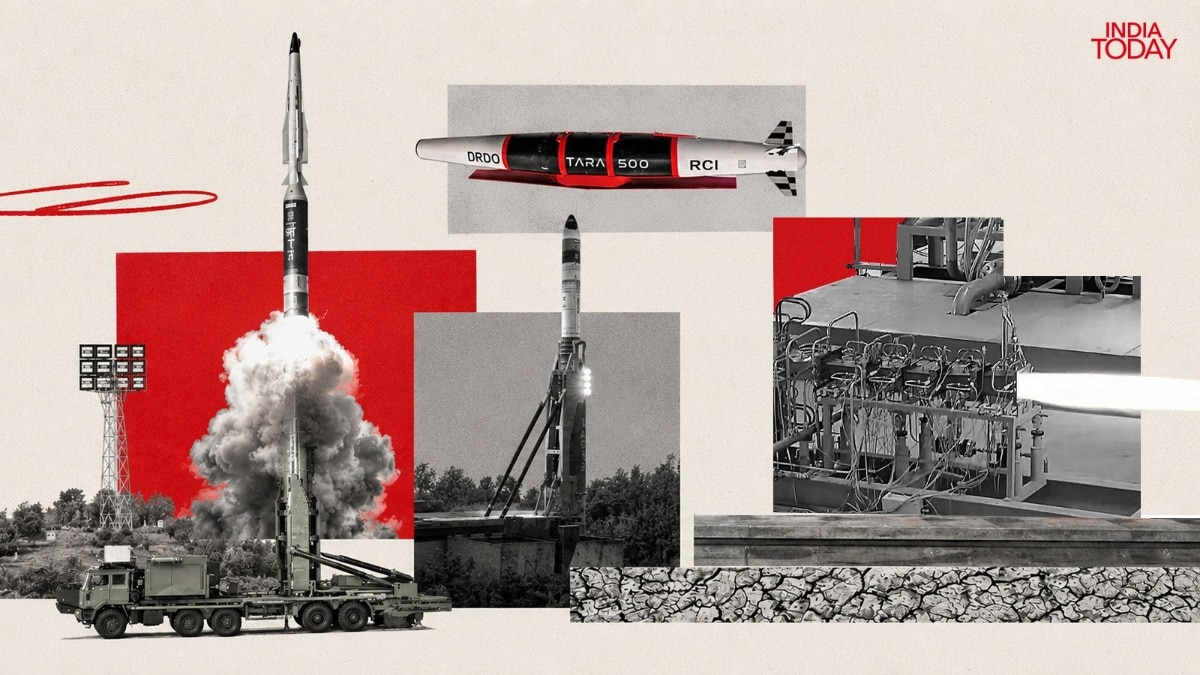
In the first week of May, as the Iran war reminded the world what modern long-range firepower can do, India held a missile festival of its own.
There was no single dramatic announcement. No grand proclamation. Just a few boilerplate press releases that, taken together, provided a snapshot of India’s existing missile and rocket force and a peek into what the future may hold.
Between May 1 and May 10, India carried out a series of tests: a long-range hypersonic anti-ship missile launch around May 1; the maiden flight trial of the Tactical Advanced Range Augmentation weapon, or TARA, on May 7; a new test of an advanced Agni missile with Multiple Independently Targetable Re-entry Vehicle, or MIRV, technology on May 8; and, on May 9, a long-duration test of a scramjet engine.
That is quite the alphabet soup. This article is an attempt to decode it.
First, the context. The Iran war has brought renewed attention to an old military truth: the side that can strike most accurately from the farthest distance has an advantage.
India did not discover this lesson in May. Its missile programme has been decades in the making, shaped by the twin threats of Pakistan and China. India possesses a broad missile ecosystem, ranging from the BrahMos cruise missile, arguably among the best in the world, to the Agni series of ballistic missiles, which forms the backbone of the country’s land-based nuclear deterrent.
What the May tests did was provide a progress report on this rocket and missile force.
Seen together, the four tests point to four different ambitions: hit ships farther out at sea, make cheap bombs smarter, get one strategic missile to do the work of several, and build the engine technology for the next generation of hypersonic weapons. The last of these — the scramjet test — may sound the most obscure, but it probably was the most important. We will get to why.
LR-AShM: THE CARRIER-KILLER
This test has not been formally acknowledged. But according to a Times of India report, India test-launched the Long Range Anti-Ship Missile, or LR-AShM sometime around May 1. Developed by the Defence Research and Development Organisation, the missile is believed to be able to hit targets up to 1,500 km away at speeds of up to ten times that of sound.
The LR-AShM’s speed places it a notch above the supersonic BrahMos family, which flies at roughly Mach 2-3. But it is still not a true-blue hypersonic missile. The missile follows a quasi-ballistic trajectory: first boosted into the upper atmosphere by a rocket motor, then dropped back towards the Earth in an unpowered glide.
Trajectories of a ballistic missile and a hypersonic missile (Photo: Wikimedia Commons)
In plain English, it is not a missile that flies like a bullet all the way to the target. It is more like a stone thrown very hard and very high before it flattens out, steers, and adjusts on its way down.
That glide is the point.
A traditional ballistic missile follows a broadly predictable parabolic arc. Once detected, its likely remaining path can be calculated. A glide vehicle makes that math much harder. It can manoeuvre inside the atmosphere, change its line, and keep air defences guessing.
The May test marked the third development trial of this missile, bringing India closer to inducting this aircraft carrier killer into its inventory. While formal details about its commissioning are awaited, it is worth noting that the missile was displayed during the 2026 Republic Day parade.
The LR-AShM on display at the 2026 Republic Day parade (Photo: Ministry of Defence)
TARA: MAKING DUMB BOMBS CLEVER
The May 7 TARA test sits at the other end of the glamour scale. It is not as dramatic as a hypersonic anti-ship missile. It does not carry the nuclear shadow of the Agni family. It does not sound like science fiction, as the scramjet does.
But it may prove one of the most useful.
TARA (Tactical Advanced Range Augmentation) is a modular precision and range-extension kit. It’s a bit like giving an unguided warhead — a ‘dumb bomb’ — spectacles, wings, and a small brain. India’s first indigenous glide weapon system, it converts unguided warheads into precision-guided weapons.
A conventional unguided bomb is simple. Drop it from an aircraft, and gravity does the rest. But for that, the aircraft must get close enough to the target, exposing itself to enemy air defences. The accuracy of the eventual strike also depends on release conditions, altitude, aircraft speed, and the weapon’s own limits.
The TARA kit turns a dumb bomb into a smart bomb (Photo: PIB)
A glide kit changes that. It allows the bomb to be released from much farther away. The wings and onboard guidance then allow the bomb to glide towards a target instead of simply falling.
TARA is not radical technology. The West developed such kits decades ago. And India has been using them for a while now. A famous example is the 2019 Balakot airstrike, when Indian Air Force jets used Israeli SPICE munition kits to hit a terrorist camp in Pakistan.
The TARA test matters because it means India has indigenised a very practical part of air warfare, reducing costs and dependence on foreign supply chains.
AGNI WITH MIRV: ONE MISSILE, MANY PROBLEMS
A day after the TARA test, India flight-tested an advanced Agni missile with MIRV technology from Dr APJ Abdul Kalam Island in Odisha. The missile carried multiple payloads targeted at different points spread across a large geographical area in the Indian Ocean Region.
The name MIRV sounds complicated. But the idea is simple.
A normal ballistic missile carries one warhead to one target. A MIRV-ed missile carries several warheads. After the missile climbs out of the atmosphere, a post-boost vehicle releases separate warhead-tipped re-entry vehicles, each aimed at a different target area.
A now-retired US Peacekeeper ballistic missile being tested. This long-exposure photo shows the paths of the multiple re-entry vehicles deployed by the missile (Photo: Wikimedia Commons)
Think of it as the difference between throwing one stone into the air and launching a pebble-filled balloon that bursts near its peak, letting the pebbles fall in different directions.
Militarily, this does two things. First, it increases the number of targets that can be threatened by one missile. Second, it makes interception far more complicated.
The nuclear-capable Agni family has long been central to India’s land-based strategic deterrent. The MIRV-ed Agni gives India’s rocket force an extra punch by making one launch count for more. But, of course, it is a launch India hopes never to make.
SCRAMJET: THE COOLEST TEST WAS ON THE GROUND
The May 9 scramjet test looks, at first glance, the least dramatic of the four. It was basically an engine that ran for 20 minutes. Boring, right? Not.
This was a test that puts India on course to developing a powered hypersonic cruise missile that can fly at speeds above Mach 5. It was, broadly speaking, a test of the kind of engine that powered Tom Cruise’s fictional hypersonic jet in Top Gun: Maverick.
Remember the LR-AShM and how it first has to be boosted into the outer atmosphere before it begins its hypersonic glide? A scramjet engine is designed to sustain hypersonic flight within Earth’s atmosphere, allowing a missile to scream towards a target while flying a lower, flatter, and less predictable path than a ballistic missile.
The scramjet sits at the extreme end of flight-engine technology. At the more familiar end are turbojets, which power your everyday airliners. They use huge fans to suck in air that is then compressed to high temperatures and mixed with kerosene. The resulting explosion provides the thrust that propels the aircraft forward.
A scramjet engine enables missiles to fly at speeds of more than five times the speed of sound (Photo: PIB)
The turbojet is a magnificent piece of engineering and extremely safe for everyday air travel, but its moving parts become a problem as speed rises. That is where the ramjet engine comes in.
Once a vehicle is moving fast enough, usually with the help of a booster, the engine does not need help sucking in air. The air is already being rammed into it, so the ramjet can do away with the spinning machinery. But even then, the air has to be slowed down before fuel is mixed and burnt. That makes combustion easier and more stable.
A scramjet removes even that comfort. The air enters the engine at supersonic speed and stays supersonic as fuel is injected and burnt inside the combustor. This allows for higher speeds. But at hypersonic speeds, heat becomes a weapon against the weapon itself.
The airframe and engine have to survive temperatures and stresses that would destroy ordinary materials. It is not just a problem of speed, but of materials, coatings, ceramics, cooling, and tolerances. That is why the May 9 test stands apart from the others.
The Agni missile is the backbone of India’s land-based nuclear deterrent (Photo: PIB)
TARA is a useful precision kit. LR-AShM is a serious glide weapon. Agni-MIRV sharpens deterrence. But the scramjet is a gateway technology.
It does not by itself give India an operational hypersonic cruise missile tomorrow. An engine test on the ground is not the same as a weapon that can launch, accelerate, breathe, steer, find a target, and survive the whole journey.
But it is a serious step forward in a missile race in which India is trying to stay abreast of the rest of the world.
And that is the real meaning of India’s May missile week. It marks steady progress in a missile programme built over decades that is now moving into a new phase: longer reach at sea, cheaper precision from the air, more complicated strategic missiles, and the engine technology for weapons that may one day fly through the atmosphere at impossible speeds.
– Ends
Published By:
Dev Goswami
Published On:
May 17, 2026 11:58 IST