Local News
Mayor Michelle Wu’s budget proposal contains cuts that have angered some City Council members.
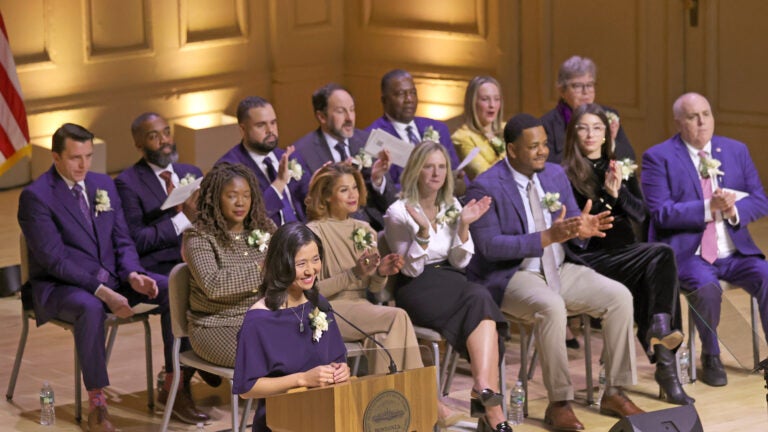
Boston Mayor Michelle Wu and the Boston City Council at their inauguration ceremony in Symphony Hall in January 2026. David L. Ryan/Boston Globe
In April, Boston Mayor Michelle Wu unveiled her $4.9 billion budget proposal for the next fiscal year. Warning of a “challenging” financial moment, Wu’s budget represented the smallest year-over-year spending increase since the aftermath of the global financial crisis.
Now, multiple Boston City Council members are considering rejecting that budget in the hopes that doing so would force Wu to submit a new proposal with increased spending and fewer cuts. The mayor is standing firm, telling the Council last week that she would not increase spending.
Councilors are currently reviewing Wu’s budget. They have the power of altering individual line items, but cannot increase the overall amount that the city is planning to spend. They have until June 10 to accept, reject, or amend Wu’s budget. The mayor then decides whether to accept or veto the Council’s changes. Her veto can be overridden by a two-thirds vote on the Council.
Councilor Brian Worrell floated the idea of returning to an older version of the budget process earlier this month, Boston Policy Institute noted at the time. In that previous version of the process, councilors could not amend individual line items, and the mayor’s initial budget was routinely rejected. The Council and the mayor’s staff then generally negotiated priorities and a new budget was submitted that could be approved.
Several councilors have asked about the current procedure for rejecting the mayor’s budget, according to a letter Wu sent to the Council last week. Some have expressed hope that doing so would cause Wu to resubmit a budget that allows for increased spending, she wrote.
The mayor stressed that her proposed budget “represents the maximum revenue that can be responsibly budgeted for the upcoming fiscal year.” Due to developments on Beacon Hill concerning the statewide budget, any resubmitted city budget from Wu could actually decrease spending levels further, she warned.
“Increasing the bottom line of the budget by either inflating revenue projections or drawing from the City’s reserves would be fiscally irresponsible,” Wu wrote.
Still, some councilors are debating rejecting Wu’s proposal outright. Councilor Erin Murphy told The Boston Globe that at least six or seven councilors are showing a “strong appetite” to do so.
“Our first responsibility is to get a budget that actually works for the city of Boston, and to me, the budget we have in front of us right now is too low,” Murphy told the Globe. “Rearranging cuts inside a budget that I think is inadequate to begin with is not going to help us.”
The city is facing a budget deficit of nearly $50 million that it must close before the fiscal year ends on June 30. Officials have blamed the costs of snow removal, police overtime, and employee health insurance as major factors that led to the deficit. The city will need to deploy “one-time funds” to close the gap, according to Wu.
If the city were to inflate revenue projects for fiscal year 2027, it would likely be staring at another budget shortfall in the near future, Wu wrote.
Even if the Council were to reject Wu’s budget, she would be able to submit it again with no changes, let alone the spending increases some councilors want, according to a memo from the city’s legal department that Wu’s office released.
The specifics of how this process will play out depends on how close to the June 10 deadline a potential rejection occurs. The Council must take definitive action adopting, amending, or rejecting the mayor’s budget by the deadline. If it fails to act, the mayor’s budget goes into effect.
The Council could therefore effectively forfeit its power to influence the budget. Councilor Sharon Durkan is urging her colleagues to focus on the task at hand instead of playing out hypotheticals about a full-on budget rejection.
“Any other conversation, I think, is a bit of a distraction from that,” she told the Globe. “We just need to get to work and roll up our sleeves and figure out what edits we want to make to the budget that’s been presented to us.”
Ross Cristantiello
Ross Cristantiello, a general assignment news reporter for Boston.com since 2022, covers local politics, crime, the environment, and more.
Sign up for the Today newsletter
Get everything you need to know to start your day, delivered right to your inbox every morning.