Local News
The Trump administration is threatening legal action, arguing that the RMV policy is unconstitutional and puts agents at risk.
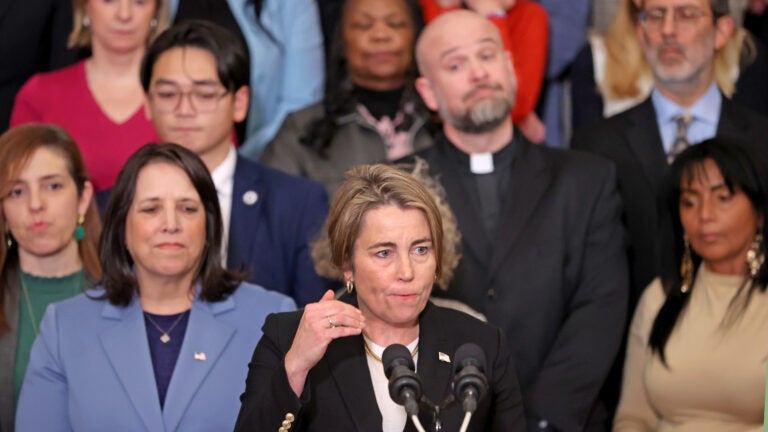
Gov. Maura Healey filed legislation meant to rein in ICE in January, 2026. David L. Ryan/Boston Globe
The Trump administration is threatening legal action over the fact that the Massachusetts Registry of Motor Vehicles is refusing to issue confidential license plates to some ICE vehicles. Gov. Maura Healey is not budging.
Assistant Attorney General Brett Shumate, who leads the Department of Justice’s Civil Division, sent a letter to Healey earlier this week demanding that she require the RMV to rescind its policy around the issuance of confidential, or undercover, license plates and registrations to vehicles used by immigration enforcement agents.
The RMV is actively refusing to issue these plates to most ICE vehicles, according to Shumate’s letter. ICE has two main law enforcement divisions: Homeland Security Investigations and Enforcement and Removal Operations. HSI investigates transnational crime, while ERO is responsible for detaining and deporting undocumented immigrants. The RMV is only issuing confidential plates to some HSI vehicles, after it certifies that the vehicles will only be used in active criminal investigations, according to Shumate’s letter.
“This discriminatory policy is not only deeply dangerous as a matter of public safety but also blatantly unlawful as a matter of constitutional law. It should be immediately withdrawn; otherwise, the United States intends to seek judicial relief,” Shumate wrote.
As she seeks reelection this year, Healey has maintained her adversarial relationship with ICE and filed legislation that would restrict its actions in Massachusetts. A spokesperson for Healey responded to Shumate in unequivocal terms Friday.
“Massachusetts is not going to allow state resources to be used to help ICE operate in secret while they are violating people’s rights and making us all less safe. Any federal, state or local agency engaging in legitimate criminal law enforcement work can receive a confidential plate. We all know that’s not what ICE is doing. This is an agency that can’t and won’t even tell us who they are arresting and why. We are not going to enable their tactics,” Jacqui Manning, a spokesperson for Healey, said in a statement.
Shumate asked that Healey respond by May 22 with assurances that all federal law enforcement agencies can once again obtain confidential plates in Massachusetts. Without that assurance, the federal government “reserves all rights,” Shumate wrote.
He also sent a copy of the letter to Attorney General Andrea Campbell’s office. Campbell declined to comment.
Shumate argued that the RMV is undermining ongoing investigations and putting officers in harm’s way. Officers, their families, and people under their protection are at risk when federal law enforcement vehicles involved in undercover activities are readily identifiable, he wrote. Even non-confidential state plates could expose officers if they are the subject of public information requests, according to Shumate.
“Such threats are particularly troubling in the current environment, in which federal officers have been the target of threats, doxing, and harassment,” he wrote.
The RMV does actively provide confidential plates to law enforcement vehicles from local, state, and federal agencies. But RMV policy dictates that confidential plates are not authorized for agencies that primarily pursue civil enforcement actions. Federal immigration enforcement is generally a civil administrative process, not a criminal one.
-
Healey calls on aviation company operating at Hanscom to cut ties with ICE
-
Laying into ICE, Healey stops short of saying it should be abolished
Confidential plates hide information about a vehicle’s owner or lessee in state and federal information-sharing systems used by law enforcement professionals. So when federal vehicles use confidential plates, state and local police cannot confirm their owners. This could potentially complicate enforcement of traffic laws and more.
In these information-sharing systems, non-confidential plates used by ICE vehicles would simply list the agency as its owner, not any individual agents, according ot the state.
Shumate also argued that the RMV’s policy is “plainly unconstitutional.” He cited the Supremacy Clause of the Constitution and accused the Healey administration of setting a double standard.
“By refusing to issue undercover registrations and plates to certain federal law enforcement agencies, while continuing to issue them to similarly-situated federal, state, and local law enforcement agencies without restriction, Massachusetts’s RMV has directly run afoul of the Supremacy Clause by discriminating against the federal government,” Shumate wrote.
Ross Cristantiello
Ross Cristantiello, a general assignment news reporter for Boston.com since 2022, covers local politics, crime, the environment, and more.
Sign up for the Today newsletter
Get everything you need to know to start your day, delivered right to your inbox every morning.