Home Improvement
It creates a home that is safe and accessible to someone who is elderly, disabled, or recovering from an injury or surgery
Adobe, Ally Rzesa/Globe Staff
Many people today are incorporating elements of universal design into their homes and remodels without even realizing it. It is not necessarily a new idea, there’s just a term for it now.
So, what is universal design? In its broadest definition, it’s the concept of configuring a home that is safe and accessible to someone who is elderly, disabled, or recovering from an injury or surgery. We are incorporating many of the ideas into our remodels with the intent of allowing our clients to “age in place.” For example, we may put extensive blocking within the walls of a bathroom remodel for future grab and safety bars.
One of the key components of a good universal design is to incorporate as much of it into a home as possible without it looking sterile or institutional. Another component is to be forward-thinking so that when adaptations need to be made in the future, it’s not an expensive and invasive remodeling project. Universal design covers quite a few areas of the house, but below, we look at the most common areas and what can be done to make them safe.
For an elderly couple in the South End, Charlie Allen Renovations installed this curbless shower for a safer bathroom experience. – Shelly Harrison Photography
Bathrooms
Bathrooms are by far the most dangerous rooms in the house for someone with mobility issues.
- Curbless showers: These can be tricky to install, but we have never worked in a home where we couldn’t design one into a bath remodel. Not having to step over a shower curb with wet feet is a huge improvement in safety.
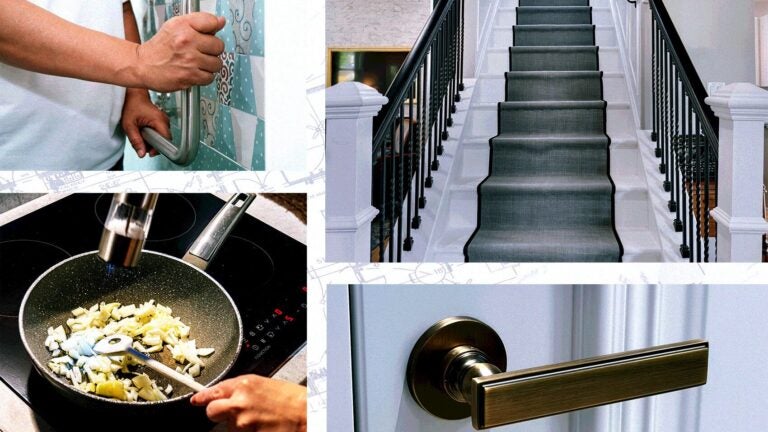
- Grab bars: As mentioned above, we install blocking inside the walls so the grab bars can be attached to solid wood. Grab bars should be installed inside and outside the shower so they can be used when getting in and out and around the toilet.
- Shower seats: Fold-up seats are the best — also attached to substantial blocking inside the walls. A permanent bench that projects into the shower can be a trip hazard. A stand-alone seat that gets placed into the shower is also quite safe, but a little unwieldy.
- Non-slip tile on floors: There are some beautiful tiles out there that can really enhance a bath design, but steer clear if they have a glazed or slippery surface. There are plenty of choices that have better traction. We always encourage clients to use mosaic tiles, especially in the shower. These are the smaller tiles with a lot of grout lines, which lend traction.
- Comfort-height toilets: These are taller than a standard toilet and make getting on and off a little easier.
- Sink space: Installing faucets with lever handles instead of something like cross handles is better. If a vanity is being installed, it is a good idea to put blocking in the wall behind the vanity for a future wall-hung sink. Wall-hung sinks are important for someone in a wheelchair.
Stairs
Arguably the second-most dangerous part of the house for anyone with mobility or sight issues is stairs.
- Flooring: Most homes in the Boston area have wood floors and stairs. They are beautiful but very dangerous. Installing a carpeted stair runner down the middle of the treads can do wonders for safety. The ends of the stair treads can be left exposed so the original stair design is preserved.
- Hand rails: Often, the original newel post and handrails are an important design element of an old home. Unfortunately, they are almost always too low by today’s building codes and present a hazard if they are leaned on for safety. We often install a secondary handrail on the inside wall at a code-compliant height.
- Lighting: It’s good to improve lighting at the top, bottom, and middle of the stair run. Just as important is to have a three-way switch at the top and bottom of the stairs.
- Receptacle for future stair lift: This is a good example of thinking ahead when you have subcontractors at the house. Most stair lifts just need a basic 15 amp receptacle at the bottom of the stairs to trickle charge the battery that powers the unit.
Kitchen
The kitchen is typically a relatively safe space, but improvements can help now or at a later date.
- Cabinets: The standard height for new kitchen cabinets is 36 inches, but there are cabinet lines that come in 32.5 inches and have a much higher toe kick at the bottom to allow the front wheels of a wheelchair to fit under the cabinets. The sink in a kitchen like this would have an opening at the bottom to allow a wheelchair to fit. This would all be a very specific kitchen design for someone who is in or expects to be in a wheelchair. If that level of universal design is not necessary at this point, there are a few things that can be done to improve accessibility. Cabinet doors on base cabinets can be awkward to open and find things even if there are pullouts in the cabinet. Drawers are much easier to store and find things, and they also have more storage than pullout drawers behind a cabinet door.
- Faucets: Touch faucets make using the sink easier for many people.
- Induction ranges: These are much safer to use than anything with an open flame. The surface cools immediately after use, which is a big advantage over ceramic top electric ranges.
Rest of the house
- Doorways and hallways: The doors and openings joining rooms together should be widened to 36 inches wherever possible. This will allow a wheelchair to navigate easily. Door hardware should be lever handles — not doorknobs — which can be difficult to use, especially in older homes.
- Lighting: Better lighting throughout the house with improved switching can help make a home safer. Motion sensor switches can be added to allow safe navigation in a bathroom at night. Night lights in the hallways and/or bathroom serve the same purpose.
- First-floor living: The possibility that an owner may need to live on the first floor in the future should be considered when designing a remodel. So, a renovation should not close off the possibility of installing a full bath on the first floor or creating a bedroom in a living room or sitting room.
Mark Philben is the project development manager at Charlie Allen Renovations in Cambridge. Send your questions to [email protected]. Questions are subject to editing. Subscribe to the Globe’s free real estate newsletter — our weekly digest on buying, selling, and design — at Boston.com/address-newsletter.
Address Newsletter
Our weekly digest on buying, selling, and design, with expert advice and insider neighborhood knowledge.