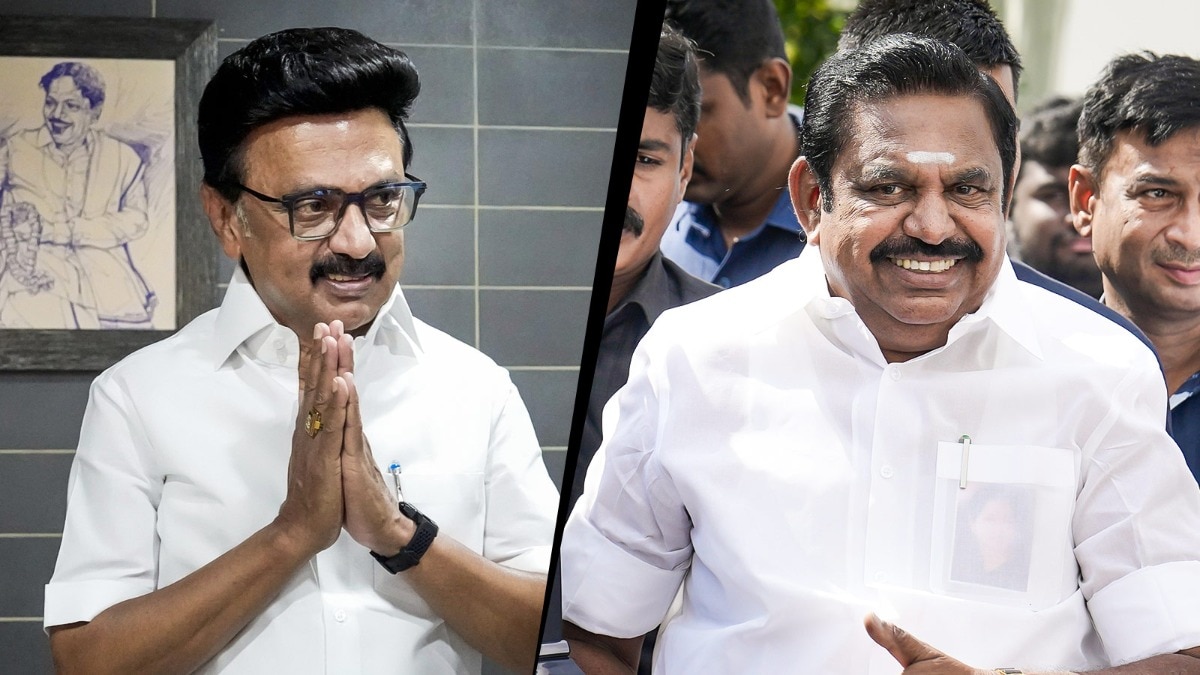
Tamil Nadu witnessed a dramatic political development on Tuesday, with a group of 30 AIADMK MLAs led by CV Shanmugam announcing support for Chief Minister Vijay. In doing so, Shanmugam also confirmed discussions around a post-poll political arrangement that once seemed unthinkable in Tamil Nadu politics, a possible understanding between AIADMK and DMK.
After Vijay’s TVK emerged as the single-largest party in Tamil Nadu but fell short of the majority mark, the state entered a phase of intense political negotiations. While an alliance between arch rivals DMK and AIADMK had long been considered politically impossible, speculation had mounted that the two Dravidian parties could explore a tactical arrangement to prevent Vijay from forming the government.
Remember, AIADMK had contested the election as part of the NDA alliance alongside the BJP.
Shanmugam claimed that proposals for an AIADMK-DMK alliance had surfaced and alleged that party General Secretary Edappadi K Palaniswami was seeking the Chief Minister’s post through such an arrangement. According to him, the move ran contrary to the party’s ideological foundations.
“The AIADMK was founded to uproot the DMK, which we consider an evil force in Tamil Nadu. That has always been the foremost aim of the AIADMK, founded by MGR and protected by Amma. But now, some proposals have emerged that are against our principles,” he said on Tuesday.
According to Shanmugam, aligning with the DMK violated the “basic principles” of the AIADMK.
“To align with the DMK, our legislators and party cadre were against that proposal. We disagreed. So, in our legislative party meeting, we took a decision. It is against the interests of our party,” he asserted.
To put the development in perspective, an AIADMK-DMK alliance in Tamil Nadu would be politically comparable to the BJP joining hands with Congress at the national level.
Shanmugam further said the AIADMK legislative party had passed a resolution opposing the proposal and elected SP Velumani as the floor leader.
Explaining the rationale behind extending support to Vijay, the AIADMK leader said the MLAs were “accepting the people’s mandate” and argued that the verdict was in favour of Chief Minister Vijay.
At the same time, he maintained that EPS remained the leader of the AIADMK, while also clarifying in the Assembly that the group was not entering into an alliance with the BJP.
CRACKS IN AIADMK AFTER POLL ROUT
Following the Assembly election results on May 4, which gave TVK 108 seats, DMK 59 and AIADMK 47 in the 234-member House, visible cracks emerged within the AIADMK over the question of supporting TVK. Signs of dissent against Edappadi K Palaniswami also became increasingly apparent.
Palaniswami had convened a post-poll review meeting to assess the party’s performance and discuss future strategy. However, several senior leaders and former ministers, including Shanmugam and SP Velumani, along with their supporting MLAs, skipped the meeting. The dissident MLAs later held a separate meeting at Shanmugam’s office.
BITTER RIVALRY OF DMK AND AIADMK
For nearly six decades, Tamil Nadu politics has revolved around the Dravidian giants DMK and AIADMK, whose rivalry shaped governments, political culture, cinema, welfare politics and even the identity of the state itself.
The DMK was founded in 1949 by CN Annadurai after splitting from the Dravidar Kazhagam led by Periyar EV Ramasamy. The split stemmed largely from ideological and organisational differences, particularly Periyar’s decision to stay away from electoral politics, while Annadurai believed political power had to be captured through elections.
Periyar EV Ramasamy Naikar and CN Annadurai.
The DMK positioned itself as the political face of the Dravidian movement, championing social justice, rationalism, anti-caste politics and Tamil linguistic identity. The party drew strength from the anti-Hindi agitations of the 1960s and rapidly expanded its support base among backward classes and the urban poor.
The AIADMK emerged from an internal revolt within the DMK. In 1972, iconic actor and DMK treasurer MG Ramachandran, popularly known as MGR, was expelled from the party after openly questioning the leadership and demanding financial transparency.
Following his expulsion, MGR launched the Anna Dravida Munnetra Kazhagam, later renamed AIADMK, invoking Annadurai’s legacy while accusing the DMK leadership of corruption and dynastic politics.
MGR transformed Tamil Nadu politics by combining cinematic charisma with populist welfare schemes. His carefully cultivated image as a benevolent screen hero translated seamlessly into electoral success. AIADMK soon emerged as the DMK’s principal rival, institutionalising a bipolar political structure in the state.
MG Ramachandran and J Jayalalithaa.
The rivalry intensified further after the rise of J Jayalalithaa following MGR’s death in 1987. Jayalalithaa and M Karunanidhi went on to lead one of India’s fiercest political rivalries for more than two decades, marked by bitter personal attacks, corruption allegations, dramatic Assembly confrontations and alternating electoral victories.
The deaths of Jayalalithaa in 2016 and Karunanidhi in 2018 fundamentally altered Tamil Nadu politics, with their successors lacking the towering mass appeal of the earlier generation.
That leadership vacuum created space for a new political challenger, paving the way for Vijay’s rise and the disruption of Tamil Nadu’s long-standing Dravidian bipolarity, though with a fractured mandate.
– Ends
Published On:
May 12, 2026 12:31 IST