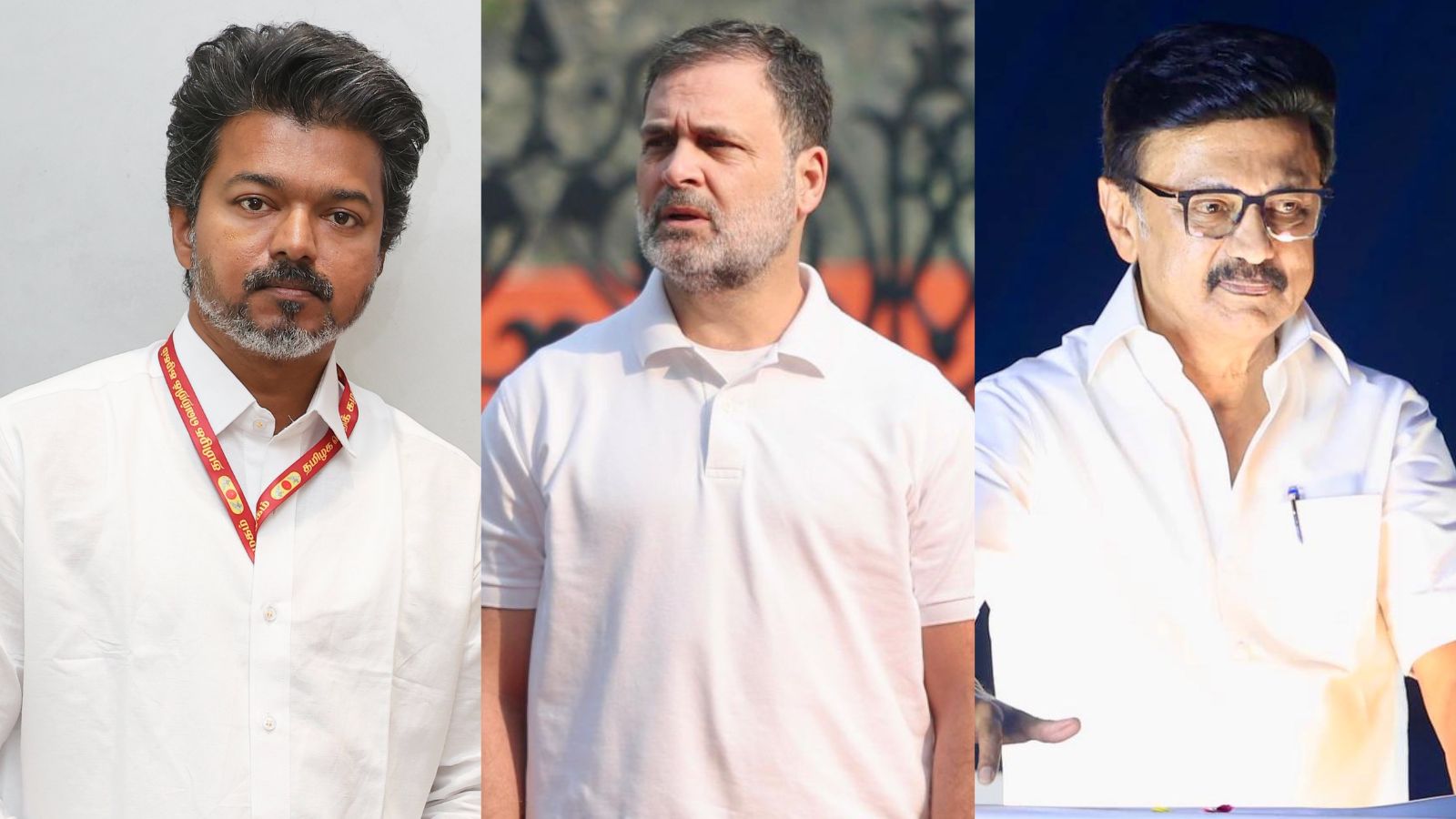
The Congress’s decision to end its decades-long alliance with the DMK and partner with Vijay’s Tamizhaga Vettri Kazhagam (TVK) to form a new government in Tamil Nadu has caused divisions within the INDIA bloc, with its constituents split over whether the move is “strategic pragmatism” or “political backstabbing”.
While some leaders of the Opposition grouping defended the Congress’s decision as necessary to keep the BJP and NDA out of power in the state, others echoed the DMK’s charge of “backstabbing”. The development has also raised questions about the cohesion of the INDIA alliance and its functioning in Parliament, where the DMK has 22 Lok Sabha and eight Rajya Sabha MPs.
Sources within the Congress indicated that the move was not universally supported even within the party. Several Congress leaders are learnt to have opposed the party’s bid to break ties with the DMK, warning that the decision could have long-term consequences. “Some people in the Tamil Nadu party unit have misguided the leadership. This is very short-sighted,” said a member of the Congress Working Committee (CWC). “The Congress won Lok Sabha seats in Tamil Nadu because of the DMK. It also secured five Assembly seats with their support. To walk away from the alliance now raises serious questions about the party’s political judgment.”
According to Congress insiders, some senior party leaders were also not in favour of the alliance with the TVK. However, Leader of the Opposition (LoP) in the Lok Sabha, Rahul Gandhi, is believed to have been persuaded by the state party unit to back the move.
Some concerns have also been raised within the Congress about the implications of the decision for parliamentary politics. “We will need the DMK in the future,” said a Congress MP from a southern state. “If the BJP attempts to push through constitutional amendments, we will need numbers to resist. The TVK will not have representation in the Lok Sabha until 2029. This is a short-term calculation with little strategic depth.”
The MP added that the move sends a troubling signal to other INDIA partners. “It suggests that alliances are expendable and contingent on immediate power equations. That weakens trust.”
The DMK reacted sharply to the development. Lok Sabha MP Ganapathi P Rajkumar described the Congress’s decision as a “classic case of backstabbing” and accused the party of losing “credibility”.
Responding to the criticism, Congress spokesperson Pawan Khera rejected the charge, drawing parallels with past political decisions. “In December 2013, the DMK announced it would contest the Lok Sabha elections alone. Was that backstabbing? No. Similarly, this decision is not backstabbing. Two like-minded parties have come together to prevent the BJP from gaining power,” he said.
Some INDIA bloc allies supported this reasoning. Shiv Sena (UBT) MP Sanjay Raut said the Congress had acted in accordance with the electoral mandate. “The people voted for the TVK to form the government, and the Congress has facilitated that. To stop the BJP, it had to align with the emerging force,” he said.
The Samajwadi Party (SP) struck a more cautious note. SP MP Rajeev Rai said it was “too early” to assess the broader implications of the decision and suggested that its impact on national politics may be limited.
However, there were dissenting voices within the SP. “This shows how desperate the Congress is for power,” said an SP MP. “It has turned against a partner that helped it win seats both in the Assembly and the 2024 Lok Sabha elections. Such decisions undermine collective strength.”
The SP MP also pointed out the DMK’s role in supporting the Opposition on key legislative battles. “Without the DMK, it would have been far more difficult to resist Bills such as those related to women’s reservation and delimitation. For short-term gains, the Congress has taken a risk that could weaken the broader alliance.”
Leaders from Left parties were similarly sceptical of the Congress’s justification. A CPI(M) MP dismissed the argument that the move was necessary to counter the BJP in Tamil Nadu. “The BJP has minimal presence in the state. Some AIADMK legislators are already inclined towards the TVK. So where is the threat that justifies such a drastic step? The reasoning does not hold,” the MP said.
The CPI’s Rajya Sabha member P Sandosh Kumar framed the move as reflective of a broader pattern in the Congress’s approach to alliances. “This is about the party’s relationship with power,” he said. “Alliances are treated as transactional. But power is not permanent — it shifts. Decisions like these will have consequences when equations change again.”
As the immediate political realignment settles, the larger question remains: whether the Congress’s gamble in Tamil Nadu will strengthen its position against the BJP, or deepen fissures within the Opposition camp that could prove costly in the long run.


Size%20-%2013%27%27%20x%2019%27%27%20.jpg "9 new art shows in India we’re excited about this May")