Boston Red Sox
We spoke with catchers Carlos Narváez and Connor Wong to learn about the team’s challenge philosophies.
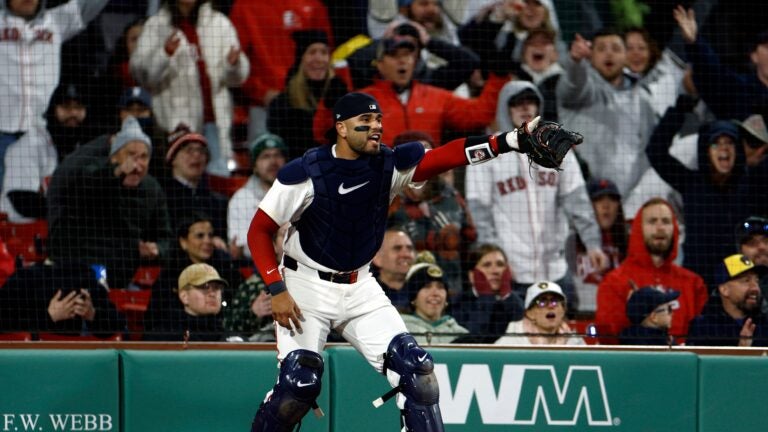
Red Sox catcher Carlos Narváez reacts during a game against the Milwaukee Brewers. Danielle Parhizkaran/Globe Staff
In the second inning of a scoreless game Monday, Red Sox catcher Carlos Narváez veered away from an oversimplified organizational rule of thumb that has consistently backfired.
Narváez, confident a 97-mile-per-hour four-seam fastball from Payton Tolle was a strike, quickly tapped his head to challenge the call of a ball. The Red Sox won the challenge and Narváez nodded to acknowledge what wasn’t ultimately that close of a call.
He tries to save the bulk of his challenges for “high-leverage situations,” but when the call is so obvious, Narváez is learning that it’s OK to question it. The moment showed growth for the 27-year-old in an area where the Red Sox have struggled mightily as a franchise so far this season.
This was a relatively rare instance where the Red Sox benefited from the automated ball-strike (ABS) challenge system and showed that perhaps they’re starting to learn from their mistakes.
For the most part, ABS hasn’t been nearly as kind to Boston as it has other teams and has frequently shifted the momentum of winnable games.
“On my end, I’m trying to play the game like it’s not ABS,” Narváez acknowledged to Boston.com.
Per Baseball Savant, Red Sox fielders (primarily catchers) are last in the majors in challenges won (10), challenge percentage (50), and challenge rate (1.1 percent) as of Tuesday afternoon.
Red Sox hitters are last in challenge rate (2.9 percent), tied for last in challenge rate vs. expected challenge percentage (-1.5 percent), and fourth to last in challenges won (11).
“As a hitter, I don’t want to say I won’t, but for me personally, it has to be blatant,” catcher Connor Wong told Boston.com.
While the season is already a month and a half in, the Red Sox are still clearly trying to master the nuances of a new system that has largely received positive reviews across the league. For a powerless lineup with holes all over – on a roster that is built to play small ball and have a surplus of tight, low-scoring games – falling short in controllable areas such as ABS simply isn’t an option.
Sometimes they’re missing opportunities, and other times they’re jumping at ones that aren’t there.
In the first inning Sunday against the Houston Astros, Wilyer Abreu quickly tapped his head, thinking that Laz Díaz called him out on strikes. In reality, Díaz simply said that the count was full. While the situation didn’t hurt the Red Sox, and provided a moment of levity, it illuminated a larger trend where they’re still grasping the cadence of the concept.
The next inning, a Cody Bolton offering to Marcelo Mayer sailed a few inches wide right. Mayer, perhaps spontaneously swayed by the Red Sox’ proclivity for pocketing their challenges for key moments, elected not to challenge what was clearly a ball. Had he walked, he likely would have scored on a Narváez double.
Despite the situation, this pitch is too far off the plate not to challenge. I’ll never get how the 2026 Red Sox are this bad at ABS. pic.twitter.com/c7Qfjif7Ni
— Tyler Milliken (@tylermilliken_) May 3, 2026
In the ninth, Narváez turned to his use-it-or-lose-it challenge on an Aroldis Chapman offering to Carlos Correa that was clearly low. An organizational philosophy influenced Mayer to hold off and Narváez to go for it, when in reality it should have been the other way around.
Red Sox hitters are fourth in Major League Baseball in percentage of challenges by the team considered to be “reasonable” but 25th in percentage of “reasonable” challenge opportunities taken. Their fielders are in the middle of the pack when it comes to percentage of challenges that are “reasonable” and last in percentage of “reasonable” opportunities taken.
They are third-to-last in rate versus expected percentage of “challengeable” pitches challenged by the fielders.
Narváez said it’s easiest for the catcher, but that hasn’t proven to be the case. Red Sox hitters are missing out on opportunities because they’re hesitant to pull the trigger. Early in the season, they had more of a green light early in games, and they’ve since adjusted that strategy to save it for when they really need it.
The Red Sox are out of ABS challenges with 1 out in the 9th.
Statcast says Carlos Narvaez entered today 4 for 12 in ABS challenges as a catcher. He’s 1 for 2 today.
— Gabrielle Starr (@gfstarr1) May 3, 2026
While that approach certainly has its perks, it also has its detriments. Using it doesn’t have to lead to losing it, while winning it can shift the momentum, and the Red Sox are still trying to strike that balance.
Narváez, who admitted he has been “missing a lot by 0.1 percent,” said the goal is to have at least one in the ninth inning whenever possible.
“If it’s a high-leverage situation and I miss it, I’m fine with it,” Narváez said. “If there’s nobody on or a man on first with no outs and I call it, I’m like, ‘Ehh.’ That’s when I feel bad. It’s a bullet that you have in your pocket. You use it when you need it.”
Before he was fired on April 25, then-manager Alex Cora noted that while the Red Sox weren’t challenging as much as some teams, he believed that they were doing so in the right moments.
“We don’t mind challenging in the second inning when it’s a middle-middle pitch, right?” Cora said on April 23. “We don’t mind that, but you have to be certain. After the seventh in a close game, it’s worth it.”
Reliever Jovani Morán said that from the pitcher’s perspective, he doesn’t think about challenging much and leaves that to the catcher. His focus is on throwing pitches in the zone that are no-doubters that catchers don’t have to challenge.
“My head is moving a lot when I’m pitching, so it’s hard to notice if it’s a strike or ball,” Morán told Boston.com.
While the Red Sox are still lagging relative to their peers, they have made strides in ABS development. Wong said it’s been “pretty cool” having the ability to challenge as a catcher and shape the game in another way.
He said it’s “just crazy” that a pitch 1/10th of an inch off the plate can be challenged and dictate the action. At the same time, he applauds umpires for their overall accuracy and said he doesn’t see how ABS is hurting the sport in any way.
Wong said he reviews a report after every game that spells out if there was a pitch in the zone the catcher didn’t challenge. He said he doesn’t feel any added pressure, noting that prior to the implementation of the system, he would have just communicated verbally with the umpire.
Now, the operation is smoother and there are fewer alterations between players and umpires as a result.
“I don’t know how the umpires feel about it,” Wong said. “I’m sure they might feel the same way in that they’re not getting yelled at as much anymore.”
Trevor Hass is a sports producer for Boston.com, where he writes and edits stories about Boston’s professional teams, among other tasks.
Get the latest Boston sports news
Receive updates on your favorite Boston teams, straight from our newsroom to your inbox.