Gardening
There are more organisms in a teaspoon of healthy soil than there are people on the planet
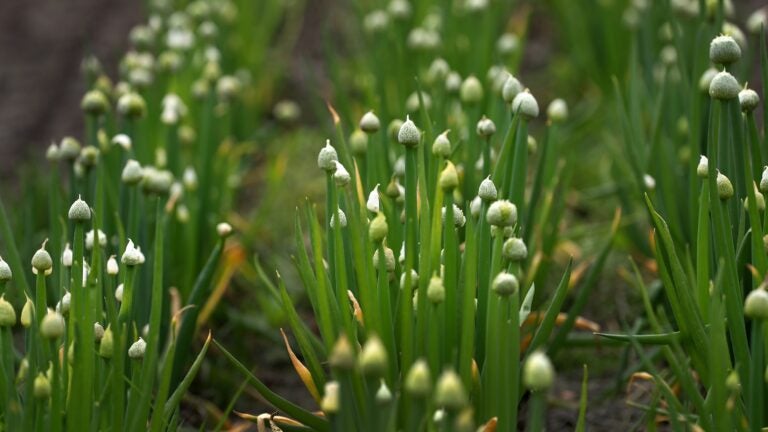
Scallions growing in the field at Clark Farm in Carlisle. David L. Ryan/Globe Staff
Seeing the fresh green of new sprouts emerging from the earth, nascent leaves forming, and the anticipation of swelling buds has lifted my spirits. The daffodils are cheerful, the cherry blossoms are reminiscent of pink clouds, and the eruption of spring ephemerals from the forest floor is a signal that the spring season is well underway.
The flower and vegetable seedlings that were carefully sown a few weeks ago have come alive, full of promise for delicious meals come summer, eaten on tables decorated by bountiful cut flowers.
Aside from the wonder and amazement of plants growing, flowering, and bearing fruit, their relationship with the soil is equally astounding — if not somewhat shrouded in mystery.
Almost all plant life on earth straddles two very different worlds: the above-ground realm, shared with us humans, and the subterranean world, where roots, rhizomes, bulbs, tubers, and corms provide anchorage, storage, and beginnings of the transport highways for water and minerals. As we approach the planting season, let us delve into the relationship between soil and plants and uncover how the way we treat soil relates to how our plants grow and thrive.
At a planetary scale, soil is a crucial component, albeit rather thin, of terrestrial ecosystems. It is as alive with complex relationships as the above-ground world, but I would argue far less understood. The physical and biochemical aspects of soils are directly related to the type of bedrock from which they were formed, the types of plants, and climate, water, temperature, and seasonality. In New England, our soils are heavily influenced by the last ice age, resulting in deposits of sandy soils, a jumble of various-sized rocks, and more organic-rich depressions that form the basis for our wetlands.
To make things more complex, we have altered the soils through agriculture and development expansion. Lets make sense of this complexity by considering the physical properties and the living components of soils separately.
Soil is made of sand, silt, and clay particles in varying proportions. Loam, generally considered good garden soil, has roughly equal amounts of each of the three categories. For example, increasing the sand portion makes it a sandy loam. A good, uncompacted loam should comprise roughly 50percent particles and 50 percent air. The empty portion of the soil provides space for water, plant roots, and living organisms. The more compacted the soil, the less space for those important resources for plants. The living portion of the soil consists of bacteria, fungi, nematodes (worms), invertebrates, and plant roots. There are more organisms in a teaspoon of healthy soil than there are people on the planet!
When living things die or are eaten, they contribute to the organic matter in soil. Tree leaves, branches, and even entire tree trunks are all parts of the soils in New England. This is yet another reason to value fallen leaves. When the organic portion is combined with the physical aspects of soil, the total determines soil fertility and therefore which kinds of plants can successfully thrive.
This is where the adage “right place, right plant” comes in. When we understand the characteristics of our soil, we can better match plants to those conditions. Thankfully, there are many great resources available to gardeners to help them learn about their soils. The first is called the Web Soil Survey by the USDA’s Natural Resources Conservation Service.
Following the instructions on the homepage, gardeners can enter their address and discover a wealth of information about the soils beneath their feet. One important caveat: the more urban and disturbed the area, the less accurate the info, due to the impacts of construction and development.
After exploring the soil survey results, the next step gardeners can take is to submit a soil sample to their local agricultural extension service, such as the UMass Soil and Plant Nutrient Testing Laboratory. Samples can be either from a point source (i.e., a single place in your garden) or as a combined sample (i.e., several sample sites from your garden, mixed and sent in as a single composite sample). Regular soil testing, every three to five years, can be very informative. The fee is $20 for routine analysis , plus $2 for postage and handling.
Dr. Elaine Ingham, a pioneering soil scientist who helped the gardening and permaculture worlds understand just how alive soil is, recently passed. Her work championed the idea that supporting the web of relationships in the soil is the best way to support the plants that grow in it. Synthetic fertilizers, especially those used on lawns, may provide nutrients to plants, but cut out the important step of supporting soil organisms. This is why fertilizer runoff is a serious issue — in lawns and in big agriculture. If the plants are not using the nutrients, they will wash away into nearby streams and bodies of water. Organic fertilizers like fish emulsion are excellent alternatives, as they provide nutrients to the life in the soil and plants.
In summary, good soil stewardship practices result in healthy, vibrant, and verdant gardens. If we abuse the soil, our plants and our health will suffer. A major tenet of ecological horticulture is to work with nature’s processes rather than against them. This holds true for the soil as much as for how plants react above ground.
Ulrich Lorimer is the director of horticulture at the Native Plant Trust in Framingham. Send your gardening questions, along with your name/initials and hometown, to [email protected]
Address Newsletter
Our weekly digest on buying, selling, and design, with expert advice and insider neighborhood knowledge.