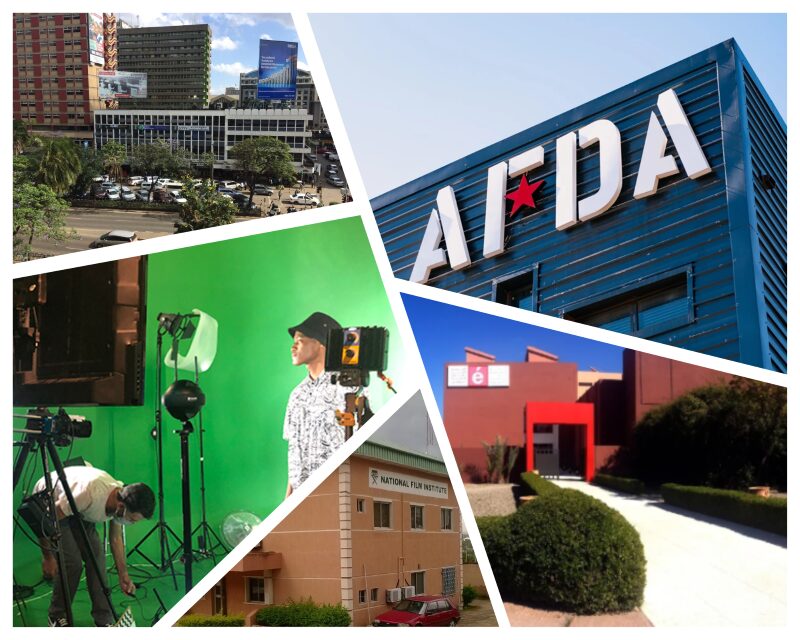
For decades, the narrative surrounding African cinema was framed by a paradox. The continent had incredible stories, yet it lacked the infrastructure required to produce them at scale. Aspiring African filmmakers who wanted elite technical training often felt compelled to leave the continent. They took their tuition dollars to New York, London, or Paris. They would return home only to find their foreign networks disconnected from the local reality.
In 2026, the equation has completely changed. The global appetite for African narratives has become a driving force in the commercial sector. International streaming platforms are investing heavily in local content, and co-production treaties are flourishing. A new generation of African diaspora students from Atlanta to London recognizes the strategic advantage of training directly on the continent. For those who wish to work within the continent’s booming creative economy, it is the most pragmatic entry point available.
Numerous notable Black filmmakers, both on the continent and in the diaspora, are actively supporting, teaching, and establishing initiatives to promote the study of filmmaking in Africa. Filmmakers such as Moussa Touré of Senegal, Judy Kibinge of Kenya, Tunde Kelani of Nigeria, Blitz Bazawule of Ghana and many more, through their work, emphasize local talent development, authentic storytelling, and the technical training necessary to build a sustainable industry.
Let’s take a critical look at where an aspiring filmmaker should spend their time and money this year.
The 2026 landscape demands institutions that offer practical training, verifiable industry access, and technical depth. Based on these criteria, five institutions currently stand out as the most vital training grounds for the next era of African cinema.
AFDA
Source: Official website
AFDA has long operated as the heavyweight of South African film education. It carries the confidence and the price tag of an institution that knows its graduates populate almost every major set in the country. Fully accredited and a member of CILECT, AFDA treats film school like a studio ecosystem. From day one, students are attached to production crews and tasked with delivering projects evaluated on their commercial viability, audience engagement, and artistic merit.
While its Johannesburg and Cape Town campuses remain the legacy hubs, the institution officially launched its new Hatfield campus in Pretoria in February 2026. This expansion opens up the school’s state-of-the-art production and post-production studios to a wider demographic. Diaspora students seeking an intense commercial trial by fire that closely mimics the actual pressures of the global film industry will find AFDA the most direct route to employability. The trade-off is the sheer velocity of the curriculum. It is a competitive environment that rewards aggressive self-starters and can sometimes overshadow slower forms of cinema. However, the direct line from campus to industry remains undeniable, as graduates leave with practical experience and a robust network of future collaborators.
Wits School of Arts, Film and Television
Source: Official website
If AFDA is the studio system, the University of the Witwatersrand School of Arts in Johannesburg is the director’s laboratory. The Wits film and television division offers a four-year undergraduate degree that aims to produce auteurs, creative producers, and critical thinkers who interrogate the medium of the moving image.
The four-year structure includes a foundational program that helps students ground their practical craft in broader academic disciplines like Philosophy or African Literature. By their third and fourth years, students move into advanced electives ranging from documentary filmmaking to digital animation. For an African American student looking to deeply understand the cultural and historical context of African narratives before filming, Wits provides an unmatched intellectual foundation. The drawback for some will be the academic rigor.
Wits recently opened an advanced cinema teaching space that meets professional standards, ensuring that conceptual ideas translate into high-quality visual outputs.
ESAV Marrakech, Morocco
Source: ESAV Marrakech
ESAV (École Supérieure des Arts Visuels), located in Marrakech, stands out as one of North Africa’s most internationally connected film schools. Founded in 2006 and later admitted as a full member of CILECT, the global network of top film and television schools, ESAV has built a strong reputation for excellence in cinema, audiovisual production, and visual storytelling. The institution offers specialized training in directing, cinematography, sound, editing, and multimedia, combining technical mastery with artistic development.
With programs accredited by Morocco’s Ministry of Higher Education and a faculty that includes both local and international professionals, ESAV provides students with hands-on, industry-relevant experience in a culturally diverse learning environment.
What makes ESAV particularly compelling for African and diaspora filmmakers is its mission to cultivate a new generation of storytellers who can shape global narratives from African perspectives. The school is intentionally international, welcoming students from across continents while grounding its training in African realities and creative expression. Films produced by its students are regularly selected and awarded at festivals across Europe, the Middle East, and Africa, reinforcing its position as a pipeline for emerging global talent.
National Film Institute, Nigeria
Source: Official Website
Nigeria’s cinematic output is legendary. Nollywood’s volume, speed, and cultural reach are unparalleled on the continent, and navigating this industry requires a specific kind of stamina and institutional knowledge. The National Film Institute, located in the creative hub of Jos, is the Federal Government’s flagship educational agency and the only degree-awarding film institute of its kind in West Africa.
Accredited by CILECT and the National Universities Commission, the National Film Institute offers a Bachelor’s in Film Arts that embeds students directly into the Nigerian motion picture machinery. The most crucial element of the institute in 2026 is its Master of Arts in Film Culture and Archiving Studies.
Preserving audiovisual heritage has become a critical emergency across the industry. The institute is currently the only establishment in the sub-Saharan region tackling this issue head-on. For students interested in the preservation, digitization, and curation of African stories, the National Film Institute offers a highly relevant pathway. It is an essential training ground for the next generation.
Africa Digital Media Institute, Nairobi
Source: Working at Africa Digital Media Institute | Glassdoor
East Africa’s creative economy is moving rapidly, driven by digital content, animation, and agile television production. At the center of this movement in Kenya is the Africa Digital Media Institute in Nairobi. Rather than offering traditional four-year academic degrees, the institute operates on a sleek, highly responsive two-year diploma model.
In 2026, the Africa Digital Media Institute has fully optimized its hybrid learning approach. With its May and September 2026 intakes currently active, the institute offers EU-accredited programs in Film and Television Production, Sound Engineering, and Animation. The hybrid model allows students to blend online theoretical sessions with mandatory, intensive on-campus practicals in Nairobi using industry-standard equipment.
Furthermore, the institute enforces mandatory internship placements, ensuring that every graduate has a foothold in the local industry before receiving their diploma. For students looking to insert themselves into Nairobi’s digital and broadcast economy, the institute is a masterclass in efficiency. It serves the modern creator perfectly, even if it lacks the prolonged academic incubation offered by traditional universities. The focus here is strictly on employable skills and getting students onto active sets as quickly as possible.
The Path Forward
The decision of where to train in 2026 ultimately comes down to an honest assessment of your personal career goals. Actor and advocate Idris Elba has continuously pushed for an expansion of local infrastructure and cinema access across the continent, emphasizing the importance of ownership. The demand for highly trained African professionals will only compound in the coming years. Now, the technical pipelines and educational institutions are operating at a level that ensures these narratives can be manufactured, owned, and preserved entirely on local soil. Whether you need the commercial urgency of AFDA, the conceptual rigor of Wits, or the agile digital integration of Nairobi’s premier institute, the tools to build a sustainable cinematic career are already waiting on the continent. Filmmakers simply need to choose the environment that best matches their vision.
Anand Subramanian is a freelance photographer and content writer based out of Tamil Nadu, India. Having a background in Engineering always made him curious about life on the other side of the spectrum. He leapt forward towards the Photography life and never looked back. Specializing in Documentary and Portrait photography gave him an up-close and personal view into the complexities of human beings and those experiences helped him branch out from visual to words. Today he is mentoring passionate photographers and writing about the different dimensions of the art world.