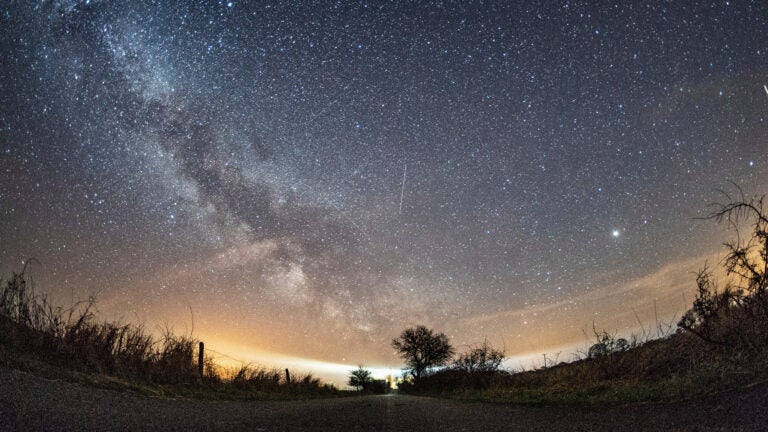
If you’re in need of a reason to get your head out of your phone and really look up, it’s this. The Lyrid meteor shower is returning this April, bringing a steady run of shooting stars across Australian skies. It’s one of the oldest recorded meteor showers, and relatively straightforward to see. Here’s how.
When to see the Lyrid meteor shower in Australia
The Lyrids will be visible from mid to late April, between April 16 and April 25 specifically.
The peak is expected to happen just after midnight on April 22, and into the early hours of April 23. So those two nights the best time to watch from Australia. During this window, you can expect around 10 to 20 meteors per hour.
And this year, conditions are especially favourable. A new moon on April 17 means darker skies during the peak, so even faint meteors have a better chance of being seen.
If you miss the peak, you can still catch the Lyrids
If you don’t manage to step outside during the exact peak on April 22 – 23, it’s not a missed opportunity. The Lyrid meteor shower is active for several nights either side of its peak, and you can still see shooting stars as long as the skies are dark enough.
The best viewing conditions across Australia will generally fall in the late-night to pre-dawn hours, when the sky is at its darkest and the meteor activity is highest.
Here’s a general guide for the best time to look up, based on local darkness windows:
- Sydney: roughly 1am – 5:30am
- Melbourne: roughly 1:30am – 5:30am
- Brisbane: roughly 1am – 5am
- Perth: roughly 12:30am – 5am
- Canberra: roughly 1:30am – 5:30am
- Adelaide: roughly 1am – 5am
- Hobart: roughly 2am – 5:30am
- Darwin: roughly 12:30am – 5am
What actually is the Lyrid meteor shower?
The Lyrids are one of the oldest known meteor showers, with sightings recorded more than 2,500 years ago.
They occur when Earth passes through the debris trail left by Comet C/1861 G1 Thatcher. As those fragments hit the atmosphere, they burn up, creating the streaks of light we see as shooting stars.
The Lyrids aren’t the most intense meteor shower of the year, but they’re consistent, showing up every April. If you’re interested in reading up on the most vibrant meteor shower, it’s the Geminids, which occur in late December.
Shouldn’t you be on the list?
Sign up to the RUSSH Club for exclusive offers and invitations.
Feature image by Michał Mancewicz via Unsplash.