6 min readUpdated: Apr 16, 2026 05:19 PM IST
Since the 1970s, the West has been dedicating one month–February in the United States of America and October in Europe–to Black history, so that the struggles, sacrifices, and achievements of an entire race of people subjected to Apartheid, slavery, violence, and all manner of dehumanising atrocities are not forgotten, and lingering inherited prejudices can be challenged and dismantled. India–which has also seen caste-based discrimination–has been observing Dalit History Month in April since 2015 along similar lines, but, much like its subjects, it is not part of the mainstream.
People usually see caste as a problem of the past or of remote rural regions of India, alleviated through reservation. But, few, except those still bearing the brunt of it, pause to reflect on the damage ingrained prejudice and socialisation continue to play in today’s world.
The best way to understand a people is to read their literature—Toni Morrison, James Baldwin, Ralph Ellison, and Octavia Butler, have helped people across continents and generations contend with this ghastly history, which is not in the past yet, as people still have to be reminded that Black Lives Matter.
I was introduced to Dalit literature in college–too late, in my opinion, the stories should be part of school syllabuses–and that too because I was majoring in literature. Joothan: A Dalit’s Life by Omprakash Valmiki was the first book that I read in the genre.
It is, however, never too late to acquaint oneself with Dalit lived history through literature.
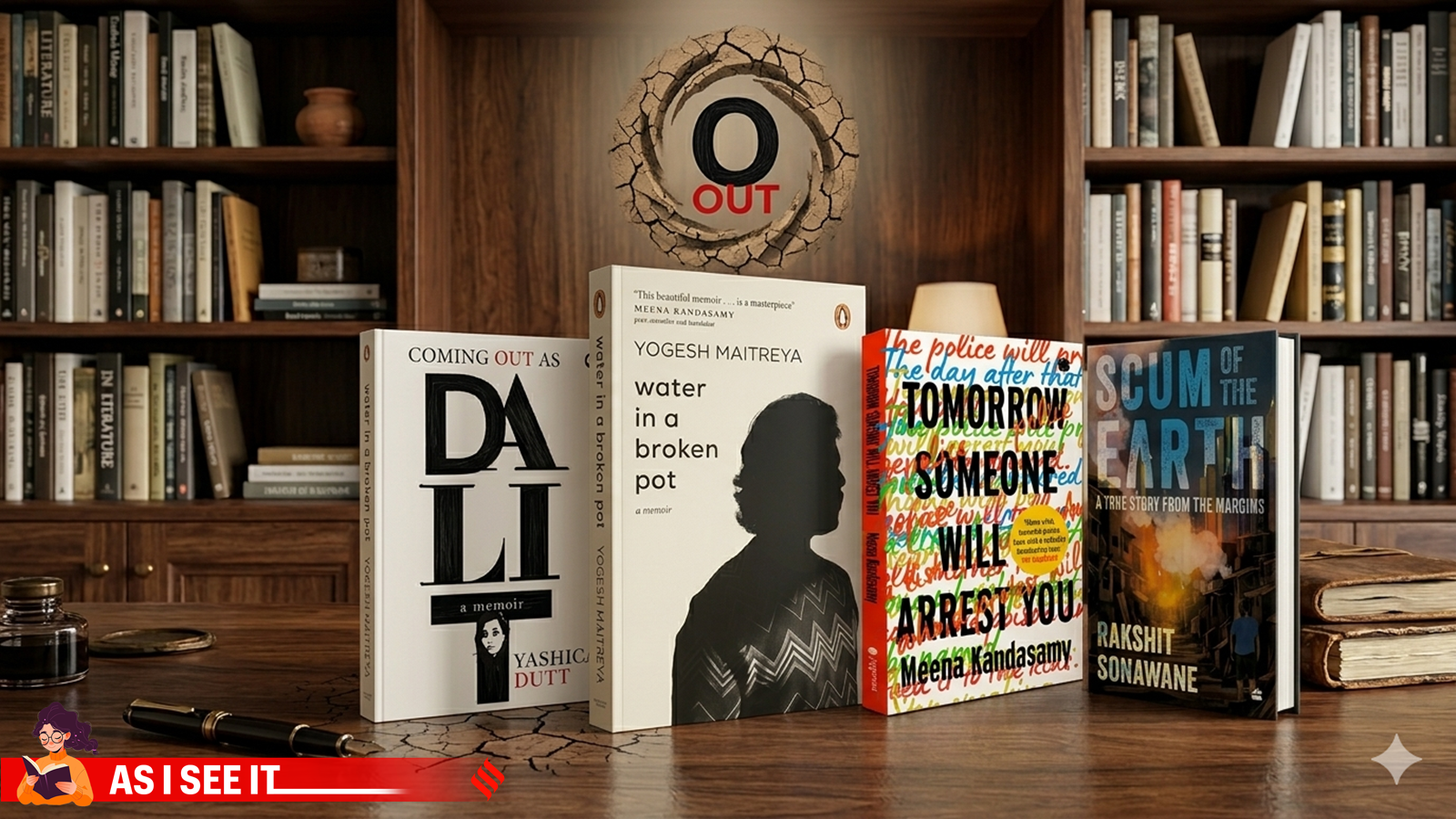
I suggest reading these four books:
Tomorrow Someone Will Arrest You—Meena Kandasamy
The book cover of Meena Kandasamy’s poetry collection, Tomorrow Someone Will Arrest You. (Source: Juggernaut.in)
The Independent once called Meena Kandasamy, who is known for raising her pen against caste oppression, and gender and systemic violence, a “one-woman, agit-prop literary-political movement.” The description could flatten a lesser writer into a slogan, but Kandasamy wears it as a provocation.
Her poetry collection, Tomorrow Someone Will Arrest You, is structured like a memoir, comprising The Poet, Her Comrade, Her Lover, Her Friends, Her Country, and moves between the intimate and the indicting. She invokes Manu’s law code not as dusty history but as an active, living policy. She dedicates her work to the Bhima Koregaon activists who have been waiting for justice since 2018. The title poem ends on the refrain “Long Live Silence.” She asks what use a poet is in a season of bloodshed and then herself answers: the poet guards the embers of a people’s rage.
Story continues below this ad
Coming Out as Dalit—Yashica Dutt
Coming Out as Dalit is a memoir by Yashica Dutt. (Source: yashicadutt.com)
How does one erase caste, when people insist on seizing one up based on your Dalit identity? One simply pretends they belong to a different caste. However, the performance of an acquired identity is exhausting, and the guilt of disassociating oneself from the fraught history and ongoing struggles takes its toll. After Rohith Vemula’s tragic suicide in 2016 over caste based discrimination, Dutta, a journalist living in New York, decided to come out–a term used by the LGBTQIA+ communities to openly embrace their sexuality and community–as Dalit. In 2023, she accused the makers of the Amazon Prime series, ‘Made in Heaven’ of using her story in an episode without any acknowledgement.
Scum of the Earth—Rakshit Sonawane
The novel is what happens when a journalist turns the tools of his trade on the country that made him. The novel–fiction based on true events–follows Avinash, a Dalit Buddhist first-generation learner, through the worlds of slum, dock, factory, and newspaper. Each is an education in what it means to be Dalit in our country in the 21st century. Sonawane’s father was a security guard, an Ambedkarite, a man who kept his principles even when the principles kept costing him. The man is present on every page, held at the careful distance of fiction, which is exactly what gives Sonawane the room to be honest without sentiment obscuring the view. He is doing what Ambedkar did in Waiting for a Visa.
Water in a Broken Pot–Yogesh Maitreya
The cover of Water in a Broken Pot byYogesh Maitreya as pictured in a library on a desk with the help of artificial intelligence (Source: amazon.in)
Yogesh Maitreya founded Panther’s Paw Press because the mainstream publishers were not doing the work, a plain sentence that indicts an entire industry. His memoir Water in a Broken Pot (Penguin India, 2023) is absolutely raw. He writes about discovering English as a young man, and feeling it dissolve on his tongue like a drug, a hallucination in which none of his caste-realities were visible. English was an escape from his squalid life, an aspiration, and the ticket to a room where things get decided. What Maitreya shows, without resorting to self-pity, is what it costs to speak a language that was never meant for you, and what you must unsee in yourself just to get through the door.
Dalit History Month is a reckoning with what we were never taught, with caste not as ancient sin but as a living system. We know Ambedkar’s name, but we don’t read his people.
Expand
© IE Online Media Services Pvt Ltd