It was the most anticipated first step on to a front porch in more than five decades when the Artemis II astronauts trod on an inflatable ring around the spacecraft that had just flown more than a million kilometres through space.
Following a near-perfect splashdown off the coast of San Diego on Friday night (local time, Saturday morning WST), a team of NASA recovery personnel and US Navy divers conducted initial safety checks and attached the inflatable collar — known as a “front porch” — around the Orion to stabilise it during the careful extraction mission.
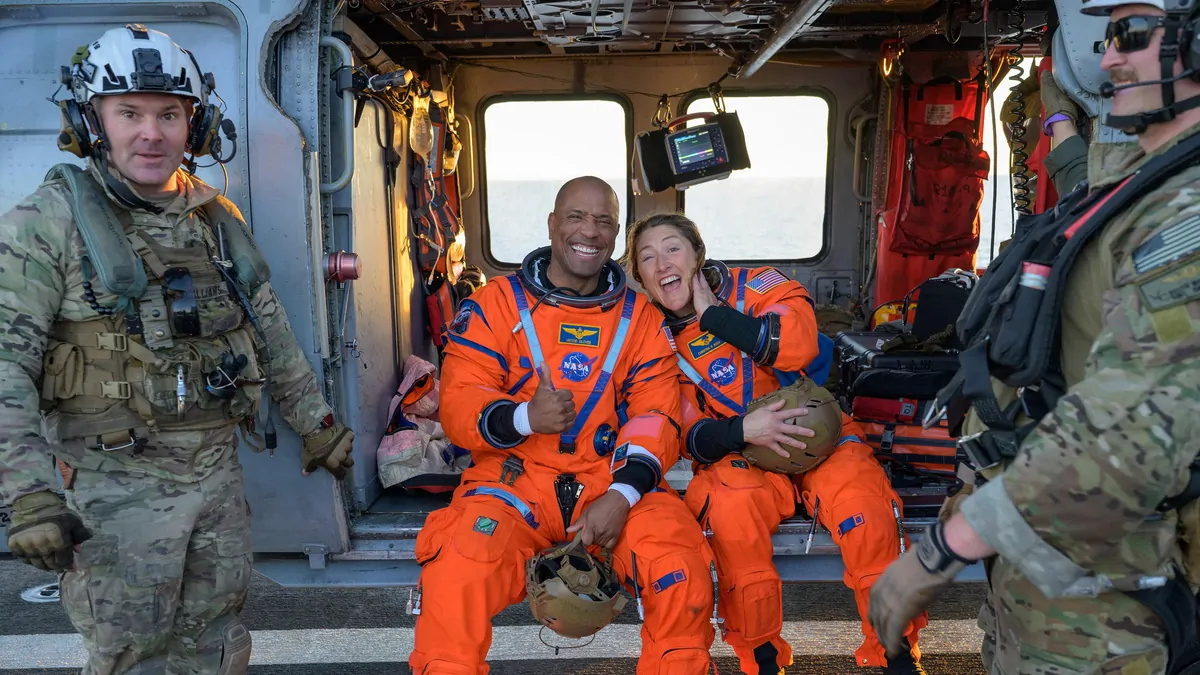
Medically trained navy divers then boarded the capsule, dubbed Integrity, for the first health checks of US astronauts Reid Wiseman, Victor Glover, Christina Koch and Canadian astronaut Jeremy Hansen after their nine-day odyssey in space.
Sign up to The Nightly’s newsletters.
Get the first look at the digital newspaper, curated daily stories and breaking headlines delivered to your inbox.
By continuing you agree to our Terms and Privacy Policy.
Then, one by one, each astronaut took their first furtive steps out of the spacecraft and on to the front porch before being airlifted by helicopter to nearby naval ship USS John P. Murtha.
Wiseman, the Artemis II commander, was the last to disembark Integrity as it bobbed in the Pacific Ocean, with his safe arrival at the ship marking the end of a lunar mission years in the making.
NASA astronaut Reid Wiseman, Artemis II commander is assisted off the flight deck after arriving aboard USS John P. Murtha after he and fellow crewmates were extracted from their Orion spacecraft after splashdown, Friday, April 10, 2026, in the Pacific Ocean off the coast of California. Credit: NASA/Bill Ingalls/(NASA/Bill Ingalls)
“From the pages of Jules Verne to a modern-day mission to the Moon, a new chapter of the exploration of our celestial neighbour is complete,” long-time NASA commentator Rob Navias said.
NASA administrator Jared Isaacman, who was aboard USS John P. Murtha, told those tuned into the NASA broadcast: “I’m still at a loss for words. The childhood Jared can’t believe what I just saw”.
The spacecraft had just endured scorching temperatures in excess of 2600C upon re-entry, engulfing the capsule in a fireball of ionised gas and cutting off radio communications for several minutes.
“If you didn’t have anxiety, you didn’t have a pulse,” Artemis II flight director Rick Henfling said of the 13-minute re-entry into the atmosphere.
PHOTO DATE: April 10, 2026.LOCATION: Off the coast of California. SUBJECT: NASA’s Orion capsule descends under its main parachutes over the Pacific Ocean following a successful 1-day Artemis II mission, April 10, 2026. Credit: Josh Valcarcel – NASA – JSC
Although the brief blackout was anticipated, the return of communications was a welcome relief, as was the sight of three white and orange parachutes unfurling themselves in the sky as Integrity slowed and gently floated down to the Pacific Ocean.
With an entry range of about 3150km, the Orion capsule landed within 1.6km of its target, a testament to the precision of NASA scientists.
Artemis II crew emerge from the capsule unknown Credit: unknown/supplied
The record-breaking mission was one of what the space agency hopes will be many crewed flights to the Moon.
It was seen as a crucial dress rehearsal for an attempt at getting boots on the lunar surface in 2028, for the first time since Apollo 17 in late 1972. From its Florida take-off on April 1 to its San Diego splashdown yesterday, the mission flew almost 1.2 million kilometres and hit a peak velocity of 39,692.86km/h.
They also reached a record distance from Earth of about 405,000km, surpassing that held by the Apollo 13 crew for the past 56 years.
But it was Integrity’s six-hour lunar flyby that gave the teams on the ground and in space an invaluable stream of scientific information in real time, including stunning imagery of the Moon’s surface and the naming of two new craters.
In a touching tribute, Hansen suggested naming a fresh crater on the Moon in honour of Wiseman’s late wife, Carroll, who died of cancer in 2020.
“A number of years ago we started this journey in our close-knit astronaut family, and we lost a loved one,” he said in a radio message to mission control in Houston.
“And there’s feature in a really neat place on the moon . . . we will be able to see this from Earth. It’s a bright spot on the Moon, and we would like to call it Carroll.”
The tender moment captured the hearts and minds of the world, as the crew tearfully embraced. Wiseman said his crewmates approached him with the idea ahead of their launch.
“I said, ‘Absolutely, I would love that . . . but I can’t give the speech. I can’t give the talk’,” he said.
The crew proposed to name another crater after their spacecraft, Integrity.
Mr Henfling said the Artemis II astronauts were “happy and healthy and ready to come home to Houston”.
They are due to return to Houston on Sunday where they will front journalists from around the globe for the first time.
A young boy wearing an astronaut costume cheers next to a woman waving a flag as they watch a live broadcast of the return of the Artemis II crew members to Earth at the San Diego Air and Space Museum during a watch party for the crew’s splash down in the Pacific Ocean, in San Diego, California, on April 10, 2026. Credit: APU GOMES/AFP
The ultimate goal of the Artemis program is to establish a long-term presence on the Moon, before embarking on a journey towards human exploration of Mars.
Glover, Koch and Hansen also made history as the first Black astronaut, the first woman and first non-US citizen, respectively, to take part in a lunar mission.
For many in a global audience captivated by the latest Moon shot, it reaffirmed the achievements of science and technology at a time when big tech has become widely distrusted, even feared.
Opinion polling showed broad public support for the aims of the mission.