There is a phrase that is suitably apt in describing the economic flow-on from the impact of the Iran war.
It was used by Prime Minister Anthony Albanese this week, who said it has “a long tail”.
The immediate status of shipping in the narrow Strait of Hormuz — through which about 20 per cent of the world’s oil production and a fifth of its liquefied natural gas output is carried — remains unclear, even if the fragile US-Iran ceasefire holds.
Sign up to The Nightly’s newsletters.
Get the first look at the digital newspaper, curated daily stories and breaking headlines delivered to your inbox.
By continuing you agree to our Terms and Privacy Policy.
That trade had slowed to a trickle under an Iranian blockade.
There remains uncertainty around if, when and how ship traffic can fully resume.
But beyond that, to get global oil and gas supplies back to pre-war levels will take time.
Damage to Gulf infrastructure will need to be repaired and ship owners will need to be comfortable that their vessels can make the journey in safety.
For Australia, at the end of the global supply chain, the delays may be significant, and will put further focus on our relationships with our major Asian suppliers.
Australia is heavily reliant on Asia for refined fuels with only two domestic refineries remaining operational.
Singapore provides us with 55 per cent of our petrol, 22 per cent of our jet fuel and 15 per cent of our diesel — which is also supplied by South Korea and Malaysia.
China provides Australia with more than 30 per cent of the nation’s jet fuel.
Senior Federal Government figures have been making contact with Asian suppliers this week.
Energy Minister Chris Bowen spoke to his Malaysian counterpart and Mr Albanese discussed regional energy security with China’s Premier Li Qiang.
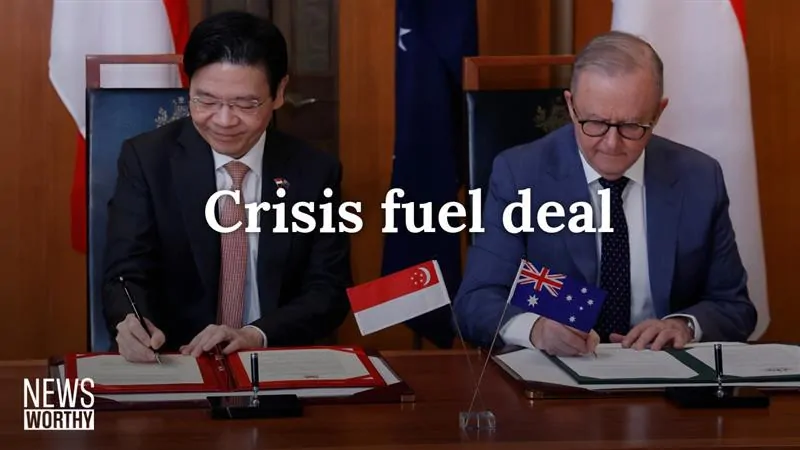
On Thursday Mr Albanese flew to Singapore for talks with Prime Minister Lawrence Wong.
Australia is a key source of liquified natural gas for Singapore.
On Friday the Australian and Singaporean leaders signed a joint statement to protect their countries’ mutual energy security and to support the flow of fuels and LNG.
The statement said they had asked their ministers to conclude a legally binding addition to the existing Singapore-Australia free trade agreements that will lock in cooperation on essential supplies such as fuel.
“By building regional cooperation on energy security and economic resilience, we strengthen our own fuel security and our own economy,” Mr Albanese said.
Mr Wong pledged to “keep these flows going as long as upstream supplies continue”.
Although the crucial and unguaranteed part of that sentence is “upstream supplies”, the agreement will be welcomed as another brick in building fuel resilience.
By Thursday average diesel prices were higher than the day the fuel excise was halved to 26.3¢ a litre.
A later deal with the States and Territories to return GST revenue to motorists took the total relief to 32¢ a litre until June 30.
But real relief depends on the smoke clearing on the Middle East conflict and a lasting resolution.
And that timing remains out of the hands of both Mr Albanese and Mr Wong.