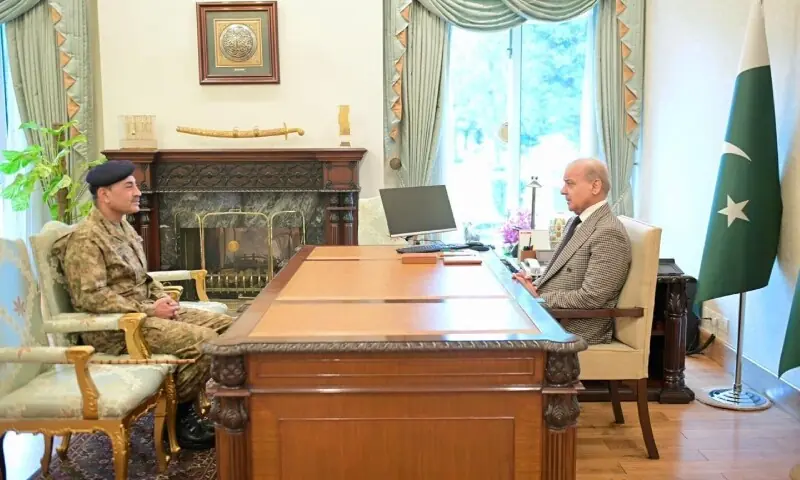
Prime Minister Shehbaz Sharif and Chief of Defence Forces and Chief of Army Staff Field Marshal Asim Munir on Thursday reviewed the “progress of Pakistan’s mediatory efforts to achieve sustainable peace in the region”.
In a statement, the Prime Minister’s Office (PMO) said CDF Munir called on PM Shehbaz.
“The dignitaries reviewed the progress of Pakistan’s mediatory efforts to achieve sustainable peace in the region. The two leaders expressed satisfaction over the de-escalation achieved so far and stressed upon the need for maintaining peace and ceasefire by all parties,” it said.
“The leadership appreciated the restraint demonstrated by all sides and reiterated Pakistan’s commitment to facilitate and provide all-out support to both sides to arrive at a peacefully negotiated settlement,” the statement said.
The statement said the premier lauded the commitment of the parties involved in the process and wished them success in their pursuit of peace.
“He also renewed his invitation to the arriving delegations and assured them of the highest consideration and support by Pakistan,” the statement concluded.
The meeting takes place as delegations from the US and Iran are due in Islamabad to hold negotiations over the weekend.
Pakistan positioned itself as a facilitator in the peace process between Tehran and Washington after the US and Israel launched attacks on Iran on February 28, setting off a conflict that gave rise to a global fuel crisis.
The day the conflict started, PM Shehbaz and Deputy Prime Minister and Foreign Minister Ishaq Dar began dialling Iranian and Gulf leaders and other regional players, stressing the need for dialogue and de-escalation.
On March 24, PM Shehbaz said Pakistan stood “ready and honoured” to host “meaningful and conclusive talks” between the US and Iran.
The next day, Washington sent a 15-point peace proposal to Tehran, which was conveyed through Pakistan. In response, Iran put forward its own set of five conditions for ending the war.
While Iranian media had initially reported Tehran’s rejection of the US proposal, Dar on March 26 confirmed that “indirect talks” were underway with Pakistan relaying messages.
Subsequently, foreign ministers of Saudi Arabia, Turkiye and Egypt were in Islamabad on March 29 and participated in a quadrilateral moot focused on de-escalation efforts in the Middle East. Dar had also said after the quadrilateral moot that Iran and US had expressed confidence in Pakistan to facilitate talks and Islamabad would be honoured to host the dialogue “in the coming days”.
A day after the moot, Dar was in Beijing, where Pakistan and China issued a five-point initiative for restoring peace and stability in the Gulf and the Middle East.
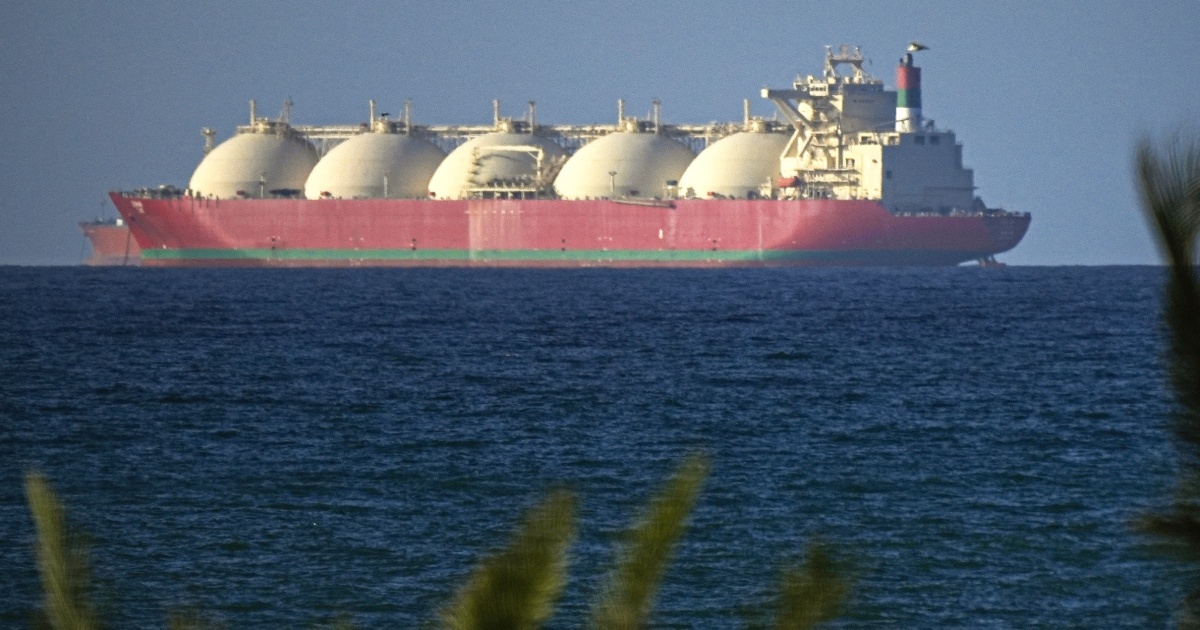
The threats of the war prolonging and intensifying escalated on April 5, when Trump, after making an expletive-laden post, issued an unusually precise deadline for Iran to agree to a ceasefire deal with Washington and allow traffic through the Strait of Hormuz — — a key maritime corridor through which 20pc of the world’s oil and liquefied natural gas flowed before the Middle East war began.
“Tuesday, 8:00 P.M. Eastern Time,” he wrote, coupled with the warning of bombing Iran’s power plants and bridges on that day, increasing pressure to prevent a worsening situation.
Meanwhile, Iranian media reported that Tehran had conveyed its response to a US proposal for ending the war to Pakistan, again rejecting a ceasefire and emphasising the necessity of a permanent end to the war.
The Iranian response consisted of 10 clauses, including an end to conflicts in the region, a protocol for safe passage through the Strait of Hormuz, lifting of sanctions, and reconstruction, the agency added.
On the day of his deadline, Trump doubled down on his threats against Iran, alarming the world.
“A whole civilisation will die tonight, never to be brought back,” he wrote, prompting backlash from even within his country.
With hours left for the deadline to end, PM Shehbaz publicly requested Trump to “extend the deadline for two weeks”, noting that diplomatic efforts for a peaceful settlement of the ongoing war were “progressing steadily, strongly and powerfully”.
He also requested Iran to open the Strait of Hormuz for a corresponding period of two weeks.
Shortly thereafter, Trump took to his Truth Social platform to say that he had spoken with PM Shehbaz and CDF Munir.
“Subject to the Islamic Republic of Iran agreeing to the COMPLETE, IMMEDIATE, and SAFE OPENING of the Strait of Hormuz, I agree to suspend the bombing and attack of Iran for a period of two weeks,” Trump announced.
Subsequently, Iran’s FM Araghchi shared a statement on behalf of Iran’s Supreme National Security Council declaring that if attacks against the country were halted, it would cease its defensive operations.
The two-week truce is based on a 10-point Iranian proposal accepted by Washington as a general framework for talks. But it remains fragile as Israel continues its attacks in Lebanon, which Israel and the US say are not part of the temporary ceasefire.
Iranian officials have rejected that interpretation, saying partial ceasefires are unacceptable and warning of a “decisive response” if violations continue.
Iran has warned it will withdraw from the ceasefire if Israeli attacks on Lebanon continue. “The Iran-US ceasefire terms are clear and explicit: the US must choose — ceasefire or continued war via Israel. It cannot have both,” Iranian Foreign Minister Araghchi said.
Later, PM Shehbaz, in a statement on X, noted the violations without naming the violator and urged restraint to allow diplomacy to proceed towards a peaceful settlement of the conflict.
On Thursday, he also held multiple phone calls, including with Lebanese PM Nawaf Salam and Bahrain’s king, Hamad bin Isa al Khalifa, and Qatar’s emir, Sheikh Tamim bin Hamad al Thani.
The leaders commended Pakistan’s diplomatic efforts, with Salam also seeking Islamabad’s support for bringing an immediate end to Israeli attacks on his country, according to the PMO.