Multiple Authors
It’s time to get weird. Every year, ESPN’s thoughtful, talented analysts produce a bevy of mock drafts to preview and predict what will happen when the NFL gathers at the end of April. And then, somewhere in the middle, I sneak in with something far more ridiculous and absurd. Most mock drafts these days have a trade or two factored in. My annual mock draft? It has 32 of them.
Today, I’m bringing my annual mock draft consisting entirely of trades to you. It is, to put it nicely, a thought exercise. Each trade occurs in its own universe, so what happened in the trade for the first overall pick doesn’t exist in the trades that occur for any of the other 31 selections. I’ll also mention scenarios where a player falls unexpectedly or a team wants to move on from a veteran, which helps create a context where a deal would make sense.
Obviously, we don’t know whether those things will happen come draft day, but remember that this time a year ago, Shedeur Sanders was expected to go somewhere in the top half of the first round, and I was mostly dismissing the idea of a Micah Parsons trade even as I included one in the piece. In that deal, the Cowboys got two first-round picks in a three-way trade sending Parsons to the Falcons, who shipped off their 2026 first-rounder to help land a much-needed edge rusher. We’re counting that one as directionally accurate.
Subscribe: ‘The Bill Barnwell Show’
I’ve tried to use general manager history and each team’s current situation to estimate how teams will approach trading up or down on draft day. Most franchises have their own private trade value chart, but we still see most of them use the Jimmy Johnson chart to help discuss and finalize trades as a lingua franca. And while it’s commonly suggested that teams discount future picks by a full round, I haven’t really found that to be true in the opening round of the draft for quite a while now. So I have only a mild discount on future picks, which I’m regressing close to the average pick in a typical round outside of extreme scenarios. This doesn’t appear to be a year when there’s significant interest in moving up, so I’m not projecting teams to pay a massive premium as they jump up in Round 1. I’ll note exceptions accordingly.
Picks in this year’s draft are notated with the round and overall pick number; the 45th pick in this year’s draft — a second-round selection — would be listed as “2-45.” Future picks are mentioned by round since we don’t know exactly where they’ll land. And with five teams holding 10 of the 32 first-round picks, well, a handful of organizations show up repeatedly throughout this mock draft. The Falcons, Colts, Packers, Jaguars and Broncos do not have their first-rounders, and none of them makes an appearance.
We’ll go chronologically No. 1 through No. 32. And, as always in an article where everything already requires a significant grain of salt, things are most absurd at No. 1 before settling down and getting (slightly) more plausible afterward.
Jump to a first-round pick:
1 | 2 | 3 | 4 | 5 | 6 | 7 | 8
9 | 10 | 11 | 12 | 13 | 14 | 15 | 16
17 | 18 | 19 | 20 | 21 | 22 | 23 | 24
25 | 26 | 27 | 28 | 29 | 30 | 31 | 32
Or jump to a trade involving:
Coleman | Crosby | Greenard
Highsmith | Johnston | McCarthy
Raiders get: 1-2, 2-33, 4-103
Jets get: 1-1
If you’ve been reading this piece over the past few years, you know I’m perpetually apologizing at the first overall pick. In most drafts, the first overall selection is a promising young quarterback going to a team that desperately needs one. That team is never going to trade out of that pick, which makes a conceit that’s already hypothetical even more preposterous. I know.
So, the only way to have a trade out of the first pick make sense for the Raiders would be one of two scenarios. One would be getting offered something they don’t expect at quarterback, like the Ravens deciding to trade Lamar Jackson, the Bears dealing Caleb Williams or the Texans shipping out C.J. Stroud in a return that would land them presumptive top pick Fernando Mendoza. We’ve seen some wild things happen this offseason, but there isn’t meaningful smoke in any of those places. So those are off the table.
Editor’s Picks
2 Related
What might be at least a tiny bit more plausible, though, is a second scenario in which the Raiders don’t feel quite as enthusiastic about Mendoza as people believe. Perhaps they prefer Alabama quarterback Ty Simpson, as ESPN’s Dan Orlovsky does after he evaluated both passers closely. Maybe they don’t have a strong opinion about the two of them and just want to make sure they end up with one of the two potential franchise starters.
In an ideal world, if the Raiders preferred Simpson, they would be able to trade down to the middle of the first round and land him while picking up significant draft capital in the process. That’s a dangerous game to play, though. Let’s say the Raiders trade the No. 1 pick to the Browns, who want Mendoza, and move down to No. 6. What if the Jets, who have visited with Simpson, take the 23-year-old quarterback at No. 2, shutting the Raiders out altogether?
Simpson is not the second-best prospect in this class, but if the Raiders want to truly ensure that they come away with one of the top two QBs, they probably can’t drop any lower than No. 2. So here’s a deal where they do so by making a deal with the Jets, who jump up one spot and get to draft Mendoza. It’s not the sort of franchise-altering trade that teams typically get if they move out of the top spot, but the Raiders add the first pick of Day 2 and the third pick of Day 3, which offers both the ability to add potentially valuable players and significant trade potential as teams simmer on players they like overnight between rounds. And the Raiders would still be in position to draft Simpson at No. 2.
Anything that doesn’t end with the Raiders drafting Mendoza in Pittsburgh would be shocking. I think it’s more likely that Simpson falls out of the first round altogether than that he lands in the top five, let alone the top two. But if things don’t break that way, this is one way for the Raiders to find their quarterback and add more in the process.
Jets get: 1-4, 3-66, 2027 fourth-round pick
Titans get: 1-2
With that being said … I would be surprised if the Jets actually did draft Simpson at No. 2. Geno Smith isn’t anything more than a short-term option in New York, but Simpson simply doesn’t have the sort of résumé we associate with a quarterback taken this high in the first round. It’s smart for teams in the top 10 to hint that they might be interested in Simpson for bluffing purposes, and someone might take the plunge, but it seems far more likely that Simpson ends up going much later in Round 1.
General manager Darren Mougey has plenty of draft capital after trading away Sauce Gardner and Quinnen Williams at the trade deadline, but teams can never have too many premium picks. The Jets can also use their Day 1 and Day 2 selections to move around the board and grab the players they want. If Simpson falls to the bottom half of the first round, nobody would be better positioned to pounce than Gang Green. In that scenario, coach Aaron Glenn could get his impact defender in the top 10 and the Jets could still pick up their potential QB of the future.
The identity of that impact defender comes into question, which makes this position fluid for the Jets. Do they want Ohio State linebacker/edge rusher Arvell Reese, who has drawn Micah Parsons comparisons? Off-ball linebackers typically fall on draft day, so if teams see Reese in that role, the Jets might be able to grab him later in the top 10. (Remember that Parsons fell to No. 12 in 2021.) Likewise, college teammate Sonny Styles is a converted safety who will be best in that hybrid linebacker role at the next level. Texas Tech edge rusher David Bailey is a more traditional prospect, but the Jets are pretty set on the edge with Will McDonald IV, Joseph Ossai and Kingsley Enagbare.
2:07
Mike Tannenbaum’s dream scenario for the Jets
Mike Tannenbaum lays out his best-case scenario for the Jets, which includes trading up late in the first round and taking Alabama QB Ty Simpson.
New York might be more agnostic about which of those defensive players it lands, and at No. 4, it could still ensure that it lands a difference-maker in the front seven. The Titans, on the other hand, might be more specific. I have to imagine that Tennessee coach Robert Saleh — who has preferred lean, athletic edge rushers for his defenses — would want to add Bailey. The Titans have Jermaine Johnson and 2025 second-rounder Oluwafemi Oladejo on the edge already, but Bailey might be the most athletic edge rusher they have drafted since Jevon Kearse. There won’t be a huge demand to trade up in the top 10 here, which is why the price would be relatively muted.
Cardinals get: 1-7, 2027 second-round pick
Commanders get: 1-3
The Cardinals have been popularly linked to front-seven players on defense, which doesn’t really make a ton of sense to me. The Arizona defense struggled in 2025, but it is relatively deep up front, with more issues in the secondary. The Cardinals could also be looking at right tackle options, but with Miami’s Francis Mauigoa, Georgia’s Monroe Freeling (played mainly LT in college) and Utah’s Spencer Fano, general manager Monti Ossenfort should have options if the team drops a little deeper into the top 10.
After a chastening 2025 season, Washington general manager Adam Peters has spent most of his offseason rebuilding a breathtakingly dismal Commanders defense. Washington did bring in some help for Jayden Daniels, but in Chig Okonkwo, Rachaad White and Jerome Ford, I see mostly secondary and rotational playmakers. The goal in this year’s draft, down their second- and fourth-round picks, might be to add the single best possible playmaker for Daniels on the offensive side of the ball.
That playmaker could be Ohio State receiver Carnell Tate, but I wonder if the Commanders go in a different direction. Peters comes from San Francisco, where the 49ers initially spent big on Jerick McKinnon in free agency and then traded for Christian McCaffrey, who transformed their offense after arriving. Notre Dame running back Jeremiyah Love might be that sort of prospect. The Commanders have generally avoided investing heavily at RB, but Love could be the sort of player who persuades them to go in a different direction.
The Titans have been popularly linked to Love at No. 4, and the Giants were reportedly in the running back market this offseason before restructuring Devin Singletary’s deal. The Commanders can’t count on Love falling to them at No. 7. Moving up would cost Washington a second-round pick in what should be a much deeper draft in 2027, but it would land the team the best possible guy for Daniels right now. Arizona, meanwhile, would land potential ammunition for its push toward a quarterback in 2027 and fall into position to take a right tackle.
Titans get: 1-9, 2-40
Chiefs get: 1-4, 5-142, 6-184
If the Titans aren’t drafting Love, moving down to the bottom of the top 10 might make sense. They could look offensive tackle, with the expectation that someone like Mauigoa could start his career at right guard before moving to left tackle and taking over for Dan Moore Jr. after the Titans eventually move on from the free agent disappointment’s contract next offseason. Hybrid guys such as Styles and Caleb Downs could also still be on the board at No. 9. Heck, there’s a chance Love might still be available with the ninth pick.
Get ready for the 2026 NFL draft
• Mocks: Kiper | Miller | Reid | Yates
• Rankings: Kiper | Miller | Reid | Yates
• Team needs | Best players by position
• Latest buzz | Full draft order | More
Titans general manager Mike Borgonzi came over from Kansas City, so I suspect Chiefs GM Brett Veach won’t have trouble reaching his former colleague in Tennessee. The Chiefs aren’t going to draft this high very often, so this is a chance for them to find the sort of difference-maker they are going to struggle in consistently finding in the bottom quarter of the first round. Could that be Tate, who would be interesting to just about every team in the 5-8 range? I’d lean more toward Bailey, who would give Steve Spagnuolo the sort of hyper-athletic edge rusher he hasn’t had for a while now in Kansas City.
Trading a second-round pick would be difficult for a team that needs an influx of young talent, but the Chiefs would still have the 29th selection to play around with after sending Trent McDuffie to the Rams. And the Titans, who have plenty of extra Day 3 picks, would turn two of them into another premium selection, giving Borgonzi three top-40 selections. This one rates as a near perfectly even swap on the Jimmy Johnson chart.
Giants get: 1-8, 3-73, 5-172
Saints get: 1-5, CB Deonte Banks
The Giants could be in the mix for Love or Tate, but their ideal addition would be Styles, who should still be available at No. 8. They traded away their 2026 third-round pick as part of the move up for Jaxson Dart a year ago, and while Love would be their long-term replacement for Saquon Barkley, getting that third-round pick back might not cost the Giants very much given their potential range of non-Love additions in Round 1.
Mickey Loomis and the Saints, of course, are never shy about moving up if there’s a player who fits their roster. They would likely need to leap the Browns and Commanders to jump the queue for Tate, who would slot in alongside Chris Olave and Devaughn Vele as the starting wide receivers for Tyler Shough. New Orleans would also take a flier on a 2023 first-round pick at cornerback in Banks, who has prototypical size for an NFL cornerback at 6-foot-2 but hasn’t lived up to expectations through three years in New York. Banks would figure in as the likely kick returner for the Saints in 2026, too.
Browns get: 1-12, 1-20, 2027 second-round pick
Cowboys get: 1-6, 1-24, 2027 fifth-round pick
The Browns aren’t in asset accrual mode as they were during the Sashi Brown era, but they’re approaching this draft with an eye on adding more premium picks, especially if the picks land in 2027. Assuming the Browns don’t draft a quarterback with one of their early selections in 2026, the target for Cleveland’s long-term answer under center would be in the 2027 class. The Browns have their own picks on Days 1 and 2 next year, which helps, but adding a second-round pick in that draft would add extra flexibility if general manager Andrew Berry needed to move up to get his guy.
1:44
Who should be the Browns’ starting QB? Stephen A., RC debate
Stephen A. Smith and Ryan Clark break down whether Deshaun Watson or Shedeur Sanders should be the starting quarterback for the Browns.
Jerry Jones has already dealt one of the Cowboys’ two first-round picks in next year’s draft as part of the Quinnen Williams trade, so though shipping off a second-rounder wouldn’t feel great, watching last year’s defense wasn’t much fun, either. The Cowboys already added an edge rusher this offseason in Rashan Gary, but even after acquiring Williams at midseason, Dallas was 23rd in sack rate when it rushed four or fewer. The Cowboys can’t stop adding players to this front seven.
This move would make sense for Dallas because it would ensure landing one of the four premium defensive players atop the board in Reese, Bailey, Styles or Miami’s Rueben Bain Jr. If Mendoza and Love come off the board within the first five picks, at least one of those defensive prospects would still be available at No. 6. The Cowboys would still have two first-round picks in this year’s draft, moving down four spots with their other selection.
Commanders get: 1-14, 3-80, 5-154, 2027 third-round pick
Ravens get: 1-7
I’ve already talked about a potential trade up for the Commanders if they’re infatuated with Love, but a trade down would be the more logical decision for Peters. The Commanders were the league’s oldest team on a snap-weighted basis in 2025. They made just five picks a year ago, and only two of those were top-125 selections. Dan Quinn’s team also doesn’t have its second- and fourth-round picks in this year’s draft because of the Laremy Tunsil trade.
There might not be a huge demand to move up in this year’s draft, but if one of those aforementioned defensive standouts remains available at No. 7, I wonder if the Ravens might come calling. We saw Baltimore very nearly trade two first-round picks for Maxx Crosby, and though that trade was eventually abandoned for the signing of Trey Hendrickson, general manager Eric DeCosta suggested afterward that the Ravens were interested in trading for Crosby and signing Hendrickson. That possibility certainly hints toward the Ravens pursuing pass-rush help at the top of this draft.
That could be a player such as Bain on the edge or Styles as a dangerous defensive playmaker next to All-Pro linebacker Roquan Smith. The Ravens would give up two third-round picks, which isn’t typically the way they operate, but neither was trading a first-round pick for a veteran, let alone two for Crosby.
Saints get: 1-3
Cardinals get: 1-8, 3-73, 2027 second-round pick
Mickey Loomis’ next trade down in Round 1 of a draft will be his first, which means there’s only one direction to travel here. I’ve already mocked a smaller move up for the Saints, so how high could they realistically go if they really wanted to make a major defensive splash?
Check out ‘NFL Draft Daily’ on ESPN2
Want to know more about the 2026 NFL draft class? ESPN’s new show ‘NFL Draft Daily’ airs Monday-Friday at 3 p.m. ET on ESPN2, ESPN+, Disney+ and Hulu. Join Mel Kiper Jr., Field Yates and other experts for the latest on top prospects.
The Jets might be open for business at No. 2, but a more realistic landing spot might be with the Cardinals at No. 3. Loomis already signed his blitzing linebacker by reacquiring Kaden Elliss this offseason, a move that would seem to rule Reese off the table, but this could be a move up for Bailey. Carl Granderson has no guaranteed money remaining on his deal after this season, and Bailey could step in, alongside Chase Young and interior rusher Bryan Bresee as the cornerstones of the Saints’ pass rush for years to come.
Arizona, again, would add a premium pick in 2027 from a team that doesn’t project to be very good.
Chiefs get: 1-18, 3-97, Edge Jonathan Greenard
Vikings get: 1-9, Edge Felix Anudike-Uzomah
We’ve heard that picking ninth gives the Chiefs a rare chance to address critical positions on their roster with a premium pick, and that’s true. What if they do that in a relatively unconventional way? George Karlaftis has settled in as a solid starter, and Chris Jones’ impact hasn’t dipped as much as his statistical production suggests, but the Chiefs would love to come out of this draft with an impact edge rusher. They might be just a tad too low to land that player at No. 9 if the board goes as expected.
One other way to address that need would be to add a star in Greenard, who racked up 12 sacks and 22 knockdowns with the Vikings in 2024 before injuries wrecked his 2025 campaign. Greenard will turn 29 in May, so he should still have a couple of years of impactful pass rushing before the Chiefs would need to worry about moving on. Greenard has two years and $37.9 million remaining on his deal, and though Brett Veach & Co. would have to address that contract with a meaningful raise, Greenard could still be an easily justifiable addition for the Chiefs, given their perennial role as Super Bowl contenders.
This trade would value the difference between Greenard and Anudike-Uzomah — a former first-round pick who hasn’t impressed with the Chiefs — as being worth the 54th pick, according to the Johnson chart, in a typical draft. The Vikings would move up from No. 18 to No. 9 and put defensive coordinator Brian Flores in line to add one of the premier defensive backs in this year’s class. The idea of Downs in a Flores defense is tantalizing, but the Vikings could also go for LSU cornerback Mansoor Delane here. Trading Greenard would open cap space and create a spot in the starting lineup for Dallas Turner, who filled in for Greenard and Andrew Van Ginkel when they were hurt last season.
The Chiefs also need cornerbacks, but I’m just not sure Veach philosophically values cornerback enough to use a top-10 pick at the position. The Chiefs could use their later first-rounder on a corner and still add that immediately impactful edge rusher in Greenard.
1:31
Why draft stocks of Rueben Bain Jr., Mansoor Delane have risen
Jordan Reid breaks down the players who saw their NFL draft stocks rise after their pro days, including Rueben Bain Jr.
Bengals get: 1-13, 3-93
Rams get: 1-10, 6-189
The Bengals don’t typically make major moves during the draft weekend, as they usually either stay put with their existing selections or make small moves around the board. Bengals fans would understandably love to add a premium pass rusher to the roster, but Cincinnati signed Boye Mafe in free agency, and the team hopes to get more out of 2025 first-rounder Shemar Stewart, who managed only one sack in eight games as a rookie.
Rams GM Les Snead and coach Sean McVay? Well, they’re the polar opposites of the Bengals in quite a few ways, including how aggressive they’ll be moving either up or down. Though the Rams still have this first-round pick from Atlanta, they no longer have their own first-rounder, having sent it to the Chiefs for Trent McDuffie. They’re also down fourth- and fifth-round picks, which might push the Rams to lean more toward trading down than up.
With the rumor mill suggesting that the Rams were at least interested in acquiring A.J. Brown and considered trading Davante Adams this offseason, there’s a chance their focus will be on adding that final playmaker for reigning MVP Matthew Stafford. Tate should be off the board by the 10th selection, but if the Rams want to add USC wideout Makai Lemon, they might need to get aggressive. The Dolphins are bereft at wide receiver and need playmakers for Malik Willis. Lemon would be a logical pick for them at No. 11.
Lemon isn’t a direct replacement for Adams in the long term, but Lemon’s willingness to work over the middle of the field and block would appeal to McVay. It’ll also get Lemon on the field immediately in what could be Stafford’s final season.
The Bengals should be looking for help at safety, off-ball linebacker and potentially on the interior of their offensive line. If Downs and Styles are off the board, moving down would still allow Cincinnati to address those spots, with someone such as Oregon safety Dillon Thieneman or Georgia linebacker CJ Allen at No. 13.
Dolphins get: 1-17, 2-50
Lions get: 1-11, 3-94
The Dolphins are in pick accrual mode, and though this doesn’t add new selections for general manager Jon-Eric Sullivan, the former Packers executive is adding another top-50 pick to his arsenal here by trading down and sacrificing one of his four third-rounders.
2026 NFL Draft Day Predictor simulator
Our mock draft simulator allows users to act as the general manager of their favorite team, giving them the opportunity to make picks in all seven rounds and conduct trades throughout the draft.
Draft Day Predictor » | Simulator »
Miami would have to be curious about Lemon if he is still on the board here, but if he’s gone, trading down and exploring the wide receivers later in the draft would make sense. Remember that the Packers were happy to use Day 2 and Day 3 picks at wide receiver before using a first-rounder on Matthew Golden last year. The jury is still out on Golden, and I wonder if Sullivan might be thinking about using multiple middle-round picks at wideout as opposed to taking a big swing in Round 1.
The Lions are sending two third-round picks to the Jaguars as a result of last year’s trade for Isaac TeSlaa, and that makes me wonder whether moving up is the right idea. At the same time, Lions GM Brad Holmes has been aggressive in previous years, and the Lions have obvious needs in their starting lineup at offensive tackle and on the edge.
The Lions might have somebody fall to them at No. 17, but if they’re thinking about adding an edge rusher across from Aidan Hutchinson, moving up might be necessary. The Cowboys, Ravens, Buccaneers and Jets all draft between Nos. 11 and 18 and would have their eyes on Akheem Mesidor (Miami) and T.J. Parker (Clemson), who both could land in this range.
Cowboys get: 1-2, 2027 fifth-round pick
Jets get: 1-12, 4-112, 2027 first-round pick, 2027 third-round pick
Well, let’s get creative. What if the Cowboys absolutely, positively love one of the defensive players in this draft and want to make sure they get that guy on their roster immediately? I know it’s difficult to imagine Jerry Jones doing something rash and dramatic, but the Cowboys’ owner has to fix Dallas’ defense, preferably sooner rather than later. The Cowboys have essentially swapped out Osa Odighizuwa for Rashan Gary and added Jalen Thompson and Cobie Durant in the secondary, but even with Quinnen Williams in the mix, the Cowboys lack star power and difference-makers in their front seven.
If the Cowboys are willing to do this deal, they move all the way up behind the Raiders, who presumably are going quarterback at No. 1. Does Jones want Reese? Bailey? Bain? Styles? Doesn’t matter. He can get whoever he wants to make an immediate impact for the Cowboys at No. 2. With this trade, the Cowboys also hold onto the 20th pick, which would allow them to address the secondary, either by selecting a player or moving down for extra draft capital. Suddenly, Jones can feel like his team is actually … stacked on defense?
For the Jets, this would be about adding draft capital and recalibrating for when they’ll need picks most. Darren Mougey would add another first-round pick with this move down, which is great, but the Jets would crucially capture that first-rounder in 2027. Yes, the Jets already own one of Dallas’ two first-round picks next year. This would ensure the Jets will land the other one, either directly from Dallas or via Green Bay; that pick will be less valuable given the Jets already are guaranteed the more favorable of those two first-round picks, but it’s still a future first-rounder.
More importantly, that pick comes in the 2027 draft, when the Jets expect to be adding their quarterback of the future. They would now have four first-round picks in their 2027 war chest, matching their total from the 2000 draft, when Gang Green landed Shaun Ellis, John Abraham, Chad Pennington and Anthony Becht in Round 1. Those are picks the Jets can use to either directly add their quarterback of the future, add talent around that signal-caller or move around the first round to make sure they can get the guy they want.
Mougey would be loading up on picks in a 2027 draft that is widely believed to be more talented and more impactful than the 2026 class, especially on the offensive side of the ball. Dropping down from No. 2 to No. 12 would hurt, but the Jets general manager would still have pick Nos. 12, 16, 33, 44, 103 and 112 in this year’s draft, which should hand coach Aaron Glenn meaningful talent as he works on rebuilding a dismal defense. The Jets wouldn’t be getting ideal value by the Johnson chart on this deal, especially if you discount future picks, but it would align more of their draft capital in a more exciting offensive class next year.
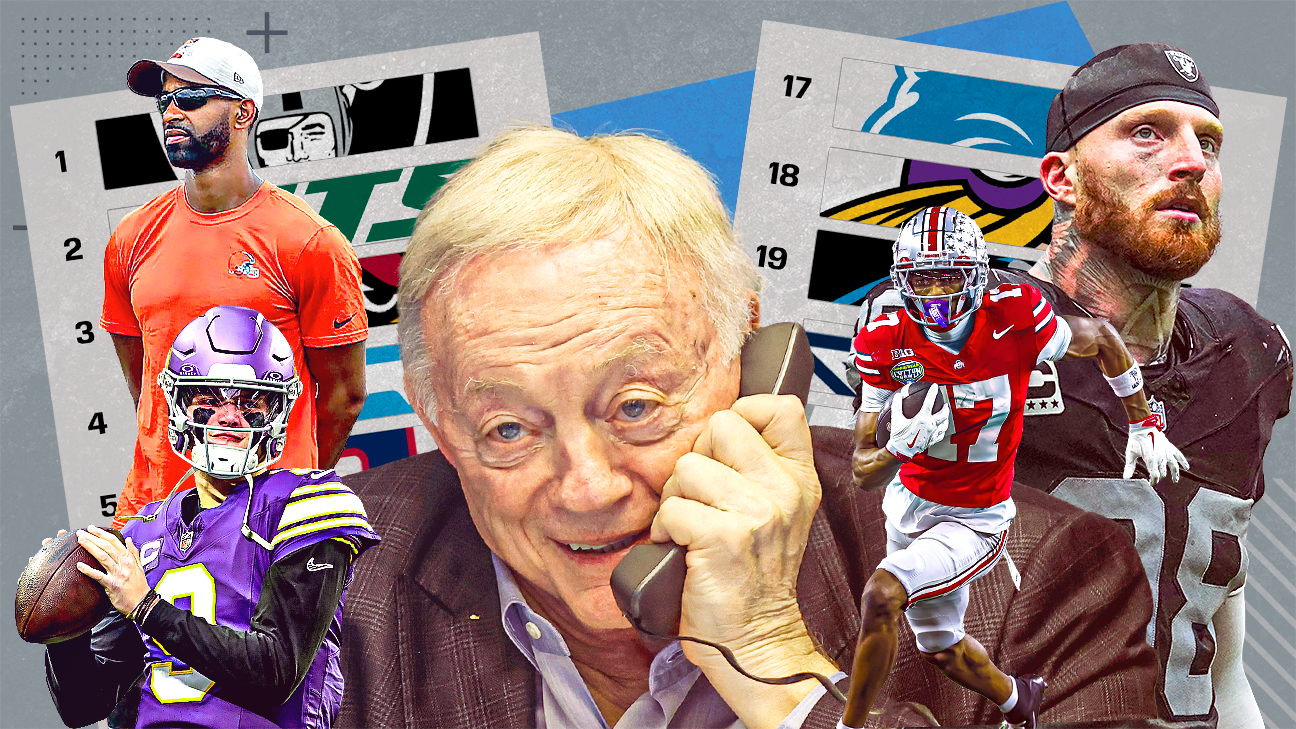
From left to right: Browns GM Andrew Berry, Vikings quarterback J.J. McCarthy, Cowboys owner Jerry Jones, Ohio State receiver Carnell Tate and Raiders edge rusher Maxx Crosby. ESPN
Rams get: 1-18, 3-97, QB J.J. McCarthy
Vikings get: 1-13
We know general manager Les Snead doesn’t value picks in the bottom quarter of the first round, so the Rams aren’t likely to move down very far if they do trade down here. And while Snead is obviously going to want to use his remaining first-round pick to address the 2026 roster, there is also an argument to be made for trying to land his team’s quarterback of the future. Stafford is 38 years old. He won league MVP last season, but with any quarterback approaching 40, it’s smart to have a backup plan in place.
A reunion with Jimmy Garoppolo still makes sense for all parties involved, but what if the Rams do want to find a younger option? Stetson Bennett IV is on the roster, but the 2023 fourth-round pick is yet to play a single pro snap and will be a free agent after the season. There hasn’t been much evidence that the Rams see him as part of their long-term future under center.
Is McCarthy a viable solution? The results we’ve seen so far say no. But great coaches also have a habit of revitalizing quarterbacks who didn’t look like NFL-caliber starters. Sean McVay turned around Baker Mayfield’s career after he had been unceremoniously dumped by the Browns and Panthers. Kyle Shanahan turned Sam Darnold in the right direction and appears to have righted the path for Mac Jones. Andy Reid helped save Nick Foles’ career before the backup won a Super Bowl with the Eagles.
Of course, McCarthy was already under one of those highly touted coaches in Kevin O’Connell, who was on McVay’s staff in Los Angeles. In addition to the issues McCarthy had as a pure passer during the 2025 season, he missed all of 2024 with a knee injury and was sidelined by multiple injuries in 2025. It might be tough to count on him making it through a full 17-game season, let alone playing well in the process.
At the right price, though, taking a flyer on McCarthy would make sense. The Vikings are unlikely to move forward with the 2024 ninth overall pick as their quarterback of the future, having signed Kyler Murray to take over as their starter in 2026 before deciding on McCarthy’s fifth-year option after the season. Getting something for the 23-year-old quarterback would make sense if the organization has decided it is going to be heading in a different direction. This move up would get the Vikes ahead of the Bucs and Jets if they want to look toward secondary help in Round 1.
This trade would value McCarthy as being worth the 112th pick in a typical draft by the Jimmy Johnson chart, a selection in the middle of the fourth round. That feels about right to me. And the Rams would be on the hook for $6.6 million over the next two years, which isn’t much for a developmental backup quarterback. Could McCarthy’s solid final four games of the 2025 season (admittedly against dismal opposing defenses) portend growth and some future success? The Rams wouldn’t be paying much to find out.
1:28
Schrager talks with McAfee about Rams’ trade discussions on Davante Adams
Peter Schrager joins “The Pat McAfee Show” to talk about Sean McVay acknowledging the Rams had trade discussions surrounding Davante Adams.
Ravens get: 1-30, Edge Chop Robinson
Dolphins get: 1-14
This would be another way for the Ravens to add a potentially impactful young edge rusher, but via moving down as opposed to up. Robinson looked like he was on a superstar track after his rookie season, when he generated quick pressures at the seventh-highest rate of any player in football, let alone among rookies, per NFL Next Gen Stats. He managed a relatively modest six sacks across 565 snaps, but that underlying performance hinted toward a budding star.
With high expectations in 2025, Robinson instead endured an utterly anonymous season. He spent the first few weeks of the year as the third edge in the Miami rotation behind Jaelan Phillips and Bradley Chubb. Robinson’s snap count increased after Phillips was dealt to the Eagles, but the 23-year-old finished the season with only three sacks and seven knockdowns. His quick pressure rate split in half, dropping from 7.4% to 3.7%, even while running a double-team rate just below league average for edge defenders.
It was a wildly disappointing sophomore campaign for a player with such promise, and when Jon-Eric Sullivan detailed his pillars for the organization moving forward, the new Miami general manager didn’t include Robinson. If the Dolphins don’t see Robinson as a difference-maker in the long term, moving him for meaningful draft capital before that comes clear would be the logical choice. This trade would value Robinson as the 42nd pick in a typical draft by the Johnson chart, a pick in the upper half of the second round.
New Ravens coach Jesse Minter has a recent track record of turning around promising young edge rushers who disappointed with their prior teams, having just unlocked a new level of play from Odafe Oweh after those very same Ravens shipped him off to the Chargers, where Minter was the defensive coordinator. Robinson would step into a rotation with second-year defender Mike Green across from free agent addition Trey Hendrickson. And the Ravens would owe Robinson only about $5 million over the next two years, which would be a very reasonable total for an organization under a serious cap crunch given what they’re paying to other stars on their roster.
Buccaneers get: 1-21, 3-76, 4-135
Steelers get: 1-15, 6-195
For Jason Licht and the Buccaneers, trading up or down would really be about feeling out the board and whether they can be patient at their preferred positions. Cornerback and edge feel like the biggest needs for Tampa Bay, and there will be different options at different tiers throughout the first round for the Bucs. If they feel like they can trade down and still land somebody such as Mesidor, Parker or Cashius Howell (Texas A&M) at No. 21, moving down and adding two middle-round picks wouldn’t be too painful.
Breaking news from Adam Schefter
Download the ESPN app and enable Adam Schefter’s news alerts to receive push notifications for the latest updates first. Opt in by tapping the alerts bell in the top right corner. For more information, click here.
The Steelers would be moving up here in an attempt to land Simpson. There’s a decent chance that they could land him at 21, but with the Jets picking at No. 16, general manager Omar Khan would have to be reasonably worried that New York would be willing to take the Alabama quarterback in the middle of the first round as opposed waiting until the start of Round 2.
The rules roughly go out the window when teams are moving up for quarterbacks, but this wouldn’t even be an exorbitant price, with the Steelers ceding one of their three third-round picks and a fourth-round compensatory selection to jump ahead of the Jets. While there are those in Pittsburgh who are fond of sixth-round pick Will Howard, the Ohio State product hasn’t yet taken a preseason or regular-season snap. Simpson would slot in as the QB2 in 2026 behind a veteran, most likely Aaron Rodgers, before taking over as the long-term option for the Steelers in 2027.
Jets get: 1-10, 4-110
Bengals get: 1-16, 2-44
If it feels as if there are a lot of Jets trades in this column, well, it helps to have all the draft picks. This is the second Jets selection, and while I would suspect that the Jets will at least be considering Simpson in the middle of the first round, my instinct is still that he makes it to the very end of Round 1. There, teams at the top of the second round might consider trading up into one of the final few picks of the draft’s opening day for him. If Mougey and the Jets do lean toward defense with their initial selection, this pick might be earmarked for help on offense.
Receiver is a need for the Jets even after extending Garrett Wilson and acquiring Adonai Mitchell via trade last year. If Wilson goes down hurt, as he did last season, this instantly becomes one of the worst receiving groups in the NFL, if not the worst. Aaron Glenn might believe Geno Smith is going to take the Jets to “the promised land,” but he can’t do it on a solo mission.
Moving up for a wide receiver such as Lemon or Arizona State’s Jordyn Tyson — or even top tight end prospect Kenyon Sadiq out of Oregon — could make sense for Mougey, who has plenty of draft capital. The Bengals aren’t in the market for a receiver, but it stands to reason that the Dolphins and Rams would be, which could leave the Jets without their preferred target at No. 16. The Bengals need as much cost-controlled talent as possible given the cost of the big three in their passing game, so adding another premium pick early on Day 2 would be the right idea for Cincinnati.
2:23
Should the Jets draft Ty Simpson at No. 16?
The “Get Up” crew weighs in on Ty Simpson’s private workout with the Jets and how high they should draft him.
Lions get: 1-23, 3-98
Eagles get: 1-17
Having traded a pair of third-round picks away in last year’s move for TeSlaa and facing a cap crunch given all of the young talent coming due for extensions, Brad Holmes should probably be looking at adding more draft capital. The former Rams executive might share his former team’s disdain for picks at the bottom of the first round, but moving down to No. 23 shouldn’t take anything off the table for Detroit. Getting back a third-round pick, albeit in the compensatory section of the third round, would be helpful for Holmes as he reimagines his roster. If the Lions are thinking right tackle, they shouldn’t have too much trouble still landing their preferred option.
Howie Roseman and the Eagles would be thinking safety here. While I’m not sure Roseman would have taken a safety in the first round in years past, the longtime Eagles general manager surprised many onlookers (myself included) by using his first-round pick on Alabama linebacker Jihaad Campbell last year, a position Philly hasn’t traditionally valued in that way.
Safety is an essential part in Vic Fangio’s defense, though, and the Eagles have an opening next to Andrew Mukuba after Reed Blankenship signed with the Texans. If Roseman covets Oregon safety Dillon Thieneman, who profiles as the sort of versatile option Fangio loves, he’s probably going to need to get moving. The Vikings need a Harrison Smith replacement, while the Panthers could also be looking for an upgrade on Nick Scott. Jumping both teams might be enough to get Roseman one of the few missing pieces for his defense.
Vikings get: 1-25, 2-60
Bears get: 1-18, 5-163
We don’t normally see many trades between division rivals, but trades involving draft picks can represent an exception. The Eagles and Cowboys traded first-round picks in 2021 in a deal that landed the former DeVonta Smith and the latter Parsons. The Vikings moved down in deals with the Lions and Packers in the 2022 draft, although that was under the stewardship of Kwesi Adofo-Mensah. It remains to be seen whether executive vice president of football operations Rob Brzezinski would be as amenable to this sort of trade, but I do have the Bears paying a bit of a premium for the privilege of making a deal within the NFC North.
Ryan Poles has already addressed some of his team’s weaknesses this offseason, but the Bears should still hope to add something meaningful on the edge. Montez Sweat is a very solid starter on one side of the line, but Dayo Odeyingbo is coming off a torn Achilles and didn’t look good in his debut season as a Bears player before the injury. Odeyingbo has no guaranteed money due in 2027, so this trade would be for a rookie who can rotate with him in 2026 before taking over as the starter next year.
The Bears have an extra second-round pick after trading DJ Moore to the Bills, which would make this deal easier to stomach in Chicago. Brzezinski’s Vikings were the league’s third-oldest team on a snap-weighted basis last season, and that was with McCarthy and Max Brosmer taking the majority of the snaps at quarterback. Adofo-Mensah was wildly successful in free agency and struggled badly with his drafts, so the Vikings need to add more young talent to their core. Picking up an extra second-round pick would make sense, especially after they made just one top-100 pick a year ago.
1:23
Can Kyler Murray revitalize his career with the Vikings?
Dan Orlovsky and Dan Graziano discuss the process Kyler Murray and the Vikings will have to take to transition him into a new style of offense.
Panthers get: 1-22, WR Quentin Johnston
Chargers get: 1-19, 5-159
Perennially in the market for playmakers to make Bryce Young’s life easier, the Panthers could very well use another first-round pick on a wide receiver in this year’s draft. I would prefer to see them address the defense, though, and this is a way for Dan Morgan’s team to get out of Day 1 of the draft with both a playmaker and a new starter on the defensive side of the ball.
The Panthers have targeted supersized receivers for their diminutive quarterback, and the 6-foot-4 Johnston fits the bill here. Drops have obviously been a concern, but Johnston can make contested catches and offers downfield explosiveness. He is coming off a 735-yard season in 2025, but Johnston was off to a hot start before the injuries at tackle and the ascension of tight end Oronde Gadsden limited his downfield opportunities.
The Chargers have said the right things about keeping Johnston, but the additions they made this offseason suggest that Los Angeles will be in 21 or 12 personnel more often than they were in 2025. Johnston would likely be the odd man out there, with Ladd McConkey as the lead wideout and Tre’ Harris potentially running as the second wide receiver. The executives who drafted Johnston are no longer in the building in Los Angeles, and I’m not sure Joe Hortiz is as motivated to pick up Johnston’s $18 million fifth-year option for 2027 as he would be for one of his own picks.
Trading Johnston gets the Chargers out of that predicament. This deal values him as being worth about the 95th pick in a typical draft, which is toward the end of the third round. Johnston would slot in ahead of Xavier Legette as a starter in three-WR sets for Carolina. The Chargers would move ahead of the Cowboys for edge-rushing help, while the Panthers could still address safety or offensive tackle or hit the edge themselves at No. 22.
Cowboys get: 1-29, 3-74, 4-109
Chiefs get: 1-20
Lost in all of the focus on the two first-round picks the Cowboys have in this year’s draft is the fact that they don’t really have much in the way of draft capital after those two first-round picks. Their second-rounder is going to the Jets as part of the Quinnen Williams deal. Their third-rounder was shipped off for George Pickens. While they landed a third-round pick for Odighizuwa, the Cowboys sent a 2027 fourth-round pick to the Packers for Gary.
What to know for the NFL offseason
• Free agent class ranks | Signing grades
• Kiper’s new mock | Best draft prospects
• Coach hirings | Draft order | See more
While I’ve pitched a couple of moves up the board for the Cowboys earlier in this column, moving down would be a defensible and even logical call for the Cowboys. Sliding to No. 29 and picking up third- and fourth-round picks would be a victory on the Johnson chart, even while it wouldn’t draw the sort of headlines Jerry Jones loves to make. (Do you wonder whether they call that draft value chart something else in the Cowboys’ building?)
This is a nearly identical move to the one Brett Veach made in 2022, when he moved up from No. 29 to No. 21 by sending third- and fourth-round picks to the Patriots. Chiefs fans remember who Veach drafted that day, of course: McDuffie, who emerged as a star in the secondary for a pair of Super Bowl winners. This would be another move up for a defensive back, with the Chiefs getting ahead of the Steelers, Chargers and Eagles for a player such as Clemson cornerback Avieon Terrell.
Steelers get: 1-11, 2027 sixth-round pick
Dolphins get: 1-21, 3-76, 2027 second-round pick
Call it a hunch. The Steelers don’t often make major moves up the board, but when they have in Round 1, it usually has been for defenders they see as future superstars. In 2003, the Steelers went from 27 to 16 and grabbed safety Troy Polamalu. That one worked out pretty well. In 2019, Pittsburgh moved up from No. 20 to No. 10 and took linebacker Devin Bush. Though Bush is coming off a career year, that season came in Cleveland, as injuries limited Bush’s impact in Pittsburgh.
If he falls out of the top 10, Ohio State safety Caleb Downs keeps lingering in my head as a player who could fascinate the Steelers. Downs has incredible instincts and football savvy. He’s a big hitter. Downs is also a playmaker, generating 12.5 tackles for loss, four picks and two forced fumbles in his two years with the Buckeyes. He’s widely regarded as one of the top-10 players in this draft, but as we’ve seen with prospects such as Kyle Hamilton and Derwin James Jr. in the past, safeties have a way of falling further than predraft boards suggest when teams are making selections.
On paper, the Steelers don’t need immediate help at safety. Jalen Ramsey converted over from cornerback in-season a year ago. DeShon Elliott should return after an injury-impacted 2025. Pittsburgh GM Omar Khan also signed Jaquan Brisker to a one-year deal in free agency, adding another playmaker at the position this offseason.
Remember, though, that the Steelers are willing to let even their first-round picks on defense sit and learn in reserve or situational roles as rookies. Polamalu didn’t start during his rookie campaign. Bush started 15 games, but the Steelers subbed him off the field regularly for third downs. Downs wouldn’t need a direct path to a starting role to justify this deal.
And though that safety room looks stacked, there are not a lot of long-term options. Brisker’s contract expires after this year. Elliott has no more guaranteed money on his deal, and though the Steelers paid him a $2.1 million bonus in March, the 28-year-old could still be a potential cap casualty before the start of the season. Ramsey could move back to cornerback this season, but even if he stays at safety, it’s no sure thing that the Steelers will be comfortable paying him $19.7 million in 2027.
2:22
McCarthy: I’ve been having regular, healthy conversations with Rodgers
Steelers coach Mike McCarthy joins “The Pat McAfee Show” to discuss how talks with Aaron Rodgers have been going.
The Steelers have three third-round picks in 2026, courtesy of the George Pickens trade and Dan Moore Jr.’s departure for the Titans in free agency. If they see Downs as a future Hall of Famer at safety, moving up for a star-caliber difference-maker would be a defensible tactic. The Dolphins would welcome another Day 2 pick in this year’s draft, and they’d also land a second-round pick in 2027, which could be very appealing if the Steelers do suffer after Mike Tomlin’s retirement.
Chargers get: 1-16
Jets get: 1-22, 3-86, 2027 third-round pick
Joe Hortiz’s trades up over his two years as Chargers general manager have been fruitful, with the former Ravens executive landing Ladd McConkey in 2024 and Oronde Gadsden in 2025. Though the Chargers can always justify adding more around Justin Herbert and could focus on the interior of their offensive line here, I still think their most likely target will be on the edge, where Odafe Oweh left in free agency, Khalil Mack is 35 years old, and Tuli Tuipulotu is about to get a much more lucrative contract. Finding a player on a low-cost deal across from Tuipulotu has to be one of Hortiz’s biggest priorities in this year’s draft.
He’s just stuck behind a few teams that could all be looking at edge help, including the Lions at No. 17 and the Cowboys at No. 20. Getting up past the Ravens and Bucs would be ideal, but if someone such as Keldric Faulk (Auburn) or Akheem Mesidor is still on the board at No. 16, moving up in a swap with the Jets would be one way to lock in a player who projects as a long-term starter at a position of need for the Chargers. The Jets would pick up two Day 2 selections, including one in the 2027 draft.
Eagles get: Edge Maxx Crosby
Raiders get: 1-23, 2027 third-round pick, Edge Nolan Smith Jr.
What, you thought we were making it through 32 trades without a Crosby deal? While Crosby is saying that he wants to move forward with the only pro organization he has ever known after his trade to the Ravens fell through, the same logic that led the Raiders to initially deal Crosby to Baltimore still holds. Vegas doesn’t appear to be close to seriously contending. Crosby turns 29 in August. He wants to win, ideally sooner rather than later. That might happen in Vegas, but by the time it does, Crosby could be well past his peak.
With a predilection for trades and an affinity for elite defensive linemen, Howie Roseman’s Eagles have always been on the fringes of the Crosby sweepstakes. The issue is money. Philly is spending a whopping $219 million on their offense this season, and though the defense comes in at just over $86 million, those figures will change in the years to come. Jordan Davis just got paid, and D-line partner Jalen Carter should be next. Cornerbacks Quinyon Mitchell and Cooper DeJean are about to get much bigger deals after 2026. The Eagles will have to shift some money from offense to the defense, and spending a ton on Crosby won’t make that process easier.
1:37
Should Cowboys, Eagles try to trade for Maxx Crosby?
The “Get Up” crew breaks down whether teams like the Cowboys or Eagles should attempt to trade for Maxx Crosby.
The logical move, as I brought up in my column on the aftereffects of the Crosby trade being rescinded last month, might be to swap veterans. It’s unclear whether A.J. Brown will still be on the Eagles’ roster in 2026, but if he gets traded, that move will likely come after June 1, when his dead cap figure can be spread between 2026 and 2027 for accounting purposes. These two sides could wait until June to make a swap involving Brown and Crosby. But while Brown would be a logical fit as a No. 1 wideout for Fernando Mendoza, it’s also fair to wonder whether the Raiders would really want to trade their top asset for a wide receiver who turns 29 in June. The better return for Crosby would be young talent as opposed to players who might be exiting their prime, even if it’s a star at a position of need, such as Brown.
This is an alternative for both sides. The Raiders would deal Crosby to the Eagles without Brown being involved. The Raiders wouldn’t land two first-round picks or get as high a first-rounder as the one they were set to receive from Baltimore, but this would be a reasonable return. Las Vegas could use the 23rd pick on a wide receiver who fits Mendoza’s timeline better, such as Omar Cooper Jr., who was the quarterback’s teammate at Indiana. The Raiders would land a third-round pick in next year’s draft, although the Eagles probably wouldn’t be sending a pick in the upper half of the third round to Vegas here.
The Raiders would also add Smith, who would step into their edge rotation as a replacement for the departed Crosby. Smith has had an up-and-down tenure after being drafted in the first round by the Eagles. He didn’t seem to fit in the defense as a rookie before racking up 10.5 sacks between the regular season and postseason in Year 2. Smith seemed on the cusp of a 2025 breakout but managed only three sacks in 11 games during a season impacted by a torn triceps.
I’m sure Roseman and the Eagles still have high hopes for Smith, but with the 25-year-old’s fifth-year-option decision coming this spring, this might be a natural time to consider a move. Crosby would step in as a major upgrade over Smith, with Jalyx Hunt starting on the other side and veterans Joe Tryon-Shoyinka and Arnold Ebiketie serving as the primary backups. Philly would also still have its second-round pick and two third-rounders in this draft, while the Eagles project to land a third-round compensatory pick in 2027 for the loss of Jaelan Phillips.
As for the cap situation, the Crosby-Brown deal would essentially be split into two parts. Brown would still be on the move after June 1, but it wouldn’t be to the Raiders, with teams such as the Patriots and Rams rumored to be most interested. That trade wouldn’t land the Eagles picks in 2026, and trading for Crosby might reduce Philly’s leverage, but there should still be enough interest in Brown to ensure that the Eagles get something meaningful for their top wide receiver.
Browns get: 1-31, 3-95, 6-191
Patriots get: 1-24
Though the Browns hoped the future first-round pick they landed from the Jaguars last year as part of Jacksonville’s move up for Travis Hunter would be a premium selection, the pick ended up landing at No. 24. The Browns could try to move up, but general manager Andrew Berry should probably be inclined to add extra picks, especially after the Browns had such a successful draft a year ago. Another one of those and Cleveland will be in great shape once it sheds the Deshaun Watson contract after this season.
Even though the Patriots unexpectedly made it to the Super Bowl, I’m not sure they should approach 2026 with a one-player-away approach. This would be a moderate move up, costing the Pats a late third-round pick and a sixth-rounder. They would be looking at two positions, both of which should be mined between Nos. 24 and 31 on draft day.
Every team between 24 and 31 could be thinking about adding a wide receiver, and the Pats might be looking to add another key wideout for third-year quarterback Drake Maye. Kayshon Boutte, DeMario Douglas and Mack Hollins are all free agents after the season, which would leave Romeo Doubs and Kyle Williams as the two players left standing at the position.
The Pats might also look for a young player on the edge, where coach Mike Vrabel doesn’t have much depth behind the duo of Harold Landry III and Dre’Mont Jones, who both are 29 years old. The Bears, Bills, Chiefs and Dolphins could all be interested in edge rushers, and that would leave the Pats in move-up mode if they have a favorite in this range.
Bears get: 1-11, 5-151, 7-227, 2027 fifth-round pick
Dolphins get: 1-25, 2-57, 2027 second-round pick
Though the Patriots probably won’t consider an all-in move, I wonder if Ryan Poles and the Bears might try to be more aggressive. Chicago is missing a bunch of Day 3 picks, but it has two second-round selections after trading DJ Moore to the Bills. The Bears have needs in the secondary and could still try to add another wide receiver for Caleb Williams, but as I mentioned earlier, the position they should be targeting is on the edge, where they would want help for Montez Sweat and a long-term replacement for Dayo Odeyingbo, who can be cut after this season.
Though moving from No. 25 to No. 18 wasn’t a drastic jump, going from 25 to 11 would be a much more significant climb. This would really make sense only if one of the top pass-rush prospects, such as David Bailey, Rueben Bain Jr. or Arvell Reese, fall out of the top 10. That seems unlikely to me, but stranger things have happened, and the Bears would be well-positioned to pounce if that occurred. If Poles is leaning offense, this would also get the Bears in position for Makai Lemon or Jordyn Tyson at wide receiver.
By trading a 2027 second-round pick, the Bears would still hold on to the second-rounder they landed from the Bills, and that would allow them to address defensive back in Round 2. And the Dolphins might prefer a second-rounder next year for the reasons I’ve mentioned earlier.
Bills get: 2-35, 3-66
Titans get: 1-26, 5-168, WR Keon Coleman
After trading that second-round pick to the Bears for DJ Moore, Bills general manager Brandon Beane should be looking to move down from No. 26 and add a Day 2 pick. He can sweeten the pot by including Coleman. Though Joe Brady has said that he values Coleman and thinks that the third-year wide receiver can continue to grow in a Bills uniform, ownership publicly trashing Coleman in that memorable postseason news conference tells you how the most important person in the building sees the 2024 second-round pick. This trade values Coleman as a fourth-rounder, which feels about right for a player who hasn’t consistently impressed so far as a pro.
1:02
Bills GM Beane discusses DJ Moore’s expected impact with Bills
Brandon Beane joins “The Pat McAfee Show” and breaks down his high expectations for wide receiver DJ Moore on the Buffalo Bills.
The Titans would add Coleman as a young player with upside to compete on the outside. Calvin Ridley agreed to a pay cut this offseason, but this could be the 31-year-old’s final season in Tennessee. Wan’Dale Robinson is likely to play a hybrid role and create after the catch. Coleman would give the Titans a bigger body to split out wide for Cam Ward. Owed just $3.8 million over the next two years, acquiring Coleman wouldn’t cost the Titans much, and they would be adding a player who came off the board at the top of Round 2 in 2024.
More importantly, perhaps, Titans GM Mike Borgonzi would jump ahead of the many teams that are evaluating edge rushers at the bottom of Round 1, including his former employers in Kansas City. I also wonder if the Titans could be thinking about adding an offensive lineman here, another position the Chiefs (and others) could be targeting in the final few picks of Day 1.
Dan Moore Jr.’s albatross deal has no guaranteed money after 2026, leaving the Titans in the market for another left tackle. JC Latham struggled badly there as a rookie and likely needs to stick on the right side. If Alabama’s Kadyn Proctor or Utah’s Caleb Lomu are still available here, the Titans could start them at right guard as rookies before moving them to left tackle next year.
49ers get: 1-23
Eagles get: 1-27, 4-127, 4-133
The 49ers are in a unique spot. Though they don’t have a third-round pick after trading for Cowboys defensive tackle Osa Odighizuwa, John Lynch’s team has four fourth-round picks, all coming between Nos. 127 and 139. I’d expect the 49ers to use some of those picks while they jump around the first three rounds of the draft, either to move up early or as a package to get back into the third round.
In this scenario, they’re trying to jump teams that are thinking about edge talents and wide receivers. The Eagles aren’t in the market for a wideout (yet), but the Browns, Bears and Bills could all at least look toward options at wide receiver. The 49ers are expected to move on from Brandon Aiyuk at some point during the offseason, and though he could be part of an Eagles trade here as an A.J. Brown replacement, I suspect any team trading for Aiyuk will want to address his contract, which would make a draft-day trade more difficult.
Philadelphia would end up with four fourth-round picks after this deal, but I have no worries about Howie Roseman finding ways to use them on his roster or as trade chits over the ensuing 24 hours. The 49ers could move up here for someone such as Washington receiver Denzel Boston, who could serve as a valuable YAC producer and eventual Mike Evans replacement on the outside in San Francisco.
Texans get: 1-19, 3-83, 6-200
Panthers get: 1-28, 2-59, 4-106
Houston general manager Nick Caserio quietly has a lot of draft capital this year. The former Patriots executive has four top-70 picks after trading away Laremy Tunsil and moving down a year ago as part of the Giants’ move up for Jaxson Dart. Though the Texans don’t have a sixth-round pick, they have two fifth-rounders and two seventh-rounders. And with an exciting core, Caserio might feel like he can afford to be aggressive in moving up for an impact first-rounder.
Houston addressed wide receiver by drafting Jayden Higgins and Jaylin Noel last offseason, but I’m not sure they can stop adding playmakers for C.J. Stroud. Tight end Dalton Schultz is on a one-year deal, and though he is an effective pass catcher, he’s not a reliable blocker. The Texans used two-tight end sets at the second-lowest rate in the NFL last season, but I wonder if offensive coordinator Nick Caley noticed what the Rams did by moving toward 13 personnel and might emulate his former employer by getting bigger with his personnel groupings.
Those could include Cade Stover and Foster Moreau, but what about Kenyon Sadiq? His ability to run away from defenders and stretch the field would be appealing for the Texans, who ranked last in yards after catch over expectation (YACOE) on a per-catch basis last season, per Next Gen Stats. The Panthers could draft Sadiq, but this trade would be an even exchange by the Johnson chart, and picking up an extra second-round pick would allow Carolina to focus on peppering Ejiro Evero’s defense with multiple early selections.
Chiefs get: 2-53, 4-121, Edge Alex Highsmith
Steelers get: 1-29
The Chiefs got this pick from the Rams by trading away a key part of their defense in Trent McDuffie. Let’s try to land them an impact player while still retaining some of that much-needed draft capital. Highsmith has been a consistently productive pass rusher for the Steelers, averaging nearly 11 sacks per 17 games over the past four seasons. He has missed nine games over the past two years, though, which isn’t ideal for a Chiefs team that prioritizes availability. Still, Highsmith is an effective two-way edge defender who could immediately step in as a valuable secondary edge rusher alongside Chris Jones and George Karlaftis. He has also posted above-average missed tackle rates throughout his career, something the Chiefs also focus on with their defenders.
Projecting NFL stats for top draft prospects
• Which WRs have the best Playmaker Scores?
• Which RBs have the best BackCAST scores?
• Which Edges have the best SackSEER scores?
Helpfully for the Chiefs, Highsmith’s contract is also affordable, as the veteran is owed $14.5 million in 2026 and $15.5 million in 2027, none of which is guaranteed. The Chiefs might want to revisit that contract before Highsmith hits free agency in 2028, but that’s very reasonable for a player with Highsmith’s consistency. Playing across from T.J. Watt helps, of course, but Highsmith would similarly benefit from the attention focused on Jones in Kansas City.
Trading Highsmith would open a spot in the Steelers’ starting lineup for Nick Herbig, who has been one of the most efficient pass rushers in football on a snap-by-snap basis over the past couple of seasons while serving as the third edge. Herbig is entering the final year of his rookie deal, and the Steelers won’t want to lose the former fourth-round pick for nothing in free agency. Coming off a 7.5-sack, 18-knockdown season, the Steelers could move Highsmith, sign Herbig to an extension and add more draft capital. This trade would value Highsmith as the 74th pick in a typical draft, a selection coming early in Round 3.
With two first-round picks, the Steelers could make a massive move up the board if this were part of a larger deal. Solely focusing on No. 29, though, this would be another way for the Steelers to get ahead of teams at the start of Round 2 for Ty Simpson or for them to add help elsewhere. Pittsburgh used a first-round pick on Broderick Jones to serve as its potential left tackle of the future, but he hasn’t excelled anywhere on the line and suffered a scary neck injury last season. If Jones’ viability is a concern, either because of his play or injury, moving up here for a left tackle prospect might make sense for Pittsburgh.
Dolphins get: 2-36, 2027 third-round pick
Raiders get: 1-30, 2027 sixth-round pick
It’s the fifth and final Dolphins trade of the mock draft! If Miami addresses wide receiver at No. 11 or doesn’t feel like there’s a wideout who fits its draft board here, this could be a spot to trade down and get another pick. With Jon-Eric Sullivan already having four third-round picks in this year’s draft, nabbing a third-round pick from the Raiders in 2027 makes more sense. Given how Vegas projects to perform next season, that third-rounder could land very favorably toward the top of the round.
The Raiders will draft a quarterback at No. 1, and this would be a move up to get Fernando Mendoza a playmaker at wide receiver. Mendoza would love to see Indiana teammate Omar Cooper Jr. come off the board here, but Denzel Boston and Texas A&M’s KC Concepcion should also be in range here. The Patriots could be interested in wide receivers at No. 31, and before the Raiders pick at 36, the Jets and Titans could be joining them. If the Raiders land Mendoza’s future favorite target here, they won’t miss the third-round selection.
Patriots get: 2-33, 2-44
Jets get: 1-31, 2-63, 4-131
This would be a relatively lopsided trade by the Johnson chart, but there are two reasons the Patriots would demand a premium to move down two picks here. One is the intra-division tax, as the Patriots probably won’t want to help the rival Jets add to their roster. The other relates to fifth-year-option flexibility. By trading out of the first round, the Patriots would lose the ability to sign their pick to a fifth-year option, which offers meaningful upside if you hit on your pick. Every general manager believes that they will nail their picks, so missing out on one extra year of cost control makes that two-pick swap more important for the Patriots than it might seem.
All of ESPN. All in one place.
Watch your favorite events in the newly enhanced ESPN App. Learn more about what plan is right for you. Sign Up Now
On the other hand, even with a fourth-round pick going to the Jets, jumping from No. 63 to No. 44 is a significant step forward for Eliot Wolf. The Patriots can still address their needs with the 33rd and 44th picks, including wide receiver, offensive tackle, edge rusher or off-ball linebacker.
The Jets would accomplish two things with this trade up. One would be getting ahead of the Seahawks for a cornerback, a position of need for Aaron Glenn. Brandon Stephens was a major liability in his first season with New York, while Nahshon Wright was signed to only a one-year contract this offseason.
The other would be getting ahead of teams that might trade into pick No. 32 to leapfrog the Jets at No. 33, which would impact the many needs the Jets have across their roster. New York shouldn’t be trading up very often, given its need for young talent, but if it has one player left in a tier at a position it really values, moving up would lock in that player.
Seahawks get: 2-39, 3-70, 5-149
Browns get: 1-32
Well, we know what Seattle general manager John Schneider does with his late first-round picks. Though anything is possible, we saw him trade out of the 32nd pick after the Seahawks won the Super Bowl in 2013. He moved down again in 2016, 2017, 2018 and twice in the first round in 2019. Missing fourth- and fifth-round picks in this year’s draft after trading for Rashid Shaheed, Schneider has to be a heavy favorite to trade out of this selection and pick up some extra draft capital for the defending champions.
Though Schneider would also miss out on the fifth-year option at No. 32, the Seahawks would pick up an extra third-round pick and restore that fifth-round selection by moving down seven spots here. The Browns would pick up the phone, and this could be to land Ty Simpson (or the quarterback of their choice). The Jets and Cardinals pick at Nos. 33 and 34, respectively, and could draft Simpson if he’s still on the board at the start of Day 2. Taking Simpson at this point of the draft also wouldn’t preclude the Browns from drafting a quarterback in 2027 if they’re not in love with what they see from the former Alabama QB as a rookie.